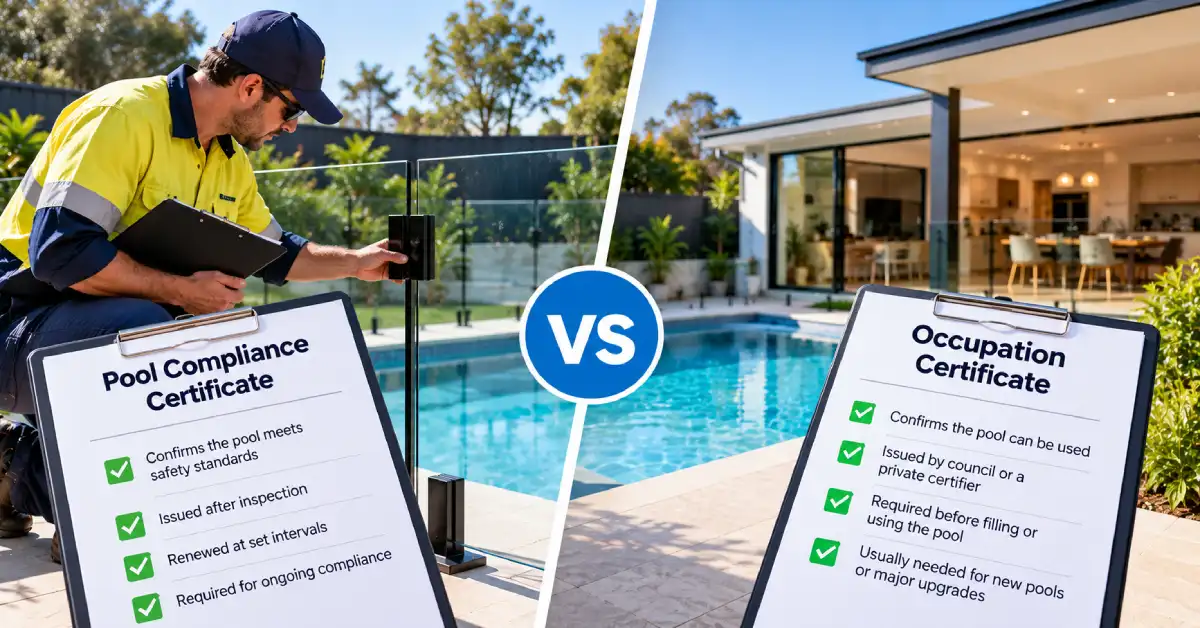
Pool compliance certificate vs occupation certificate NSW comes down to purpose. A Certificate of Compliance confirms an existing pool barrier passed NSW safety requirements. A relevant Occupation Certificate authorises use of a newly completed pool and can also satisfy certain sale or rental requirements for three years.
The NSW Government pool safety guidance recognises both documents. However, they are issued through different processes and should not be treated as interchangeable in every situation.
This guide is for NSW homeowners, landlords, sellers, buyers and property managers. It explains which certificate applies and when another inspection may be required.
Key Takeaways
- A Certificate of Compliance confirms the pool barrier passed a compliance inspection.
- An Occupation Certificate belongs primarily to the new construction approval process.
- A relevant Occupation Certificate must authorise pool use and be less than three years old.
- NSW Certificates of Compliance are generally valid for three years.
- A relevant Occupation Certificate can satisfy certain NSW sale and lease requirements.
- A Certificate of Non-Compliance cannot replace either document for a residential tenancy.
- Pool registration remains a separate NSW requirement.
- An Occupation Certificate does not remain a substitute forever.
What Is the Main Difference?
The main difference is what each document certifies.
| Document | Main Purpose | Common Situation |
| Certificate of Compliance | Confirms an existing pool barrier complied when inspected | Existing pool, sale, lease |
| Occupation Certificate | Authorises use of completed approved development | Newly constructed pool |
| Relevant Occupation Certificate | An Occupation Certificate under three years old that authorises pool use | Sale or lease documentation |
| Certificate of Non-Compliance | Records identified pool compliance defects | Certain property sales |
The two certificates can overlap for property transactions. However, their original purposes remain different.
What Is a Pool Compliance Certificate?
A NSW swimming pool Certificate of Compliance confirms that the pool met applicable swimming pool safety requirements when inspected.
A local council or appropriately registered swimming pool certifier can carry out that inspection.
The assessment can include:
- pool fencing;
- gates and latches;
- barrier openings;
- non-climbable zones;
- relevant boundary barriers;
- doors or windows where applicable;
- required pool safety signage.
If the pool passes, a Certificate of Compliance can be issued.
National Pool Safety provides Swimming Pool Certificate of Compliance NSW services for eligible NSW properties.
What Is an Occupation Certificate?
An Occupation Certificate forms part of the NSW development and construction certification process.
The appointed principal certifier issues it when the required work has reached the appropriate stage and applicable requirements are satisfied.
For a newly constructed swimming pool, NSW Government guidance states that nobody should use the pool before the required Occupation Certificate is issued.
The permanent pool barrier must also undergo the required inspection.
This makes the Occupation Certificate particularly important when completing a new pool.
What Is a Relevant Occupation Certificate?
A relevant Occupation Certificate has a specific meaning under NSW swimming pool law.
It is an Occupation Certificate that:
- authorises the use of the swimming pool; and
- is less than three years old.
Therefore, an old Occupation Certificate from when the pool was originally built cannot remain a substitute indefinitely.
The certificate must also relate to the swimming pool itself.
An Occupation Certificate for unrelated house renovations does not automatically qualify.
When Do You Need a Compliance Certificate?
A Certificate of Compliance becomes important when an existing pool needs current evidence of pool-barrier compliance.
Common situations include:
- preparing an existing property for lease;
- preparing a property for sale;
- replacing expired pool certification;
- confirming compliance after rectification;
- meeting another property-management requirement.
The certificate normally follows a dedicated pool compliance inspection.
If you already have one, National Pool Safety’s pool compliance certificate validity guide explains how to check its three-year validity period.
When Do You Need an Occupation Certificate?
An Occupation Certificate mainly relates to newly completed development.
For a new swimming pool, it confirms that the relevant approval and certification process has reached the stage required before use.
A principal certifier handles this process.
This differs from asking a swimming pool inspector to inspect an established pool solely for a Certificate of Compliance.
For new construction, temporary fencing, final barriers and required inspections all form part of the wider certification pathway.
See the National Pool Safety guide to temporary pool fencing requirements NSW for construction-stage barrier requirements.
Which Certificate Works When Selling?
NSW sellers have several possible pool-document pathways.
For most applicable properties, the sale contract needs the required pool registration documentation and one accepted compliance document.
That document can include:
- a valid Certificate of Compliance;
- a relevant Occupation Certificate; or
- a valid Certificate of Non-Compliance.
A relevant Occupation Certificate must be less than three years old and authorise use of the pool.
A seller therefore does not always need to obtain a new Certificate of Compliance when a qualifying Occupation Certificate already exists.
National Pool Safety’s guide to pool certificates when selling a house explains these sale pathways in detail.
Which Certificate Works When Renting?
Residential tenancy rules are stricter.
For an applicable NSW rental property, the landlord or agent generally needs:
- a valid Certificate of Compliance; or
- a relevant Occupation Certificate.
The pool must also be registered.
A Certificate of Non-Compliance cannot replace these documents for the relevant rental requirement.
This difference matters for landlords who recently purchased a property using a Certificate of Non-Compliance.
Before a new tenancy begins, the barrier may need rectification and compliant documentation.
Our guide to renting a property with a pool in NSW covers landlord requirements separately.
How Long Does Each Certificate Last?
For swimming pool purposes, both documents commonly involve an important three-year period.
Certificate of Compliance
A NSW Certificate of Compliance is generally valid for three years from its issue date.
Relevant Occupation Certificate
An Occupation Certificate qualifies as a relevant Occupation Certificate while it is less than three years old and authorises pool use.
After that period, it no longer meets that definition for these pool-document requirements.
The underlying Occupation Certificate does not simply disappear. Its usefulness as a substitute for current swimming pool compliance documentation changes.
Do Both Certificates Prove the Same Thing?
No.
This is one of the most important points in the pool compliance certificate vs occupation certificate NSW comparison.
A Certificate of Compliance specifically addresses pool compliance under the NSW swimming pool safety framework.
An Occupation Certificate relates to approved development and authorises occupation or use after the relevant certification process.
A council swimming pool certification form specifically notes that a pool Certificate of Compliance is not an Occupation Certificate. It also does not certify every condition of the original development consent.
The documents can serve overlapping transaction purposes without becoming the same certificate.
Who Issues Each Certificate?
Different professionals may be involved.
| Certificate | Typical Issuer |
| Pool Certificate of Compliance | Council or appropriately registered pool certifier |
| Occupation Certificate | Principal certifier for the development |
| Certificate of Non-Compliance | Council or appropriately registered certifier after failed inspection |
A registered swimming pool inspector does not automatically act as principal certifier for a new construction project.
Always identify which document you actually need before booking an inspection.
Does Pool Registration Replace Either Certificate?
No.
Pool registration, a Certificate of Compliance and an Occupation Certificate serve different purposes.
Registration records the pool on the NSW Swimming Pool Register.
It does not automatically prove that the pool barrier complies.
Likewise, having a compliance certificate does not remove the separate registration requirement.
If the pool has not been registered, see National Pool Safety’s guide to registering a pool in NSW.
Which Certificate Do You Need?
Use this quick decision guide:
- New pool awaiting first use?
Follow the principal certifier’s Occupation Certificate process. - Existing pool needs current compliance evidence?
Arrange a pool compliance inspection. - Selling with an Occupation Certificate under three years old?
Check whether it qualifies as a relevant Occupation Certificate. - Renting the property?
Confirm you have a valid Compliance Certificate or relevant Occupation Certificate. - Occupation Certificate is over three years old?
It no longer qualifies as a relevant Occupation Certificate under the NSW swimming pool definition.
Frequently Asked Questions
Is a pool Compliance Certificate the same as an Occupation Certificate?
No. A Compliance Certificate confirms pool-barrier compliance. An Occupation Certificate authorises use of approved completed development.
Can I use an Occupation Certificate instead of a Compliance Certificate?
Yes, in certain NSW sale and rental situations. It must qualify as a relevant Occupation Certificate and be less than three years old.
How old can a relevant Occupation Certificate be?
It must be less than three years old and authorise use of the swimming pool.
How long is a Pool Compliance Certificate valid?
A NSW swimming pool Certificate of Compliance is generally valid for three years from its issue date.
Can I rent with a Certificate of Non-Compliance?
No. A Certificate of Non-Compliance cannot replace the required Compliance Certificate or relevant Occupation Certificate for an applicable residential tenancy.
Can I sell without a Compliance Certificate?
Potentially. NSW sales can also use a relevant Occupation Certificate or, in qualifying circumstances, a Certificate of Non-Compliance.
Does pool registration replace certification?
No. Registration and compliance certification are separate NSW swimming pool requirements.
Need Current Pool Certification?
If your Occupation Certificate is no longer within the relevant three-year period, or you need current compliance documentation, the pool may require a new barrier inspection.
National Pool Safety can assess existing NSW swimming pools and identify any barrier issues that require attention before certification.
Need to confirm which swimming pool document applies to your property? Contact National Pool Safety for professional pool compliance guidance and inspection services.