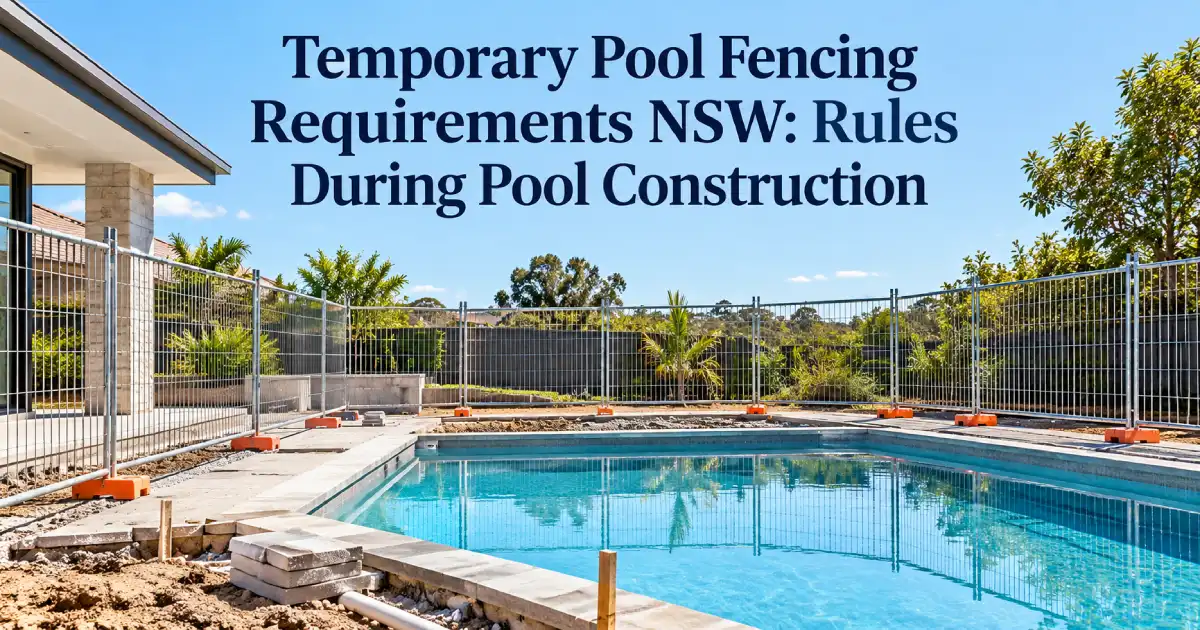
Temporary pool fencing requirements NSW require a child-resistant barrier around a swimming pool area while the pool is under construction. The temporary barrier must restrict access to the excavation or pool until the compliant permanent barrier is installed, inspected and the required Occupation Certificate is issued.
The NSW Government guidance for new pools specifically requires owners building or installing a new pool to install child-resistant temporary fencing during construction, arrange inspection of the permanent barrier by the principal certifier and prevent anyone from using the pool until an Occupation Certificate has been issued.
At National Pool Safety, we inspect swimming pool barriers across Canberra and surrounding NSW areas including Queanbeyan, Googong, Jerrabomberra, Bungendore, Yass and Murrumbateman. This guide explains how temporary fencing fits into the NSW construction process and when it should be replaced by the final compliant pool barrier.
Do You Need Temporary Pool Fencing During Construction in NSW?
Yes.
When building or installing a new swimming pool in NSW, the pool area must have child-resistant temporary fencing during construction.
This requirement is important before the project reaches the finished-pool stage. An unfinished pool may contain water from construction, testing or rainfall. Even an empty excavation can present a serious access hazard.
For this reason, owners and builders should not wait until the permanent pool fence is ready before restricting access.
The temporary barrier is intended to protect the pool construction area during the period between excavation and completion of the permanent compliant barrier.
When Should Temporary Pool Fencing Be Installed?
Temporary protection should be considered as soon as the pool construction area presents an access hazard.
NSW Government guidance requires child-resistant temporary fencing around the pool area while it is under construction.
The precise construction sequence can vary between projects. For example, one pool may be excavated and completed quickly, while another may remain unfinished during other building or landscaping work.
The safest approach is to plan temporary barrier requirements before excavation begins rather than trying to arrange fencing after the pool structure already exists.
Your development approval or certifier may also contain project-specific conditions relating to temporary barriers.
Is Ordinary Construction Fencing Enough?
Not necessarily.
General construction fencing is designed primarily to secure a worksite. A temporary swimming pool barrier has the additional purpose of restricting access by young children.
A fence around the entire development site should therefore not automatically be assumed to satisfy pool barrier requirements.
The barrier protecting the pool area needs to be suitable for its intended child-resistant function and comply with the requirements applying to the development.
If the barrier contains a gate, the gate must also control access effectively.
Owners should follow the approved plans, development consent conditions and directions of the principal certifier rather than relying on the appearance of the fence alone.
Does the Temporary Fence Need a Pool Gate?
If access through the temporary barrier is required, the access point needs to remain secure.
Construction workers may need to enter the pool area regularly, but that does not mean the gate should remain open when workers leave.
Pool gates under NSW safety requirements are designed around self-closing and self-latching principles.
Temporary barrier arrangements should similarly prevent uncontrolled access to the pool construction area.
Where a permanent gate has already been installed, its compliance becomes particularly important. A gate that needs to be pushed shut or manually latched may not provide an effective child-resistant barrier.
For the permanent barrier requirements, see our guide to pool gate requirements NSW.
Can the Temporary Pool Fence Be Removed During Building Work?
The barrier may sometimes need to be altered temporarily so construction work can proceed, but the pool area should not simply be left accessible.
Construction projects change rapidly. Excavators, concrete work, paving, landscaping and installation of pool equipment may all require access around the pool.
Barrier planning should therefore form part of the construction sequence.
If temporary fencing needs to be moved, the builder and property owner should make sure another suitable access-control arrangement remains in place where required.
Do not assume that because the pool is unfinished it is safe to leave without a barrier.
What Fence Measurements Apply During Pool Construction?
Temporary barriers are part of a regulated construction environment and need to satisfy the requirements applying to the project.
For the completed permanent barrier, current NSW guidance commonly requires:
- at least 1200mm barrier height for a standard pool fence;
- no more than 100mm clearance underneath many pool barriers;
- no more than 100mm between vertical members;
- appropriate non-climbable zones; and
- compliant gates and latches.
These figures are particularly useful when planning the final pool enclosure.
Our pool fence gap requirements NSW guide explains the common 100mm opening limits in more detail.
For temporary construction fencing, owners should follow the approved barrier design and principal certifier’s requirements rather than trying to build an improvised barrier from general measurements alone.
What Happens When the Permanent Pool Fence Is Installed?
Temporary fencing is not intended to become the long-term pool barrier unless the installed system itself has been designed, approved and completed as the permanent compliant barrier.
NSW Government guidance specifically requires owners of new pools to arrange an inspection by the principal certifier after installation of the permanent fence.
The inspection considers whether the completed barrier satisfies the requirements applying to the project.
Relevant items can include:
- fence height;
- openings;
- gates;
- latches;
- non-climbable zones;
- boundary fencing;
- surrounding structures;
- finished ground levels.
The final inspection should therefore be planned as part of the construction schedule.
Which Australian Standard Applies to a New NSW Pool?
For newly constructed NSW pools, current barrier requirements generally reference AS 1926.1-2012 through the applicable NSW regulatory framework.
This standard addresses safety barriers for swimming pools and covers technical areas including fence height, openings, gates and non-climbable zones.
Older pools can be assessed under earlier standards depending on their construction date, but a new pool construction project should be designed around the current requirements applying to the development.
Do not assume that an old fence can automatically be reused simply because it previously surrounded a pool. Its suitability should be confirmed as part of the new project.
Can Landscaping Be Completed Before the Final Pool Inspection?
Landscaping and pool barrier compliance are closely connected.
Changes to finished ground levels, retaining walls, garden beds, paving and outdoor structures can affect the final barrier.
For example, raising the ground beside a 1200mm fence may reduce its effective height.
This is why the final barrier should be assessed in the context of the completed or substantially completed surrounding area.
If landscaping is still changing after the barrier inspection, later work should not compromise the barrier.
What Sign Is Required While the Pool Is Under Construction?
NSW requires a warning notice to be displayed prominently near a swimming pool while it is under construction.
The NSW Government states that the notice must indicate that:
“This swimming pool is not to be occupied or used.”
The construction-stage notice must remain displayed until the relevant Occupation Certificate or Certificate of Compliance has been issued.
The sign serves a different purpose from the normal CPR signage required around completed swimming pools.
Owners should therefore not assume that installing a CPR sign alone satisfies the construction warning requirement.
Can You Fill or Use the Pool Before the Occupation Certificate?
You should not use the new pool before the required Occupation Certificate has been issued.
NSW Government guidance clearly states that a pool under construction must not be used by anyone until the Occupation Certificate is issued.
Development consent conditions can also restrict filling or use of the pool until the required permanent safety barrier has been installed and inspected.
Owners planning a first swim immediately after construction should therefore make sure certification is included in the timeline.
Physical completion of the pool does not automatically mean the pool is legally ready to use.
What Is the Principal Certifier’s Role?
A principal certifier must be appointed for the project as required.
The principal certifier oversees relevant stages of the development and determines whether the completed work meets requirements before the appropriate Occupation Certificate is issued.
This is different from a general tradesperson checking whether the fence looks complete.
A fencing contractor may install or rectify the barrier, but certification is a separate regulatory step.
If you are unsure whether an existing or newly installed barrier is ready for assessment, National Pool Safety’s Swimming Pool Barrier Inspection NSW service explains what is checked during a barrier inspection.
Does a New Pool Need to Be Registered?
Yes. Registration forms part of NSW swimming pool obligations. Registration and construction approval are separate matters.
A pool should be recorded on the NSW Swimming Pool Register, but registration itself does not prove that the pool barrier complies. Compliance is established through the relevant inspection and certification process.
For step-by-step guidance, see how to register a pool in NSW. Keeping registration, approval documents, inspection records and Occupation Certificate information together can make future property transactions easier.
Common Temporary Pool Fencing Mistakes
Several problems can occur during the construction phase.
Treating Site Fencing as Pool Fencing
A general construction fence may not provide the child-resistant protection required around the pool area.
Leaving the Access Gate Open
Frequent worker access can lead to a gate being tied or propped open, defeating the purpose of the barrier.
Removing the Barrier Too Early
Temporary fencing should not simply disappear because the permanent fence has arrived on site. The transition between temporary and permanent protection needs to remain secure.
Ignoring Landscaping Changes
Paving, retaining walls and ground-level changes can affect the final barrier measurements.
Using the Pool Before Certification
Finishing construction or filling the pool does not replace the requirement for the relevant inspection and Occupation Certificate.
Preparing the Permanent Barrier for Inspection
Before the principal certifier attends, walk around the entire completed barrier. Check that the gate closes and latches from multiple open positions.
Look underneath fence panels for excessive gaps and inspect the areas where the fence meets gates, walls or other structures. Remove construction materials, ladders, equipment and furniture that could create climbable points beside the fence.
Check that finished ground levels and landscaping match the final approved arrangement. If rectification is needed, addressing obvious issues before inspection can reduce avoidable delays.
Temporary Fencing Is Only One Stage of Pool Compliance
The temporary fence protects the construction phase, but the compliance process continues after it is removed.
A typical new-pool pathway is:
- obtain the required approval;
- appoint the principal certifier;
- secure the pool construction area with temporary child-resistant fencing;
- complete the pool and permanent barrier;
- maintain required construction warning signage;
- arrange inspection of the permanent barrier;
- obtain the relevant Occupation Certificate;
- register and maintain the pool as required.
Planning these steps from the beginning is much easier than trying to correct barrier or certification issues after the pool is complete.
Frequently Asked Questions About Temporary Pool Fencing Requirements NSW
Q1: Is temporary pool fencing mandatory during construction in NSW?
Answer: Yes. NSW Government guidance requires child-resistant temporary fencing around a new swimming pool area while the pool is under construction.
Q2: When should temporary pool fencing be installed?
Answer: It should protect the construction area while the pool or excavation presents an access hazard. Owners should plan the barrier before construction reaches a stage where the pool area can be accessed.
Q3: Can normal construction fencing be used around a pool?
Answer: Do not assume ordinary site fencing automatically satisfies pool safety requirements. The pool area needs a suitable child-resistant barrier that meets the requirements applying to the development.
Q4: Does the temporary pool gate need to stay closed?
Answer: Yes. Access through the barrier should remain controlled. A gate that is routinely propped open defeats the purpose of the child-resistant barrier.
Q5: When can temporary pool fencing be removed?
Answer: Temporary fencing should only be removed when an effective compliant barrier arrangement has replaced it. The permanent barrier must then complete the required inspection and certification process.
Q6: Can I use a new pool before the Occupation Certificate is issued?
Answer: No. NSW Government guidance states that a new pool must not be used until the required Occupation Certificate has been issued.
Arrange a Pool Barrier Inspection in NSW
Temporary pool fencing requirements NSW are designed to keep the pool construction area protected until the finished barrier is ready and properly assessed.
National Pool Safety provides swimming pool barrier inspections across Canberra and surrounding NSW areas for homeowners, builders, property managers and other property stakeholders.
If your permanent pool fence has been installed and you want to identify barrier issues before the final compliance process, view our Swimming Pool Barrier Inspection NSW service.
Checking gates, openings, non-climbable areas and surrounding structures before the final stage can help prevent straightforward barrier defects from delaying completion of the project.