New Pool Occupation Certificate NSW: What You Need Before Using the Pool

A new pool occupation certificate NSW must be issued before anyone uses a newly constructed swimming pool. The permanent pool barrier must first be installed and inspected by the appointed principal certifier. The pool should remain unused until that certification stage is complete.
NSW Government guidance also requires temporary child-resistant fencing while the pool remains under construction. The completed permanent barrier must comply with the requirements applying to the approved development. A construction warning sign must also remain displayed until the relevant certificate is issued.
This guide explains the final steps before using a new NSW swimming pool. It covers fencing, inspections, signage, registration and Occupation Certificates. It also explains how an Occupation Certificate differs from a standard pool compliance certificate.
Key Takeaways
- A new NSW pool must not be used before the required Occupation Certificate is issued.
- The permanent safety barrier needs inspection by the appointed principal certifier.
- Temporary child-resistant fencing is required during pool construction.
- A construction warning sign must remain displayed during the required construction period.
- Pool registration and an Occupation Certificate are separate requirements.
- A Certificate of Compliance and an Occupation Certificate are different documents.
- A relevant Occupation Certificate can have later value for some property sale or leasing requirements.
- Barrier defects can delay final certification and pool use.
What Is a Pool Occupation Certificate?
A pool Occupation Certificate confirms that the approved work has reached the required stage for lawful use. The principal certifier determines whether the necessary requirements have been satisfied. The certificate is part of the building approval and certification process.
For a new swimming pool, barrier compliance forms an important part of that process. NSW Government guidance requires the permanent pool fence to be inspected after installation. The pool cannot be used until an Occupation Certificate has been issued.
This differs from simply completing the pool construction. A finished shell, filtration system and filled pool do not automatically authorise use. Certification must still be completed.
When Is the Certificate Required?
The new pool occupation certificate NSW requirement applies before the newly constructed pool is used.
NSW Government guidance tells owners not to allow anyone to use the pool before certification. This requirement helps ensure the permanent safety barrier has been completed first. It also prevents an unfinished construction area becoming an accessible swimming pool.
Your development approval can also contain property-specific conditions. These conditions may affect inspections, landscaping, drainage or other approved works. The principal certifier checks the requirements relevant to that development.
Who Issues the Occupation Certificate?
The appointed principal certifier issues the Occupation Certificate where the relevant requirements have been satisfied.
A principal certifier may be a registered certifier or the local council. The certifier remains independent from the builder and assesses compliance with approved work. NSW Government guidance explains that the builder cannot choose or influence the owner’s certifier.
National Pool Safety provides pool barrier and safety inspections in NSW. However, the Occupation Certificate itself forms part of the principal certifier’s construction certification process.
Owners preparing a new barrier can review National Pool Safety’s Swimming Pool Barrier Inspection NSW service before the final certification stage.
What Must Be Completed First?
Several important safety items should be ready before the final pool certification process.
The permanent child-resistant barrier must be installed. Its gate, openings and surrounding area must meet the requirements applying to the development. Construction-stage access controls should remain effective until the permanent arrangement takes over.
Common final checks include:
- permanent barrier height;
- bottom and vertical openings;
- self-closing pool gates;
- self-latching gate hardware;
- non-climbable zones;
- boundary barriers where applicable;
- finished ground levels;
- nearby structures and landscaping.
For current barrier standards, see National Pool Safety’s AS 1926.1 pool fence requirements NSW guide.
Does the Permanent Fence Need Inspection?
Yes.
NSW Government guidance requires the permanent pool fence to be inspected by the principal certifier after installation. The inspection occurs before the new pool is approved for use.
Owners should avoid treating the final inspection as a simple paperwork step. Small barrier defects can prevent the certification process from progressing. Gate operation, gaps and nearby climbable objects deserve particular attention.
National Pool Safety’s Swimming Pool Safety Inspection NSW service can help identify relevant pool-barrier issues.
Can You Use the Pool Before Certification?
No.
A newly constructed pool should not be used before the required Occupation Certificate is issued. NSW Government guidance states this requirement directly.
This means practical completion does not equal permission to swim. The pool may look finished while final certification remains incomplete. Owners should include certification time within the overall construction schedule.
The same rule matters when planning handover dates. Avoid promising pool access before the principal certifier completes the required process.
Can You Fill the Pool With Water?
Whether water can be added before final certification can depend on the approval conditions and construction process.
However, nobody should use the pool before the required Occupation Certificate is issued. Temporary fencing and construction controls must also remain effective during the unfinished stage.
Check your development consent and principal certifier’s requirements before filling the pool. Do not assume that filling and using the pool are treated identically.
What Sign Is Required During Construction?
A swimming pool under construction requires a specific warning notice.
The NSW Swimming Pools Regulation requires the notice to state that the swimming pool is not to be occupied or used. It must remain prominently displayed during the required construction period.
This construction notice is different from the normal CPR sign. Completed swimming pools have separate resuscitation signage requirements.
National Pool Safety explains those requirements in its CPR sign requirements NSW pool guide.
Does a New Pool Need Registration?
Yes. NSW swimming pools must also be registered on the NSW Swimming Pool Register.
Registration records the swimming pool against the property. However, registration does not replace the principal certifier’s final construction certification. These are separate processes with different purposes.
National Pool Safety’s how to register a pool in NSW guide explains the registration process and required property details.
The official NSW Swimming Pool Register also provides registration and certificate records for relevant pools.
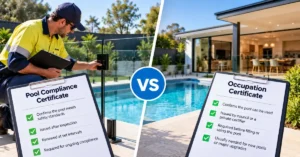
Occupation Certificate vs Compliance Certificate
These documents are related, but they do not serve exactly the same purpose.
| Document | Main Purpose |
| Occupation Certificate | Confirms approved new construction can be occupied or used |
| Pool Certificate of Compliance | Confirms an existing pool barrier meets applicable pool safety requirements |
| Registration Certificate | Confirms the pool is recorded on the NSW Swimming Pool Register |
| Certificate of Non-Compliance | Records that an inspected pool currently does not comply |
A new pool occupation certificate NSW therefore belongs primarily to the new construction process.
A pool Certificate of Compliance becomes especially relevant for existing properties, future sales, leases and other compliance situations.
National Pool Safety provides a dedicated Swimming Pool Certificate of Compliance NSW service for relevant NSW pool certification requirements.
How Long Is a Relevant Occupation Certificate Useful?
A relevant Occupation Certificate can also matter after the construction stage.
For NSW property transactions, a relevant Occupation Certificate can generally be used for three years from its issue date. The pool also needs the required registration documentation where applicable.
After that period, owners may need a current pool Certificate of Compliance for later transaction requirements.
This is different from the original requirement to obtain the Occupation Certificate before first using the new pool.
What Can Delay the Certificate?
Barrier defects are a common reason the final stage needs more work.
Potential issues include:
- a gate that does not self-close;
- a latch that fails to engage;
- excessive fence gaps;
- climbable objects inside the NCZ;
- unfinished boundary barriers;
- changed finished ground levels;
- incomplete approved work.
Some defects become visible only after landscaping or paving finishes. For this reason, schedule final barrier checks after the surrounding surfaces have reached their approved finished levels.
Final Pool Certification Checklist
Before the principal certifier’s final pool inspection, review these items:
- Complete the permanent pool barrier.
- Test every gate from several open positions.
- Check fence gaps and finished ground levels.
- Remove climbable objects beside the barrier.
- Complete required landscaping affecting the fence.
- Display the required warning and CPR signage.
- Confirm pool registration requirements.
- Gather documents requested by the principal certifier.
- Do not use the pool before certification.
This checklist does not replace the certifier’s assessment. It simply helps identify obvious issues before the final stage.
Frequently Asked Questions
Q1: Do I need an Occupation Certificate for a new NSW pool?
Yes, where required for the approved development. NSW Government guidance says a new pool must not be used before its Occupation Certificate is issued.
Q2: Who issues a pool Occupation Certificate?
The appointed principal certifier issues the Occupation Certificate after assessing the relevant approved work and required certification conditions.
Q3: Can I swim before the Occupation Certificate arrives?
No. NSW Government guidance specifically says nobody should use the pool before the required Occupation Certificate has been issued.
Q4: Is an Occupation Certificate the same as pool registration?
No. Registration records the swimming pool on the NSW Swimming Pool Register. The Occupation Certificate relates to the approved construction and use.
Q5: Is an Occupation Certificate a Compliance Certificate?
No. They are different documents. However, a relevant recent Occupation Certificate can satisfy some later NSW sale or leasing documentation requirements.
Q6: How long can a relevant Occupation Certificate apply?
For certain NSW pool property transactions, a relevant Occupation Certificate generally remains useful for three years from its issue date.
Prepare Your New Pool for Final Inspection
A new pool occupation certificate NSW marks an important final step before using a newly built swimming pool. The permanent barrier, gates and surrounding access conditions should therefore be ready before final assessment.
National Pool Safety can assess swimming pool barriers across Canberra and surrounding NSW areas. A professional barrier inspection can identify safety issues before they create avoidable delays.
Preparing a newly built pool for final certification? Contact National Pool Safety to arrange a professional pool barrier assessment before the pool is opened for use.