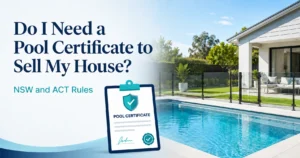
If you are selling a house with a pool in NSW, you need prescribed pool safety documents included in the contract for sale-but you do not always need a certificate of compliance.
Depending on the property, the requirement may be satisfied by a valid certificate of compliance, a relevant occupation certificate with evidence of pool registration, or a valid certificate of non-compliance.
If the required documents are missing, a purchaser may be able to rescind the contract within 14 days of exchange, unless settlement has already occurred.
The ACT rules are different. During the current transition period ending 30 April 2028, property owners with regulated pools must provide prescribed disclosure information. From 1 May 2028, the ACT compliance framework changes.
National Pool Safety works with homeowners, real estate agents, property managers and conveyancers across Canberra and surrounding NSW. This guide explains what sellers need, what happens if a pool fails inspection, and when to arrange compliance before listing.
Key takeaways
- In NSW you cannot properly market a property with a pool until the prescribed documents are annexed to the contract for sale.
- If those documents are missing, the purchaser may rescind the contract within 14 days of the date of the contract and have their deposit refunded.
- A certificate of non-compliance can be used to sell. It cannot be used to lease.
- In the ACT, disclosure obligations already apply during the transition period that runs to 30 April 2028.
- From 1 May 2028, ACT sellers will need a valid compliance certificate to meet disclosure requirements.
Do I need a pool certificate to sell my house?
You need the correct pool safety documentation, but not necessarily a certificate of compliance.
For most NSW properties with a swimming pool or spa, the contract for sale needs one of the following:
- A valid certificate of compliance
- A relevant occupation certificate with evidence of pool registration
- A valid certificate of non-compliance
This means a pool that does not currently pass inspection does not automatically stop you from selling. Before arranging certification, make sure your pool is registered. See our guide on how to register a pool in NSW. If you are concerned about whether the barrier will pass, read why pools fail inspection.
What NSW requires on the contract for sale
Two things have to be attached. The first is fixed. The second gives you options.
- A certificate of registration. This is issued once you register the pool on the NSW Swimming Pool Register. Registration is free and takes about 10 minutes. Our guide on how to register a pool in NSW walks through the form.
- One of the following three documents.
| Document | What it means | Effect on the sale |
| Certificate of compliance | The barrier was inspected and passed. Valid for three years. | Cleanest option. Nothing outstanding. |
| Relevant occupation certificate | Issued for the pool, and less than three years old. | Accepted in place of a compliance certificate. |
| Certificate of non-compliance | The barrier was inspected and failed. Lists the defects. | Sale can proceed, but the obligation passes to the buyer. |
You need one of those three, not all of them. Most sellers obtain a certificate of compliance through a pool compliance inspection because it is the option that raises no questions from a buyer.
The 14-day rescission risk
If the prescribed pool documentation is missing from an NSW contract for sale, the purchaser may be entitled to rescind within 14 days of exchange, unless settlement has already taken place.
That is why pool documentation should ideally be dealt with before the property goes to market.
A sensible sequence is:
Register → Inspect → Rectify if required → Obtain documentation → Give documents to your conveyancer.
This reduces the chance of compliance paperwork becoming an issue after a buyer has already been found.
For advice about a specific contract, speak with your solicitor or conveyancer.
Selling with a certificate of non-compliance
If your pool fails inspection, you can still sell. A certificate of non-compliance can be annexed to the contract, and the obligation to rectify then passes to the purchaser, who generally has 90 days from completion to carry out the work and obtain a certificate of compliance.
There is an important exception. Where the non-compliance is such that the pool poses a significant risk to public safety, the certifier must immediately notify the local authority, and the 90-day transfer to the buyer does not apply in the same way. Your conveyancer will advise on the position if this arises.
Our guide on why pools fail inspection covers the most common defects and roughly what they cost to put right.
Leasing a NSW Property With a Pool Is Different
The rules for leasing are stricter than the certificate-of-non-compliance pathway available for a sale.
When a residential tenancy agreement is entered into for an NSW property with a swimming pool or spa, the landlord or agent generally needs to provide the tenant with a copy of:
- a valid certificate of compliance; or
- a relevant occupation certificate issued within the applicable three-year period.
A certificate of non-compliance cannot be used to satisfy the NSW rental requirement.
That means a landlord cannot simply transfer responsibility for pool barrier defects to a tenant.
For property managers and landlords, arranging an inspection before a new tenancy begins can provide time to address any barrier issue before the tenancy documentation is finalised.
Does This Apply to Spas?
NSW swimming pool legislation also applies to relevant spas and spa pools.
If a spa is capable of holding water deeper than 300mm, pool safety requirements may apply depending on the installation and circumstances.
Spa owners should therefore not assume that a spa is outside the swimming pool safety framework simply because it is smaller than a conventional pool.
For a detailed explanation, read our guide to spa pool fence rules in NSW.
What the ACT requires right now
Canberra sellers frequently assume nothing applies until 2028. That is incorrect. Disclosure obligations commenced on 1 May 2024 and apply to sales and leases now, during the transition period that runs to 30 April 2028.
During the transition period, if you are selling or leasing an ACT property with a regulated pool or spa, you must:
- Provide the Pool Owners Guidance Material issued by the Minister under the Building Act 2004, which sets out the obligations on owners of premises with a regulated pool. This applies where the pool or spa was built, altered or installed before 1 May 2023.
- Provide at least one of these documents:
- An exemption certificate
- A compliance certificate obtained from an authorised person
- A swimming pool disclosure statement
- A certificate of occupancy covering the pool and safety barriers, not older than five years
The disclosure statement is the lowest-cost route. It sets out the information reasonably within your knowledge as owner regarding the age of the pool and its status against the prescribed safety standard. The ACT Government publishes an example.
The trade-off is that a disclosure statement tells a buyer you do not know whether the pool complies, while a compliance certificate tells them it does. In a competitive market that difference tends to show up in the offer. Our ACT pool compliance page explains the certificate route.
What changes in the ACT on 1 May 2028
At the end of the transition period, the disclosure statement option disappears. From 1 May 2028, prescribed information for a sale or lease requires a valid compliance certificate.
From that date it also becomes an offence to have a regulated pool without a safety barrier meeting the prescribed standard, assessed against AS 1926.1-2012 and AS 1926.2-2007.
If your ACT pool was built, altered or installed before 1 May 2013, you are required to obtain a compliance certificate before 1 May 2028 and lodge it within 30 days. A certificate obtained during the transition period remains valid until 1 May 2032, which is a genuine reason to act early rather than wait.
Strata and Shared Swimming Pools
NSW has specific exceptions for certain strata and community scheme properties. The usual sale and lease pool-document requirements described above do not apply in the same way to an individual lot in a strata or community scheme containing more than two lots.
Responsibility for common-property swimming pools commonly sits with the owners corporation, and separate inspection and compliance obligations can apply.
If you manage a shared swimming pool, National Pool Safety’s strata and body corporate pool inspection service is designed for these properties.
Individual owners preparing to sell a strata or community title property should confirm the documentation requirements with their conveyancer because the exact position depends on the scheme.
When to book your inspection
Work backwards from your listing date, not your settlement date.
Eight weeks out. Register the pool if you have not already. Book the inspection. This gives you room to rectify anything that fails and get reinspected without pressure.
Four weeks out. Rectification work done, reinspection complete, certificate issued. Give the certificate to your conveyancer so it can be annexed to the contract.
Listing. Agent markets the property with the contract complete.
Sellers who follow that sequence pay an inspection fee and, at worst, a tradesperson’s afternoon. Sellers who book two weeks before exchange pay for urgency at every step, and risk the 14-day rescission window on top.
For what the inspection itself costs, see our guide on pool compliance certificate costs.
FAQs
Question: Do I need a pool certificate to sell my house in NSW?
Answer: Yes. A certificate of registration plus either a certificate of compliance, a relevant occupation certificate, or a certificate of non-compliance must be annexed to the contract for sale.
Question: What happens if the pool documents are missing from the contract?
Answer: The purchaser may rescind the contract within 14 days of the date of the contract and have their deposit refunded. Speak to your conveyancer about your specific situation.
Question: Can I sell if my pool fails inspection?
Answer: Yes. A certificate of non-compliance can be attached to the contract, and the buyer generally has 90 days from completion to rectify the defects. This does not apply in the same way where the pool poses a significant risk to public safety.
Question: Can I lease with a certificate of non-compliance?
Answer: No. Leasing a NSW property with a pool requires a certificate of registration plus a certificate of compliance or a relevant occupation certificate.
Question: Do I need a pool certificate to sell my house in the ACT?
Answer: Not during the transition period, which runs to 30 April 2028. You must disclose prescribed information, which can be satisfied with a disclosure statement, an exemption certificate, a recent certificate of occupancy, or a compliance certificate. From 1 May 2028 a valid compliance certificate is required.
Question: How long is a NSW pool compliance certificate valid?
Answer: Three years from the date of issue.
Question: Does this apply to spas and inflatable pools?
Answer: Yes. The Swimming Pools Act 1992 applies to any pool or spa capable of holding water deeper than 30cm, including portable and inflatable pools.
Question: How long before listing should I get the inspection done?
Answer: Around eight weeks. That allows time to rectify any defects and complete a reinspection before your conveyancer needs the certificate.
Selling a House With a Pool? Get the Paperwork Ready Before You List
Pool compliance is easier to manage when it is addressed before the property reaches the market, rather than during the final stages of a sale.
An early inspection gives you time to understand the barrier’s condition, rectify any issues if necessary and make sure your solicitor or conveyancer has the appropriate pool documentation when preparing the contract.
National Pool Safety provides pool compliance inspections for homeowners, real estate agents, property managers, conveyancers and body corporate managers across Canberra and surrounding NSW.
If the barrier meets the applicable NSW requirements, the appropriate certification process can be completed. If issues are identified, you receive clear information about what needs attention so you can decide how to proceed before listing. For Canberra sellers, we also provide ACT pool compliance inspections under the ACT pool safety framework.
Preparing to sell a property with a pool? Book your pre-sale pool inspection or call National Pool Safety on 02 6189 8455.