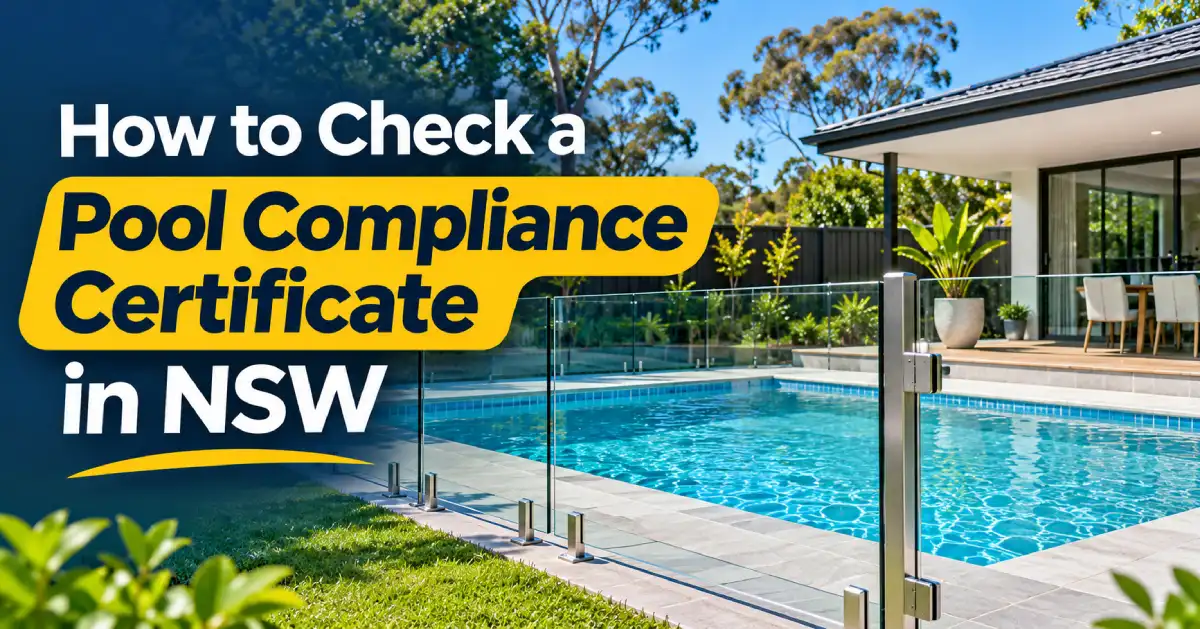
To check pool compliance certificate NSW records, search the property address on the NSW Swimming Pool Register. If the pool is registered, the register can show its registration record and available Certificate of Compliance or Non-Compliance information. Check the certificate issue date carefully because a Compliance Certificate is generally valid for three years.
The NSW Government upgraded the Swimming Pool Register in March 2026. Pool and spa registrations are now linked to the property address, rather than an individual owner’s personal details.
This makes the register the key place for owners, buyers, landlords and agents to verify NSW pool records.
How Do You Check a Pool Certificate?
The simplest way to check pool compliance certificate NSW records is through the official NSW Swimming Pool Register.
The register provides a public property-search function.
Step 1: Open the Register
Go to the NSW Swimming Pool Register and select Search.
The system may ask you to complete a verification check before continuing.
Step 2: Search the Property
Search for the NSW property containing the pool or spa. Registration is now linked to the property address.
This is useful when:
- you recently bought the property;
- an old owner obtained the certificate;
- you cannot locate the original document;
- an agent has provided certificate details;
- you are preparing to sell or rent.
Step 3: Review the Pool Record
If the pool is registered, review the available records.
Depending on the property’s history, the register can include:
- Certificate of Registration;
- Certificate of Compliance; or
- Certificate of Non-Compliance.
Do not stop when you find the registration certificate.
A Certificate of Registration is not evidence that the barrier passed a compliance inspection.
Registration vs Compliance Certificate
This is one of the most common areas of confusion.
| Record | What It Shows |
| Certificate of Registration | The pool is recorded on the NSW Swimming Pool Register |
| Certificate of Compliance | The pool met applicable compliance requirements when inspected |
| Certificate of Non-Compliance | The inspection identified non-compliance |
| Relevant Occupation Certificate | May serve as accepted documentation in certain property situations |
The NSW Government specifically states that registering a pool does not mean it complies.
Compliance is assessed separately through an inspection. If your pool is not yet registered, see National Pool Safety’s how to register a pool in NSW.
How Do You Check Certificate Validity?
Once you locate the Compliance Certificate, check its issue date.
Under the NSW Swimming Pools Act, a Certificate of Compliance generally remains valid for three years from the date it is issued.
For example:
Issue date: 18 November 2024
Normal three-year point: 18 November 2027
Do not calculate the validity period from:
- when you bought the property;
- when the pool was built;
- when the inspection was booked; or
- when you downloaded the certificate.
The certificate issue date matters. National Pool Safety’s pool compliance certificate validity guide explains expiry and renewal in more detail.
Can a Certificate Become Invalid Earlier?
Yes.
The normal validity period is three years, but the Swimming Pools Act provides that a Certificate of Compliance ceases to be valid if a direction under section 23 is issued for that swimming pool.
Owners should also remember that the barrier still needs ongoing maintenance.
A certificate does not mean you can ignore:
- a gate that stops self-closing;
- a damaged latch;
- broken fence panels;
- changing ground levels;
- new climbable objects;
- barrier alterations.
The document records compliance from the certification process. The physical barrier still needs to remain safe.
What If the Certificate Is Missing?
First, search the NSW Swimming Pool Register. If the pool is registered but no current Compliance Certificate appears, consider several possibilities.
The certificate may:
- never have been issued;
- have expired;
- have been replaced by another record;
- relate to a recent inspection still being processed; or
- not be the document you expected.
A pool must be registered before a Certificate of Compliance can be issued.
Where a current certificate is required but none exists, arrange an inspection with the local council or an appropriately registered swimming pool certifier.
National Pool Safety provides Swimming Pool Certificate of Compliance NSW services across Queanbeyan, Googong, Jerrabomberra, Yass, Bungendore and surrounding NSW areas.
How Quickly Does a New Certificate Appear?
NSW legislation requires the issuing council or registered certifier to provide certificate details for entry on the Swimming Pool Register.
Current register guidance says compliant inspection certificates can be generated within three days of the inspection.
Therefore, a certificate from a very recent inspection may not always appear immediately. If the expected record is still missing after the normal processing period, contact the council or certifier that carried out the inspection.
Keep any certificate or inspection documentation they supplied.
What If the Register Shows Non-Compliance?
Do not confuse a Certificate of Non-Compliance with a current Compliance Certificate.
A Non-Compliance Certificate means the barrier did not satisfy the applicable requirements at inspection.
The document can identify problems requiring rectification.
Common issues can include:
- gate closing faults;
- latch problems;
- excessive gaps;
- climbable objects;
- non-compliant barrier sections.
For the next steps, see National Pool Safety’s Certificate of Non-Compliance NSW guide.
A later successful inspection is required before a Certificate of Compliance can be issued.
Why Buyers Should Check the Register
Buyers should verify the pool documents supplied with a property contract rather than relying only on a verbal statement that the pool is “certified.”
For applicable NSW sales, the contract generally needs a Certificate of Registration plus one accepted pool document.
That can include:
- a valid Certificate of Compliance;
- a relevant Occupation Certificate; or
- a Certificate of Non-Compliance.
Searching the register helps confirm what records exist against the property.
Our buying a house with a pool NSW guide explains what buyers should check before settlement.
Why Landlords Should Check the Date
Rental requirements make validity particularly important.
For applicable NSW residential tenancies, a Certificate of Non-Compliance cannot replace the required compliant documentation.
A landlord or agent generally needs a valid Certificate of Compliance or qualifying relevant Occupation Certificate.
Therefore, check the issue date before preparing a new tenancy. Do not assume a certificate used for a previous tenant remains valid today.
Can You Download Pool Records?
The NSW Swimming Pool Register provides access to relevant certificates associated with registered pools.
Older official register guidance confirms that registration, compliance and non-compliance certificates can be downloaded and printed from the online register.
This can be useful when the original paper or emailed copy has been lost.
When saving the document, keep the complete certificate rather than only taking a screenshot of the search result.
Certificate Verification Checklist
Before relying on a NSW pool certificate, confirm:
- the property address matches;
- the pool is registered;
- you are viewing a Compliance Certificate, not only registration;
- the issue date is correct;
- the normal three-year period has not passed;
- there is no known direction affecting validity;
- no later Non-Compliance record changes the situation;
- the physical barrier has continued to be maintained.
If a sale or tenancy depends on the document, confirm requirements early.
What If the Certificate Has Expired?
Expiry does not automatically mean the pool barrier is defective. It means the previous Compliance Certificate has passed its normal validity period.
Where current certification is required, a new inspection will generally be needed.
Before booking, you can use National Pool Safety’s pool inspection preparation checklist to check common barrier issues.
Repairing simple problems beforehand may reduce avoidable reinspection work.
Frequently Asked Questions
Q1: Where can I check a NSW pool compliance certificate?
Use the official NSW Swimming Pool Register and search for the property containing the pool or spa.
Q2: Can I search using the owner’s name?
The improved NSW register links pool registration to the property address rather than an individual owner’s personal details.
Q3: Does pool registration mean the pool complies?
No. Registration and compliance certification are separate processes.
Q4: How long is a NSW pool compliance certificate valid?
A Certificate of Compliance generally remains valid for three years from its issue date.
Q5: Can a certificate become invalid before three years?
Yes. Under the Swimming Pools Act, it ceases to be valid if a relevant direction under section 23 is issued.
Q6: What if the register shows a Non-Compliance Certificate?
That indicates the pool failed the applicable compliance assessment. Identified defects generally need rectification before a Compliance Certificate can be issued.
Q7: Can I download a certificate from the register?
Yes. Relevant registration and certification records associated with a registered pool can be accessed through the NSW Swimming Pool Register.
Verify Before You Rely on the Certificate
Knowing how to check pool compliance certificate NSW records is especially important before a sale, new tenancy or property purchase.
Search the official register, confirm the document type and check its issue date. Remember that pool registration alone does not confirm compliance.
Cannot find a current certificate, or has your existing certificate expired? Contact National Pool Safety to arrange a professional NSW pool barrier inspection and compliance certification where the applicable requirements are met.