
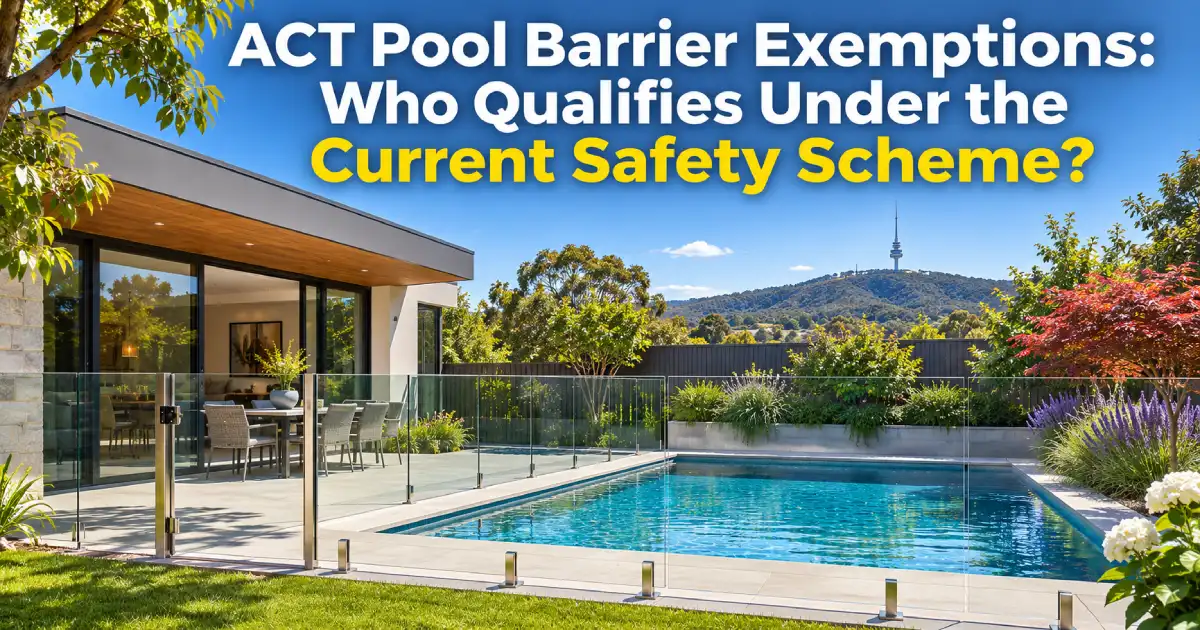
ACT pool barrier exemptions apply only in specific circumstances. Some pools and older spas receive automatic standing exemptions, while certain owners of pools built before 1 May 2023 may apply for a Ministerial exemption. Newer pools generally have far fewer exemption pathways.
The ACT home swimming pool safety scheme started on 1 May 2024. From 1 May 2028, regulated residential pools and spas generally need barriers meeting the prescribed safety standards unless a valid exemption applies.
The type of exemption available depends heavily on the pool or spa’s construction, alteration or installation date.
This guide explains who may qualify, which exemptions happen automatically, and when an application is required.
What Pools Are Covered by the ACT Scheme?
The ACT safety scheme generally applies to residential swimming pools and spas capable of holding water deeper than 30cm.
This includes many:
- in-ground pools;
- above-ground pools;
- spas;
- demountable pools;
- portable pools;
- temporary pools; and
- wading pools.
However, not everything containing water falls within the scheme. For example, an inflatable pool that can simply be inflated and deflated and has no filtration system is excluded from the scheme.
That is different from receiving an exemption. A framed or filtered portable pool may instead be treated as a demountable pool and fall within the rules.
National Pool Safety’s ACT pool fence requirements explains which residential pools generally need safety barriers.
What Is a Standing Exemption?
A standing exemption applies automatically when the pool meets the conditions written into the ACT regulation.
You do not apply to the Minister for one.
Current ACT rules provide three main standing exemption situations.
| Pool or Spa | Standing Exemption |
| Demountable pool | In place for no more than 3 consecutive days |
| Spa built before 1 May 2023 | Secured by a qualifying lockable child-resistant structure |
| Pre-May 2023 spa on apartment balcony | Access restricted by qualifying self-closing and self-latching doors or windows |
The conditions must actually be satisfied. Simply calling a pool “temporary” does not automatically make it exempt.
Demountable Pools Used for Three Days
A regulated demountable pool can receive a standing exemption when it remains in place for no more than three consecutive days.
This exemption applies regardless of the pool’s original construction-date category.
If the pool stays installed longer, the exemption no longer applies on that basis. Owners should also distinguish demountable pools from simple inflatable pools that are excluded from the scheme because they have no filtration system.
The duration and design both matter.
Are Older Spas Exempt From Pool Fencing?
Some are.
A spa built, altered or installed before 1 May 2023 can qualify for a standing exemption where it is covered and secured by an appropriate lockable child-resistant structure.
Examples can include a:
- lid;
- grille;
- mesh; or
- other qualifying structure.
The structure must meet the prescribed construction and opening requirements. An ordinary loose spa cover is not automatically enough.
National Pool Safety’s ACT properties compliance guide can help owners identify which construction-date rules apply.
What About a Spa on an Apartment Balcony?
A pre-May 2023 spa located on an apartment balcony can also qualify for a standing exemption in certain circumstances.
The balcony must only be accessible through appropriate self-closing and self-latching doors or windows restricting access.
This standing exemption does not extend to newer spas in the same way. For a spa built on or after 1 May 2023, the pool-safety barrier must generally comply with the standard applying when it was built or installed.
What Is a Ministerial Exemption?
A Ministerial exemption is different from a standing exemption. The owner or owners corporation must apply for it. Eligibility is assessed against prescribed grounds and the current Ministerial exemption guidelines.
The ACT Government describes these exemptions as alternative pathways for situations where compliance with the normal prescribed safety standards may not reasonably be achievable.
A Ministerial exemption may be complete or may only exempt part of the applicable safety standards.
Owners should not assume approval simply because upgrading a barrier is expensive or inconvenient.
Which Ministerial Exemptions Are Available?
Current ACT guidance identifies five main grounds.
1. The Site Cannot Physically Accommodate a Compliant Barrier
This ground is limited to a regulated pool built or altered before 1 May 2013.
It can become relevant where the physical layout prevents installation of a barrier meeting the prescribed standards.
For example, compliance might require substantial alteration or removal of part of an existing building. A difficult layout alone does not guarantee approval.
2. A Protected Tree Would Be Affected
A pool built before 1 May 2013 may potentially qualify where compliance would be reasonably likely to require approval to remove a protected tree.
The existence of a tree near the pool is not enough. The application needs to satisfy the exemption criteria.
3. Heritage Significance Would Be Harmed
This ground can also apply to certain pools built before 1 May 2013. It relates to situations where complying with the prescribed barrier standard would significantly adversely affect the heritage significance of a registered place or object.
This is a specific heritage pathway, not a general exemption for older homes.
4. Disability Access Would Be Substantially Affected
Pools built before 1 May 2023 may have access to a Ministerial exemption where normal barrier compliance would substantially impede an occupier with disability from accessing the pool.
Alternative safety measures may still be required.
The exemption framework aims to balance accessibility with child safety rather than removing safety controls altogether.
5. The Pool Is Planned for Demolition
Pools built before 1 May 2023 can potentially qualify where there are documented plans to demolish the pool within 24 months of the exemption application.
Owners need actual demolition plans. A future intention to remove the pool at some undefined time is not the same thing.
Which Pools Cannot Use These Ministerial Grounds?
Pools built, altered or installed on or after 1 May 2023 generally do not have access to the listed Ministerial exemption grounds.
These newer pools are expected to meet the modern Building Code and Australian Standards applying when they were built.
The main automatic exemption relevant across construction dates is the short-term demountable-pool exemption.This is why construction date is the first fact owners should establish.
Exemption Eligibility by Pool Age
| Exemption | Before May 2013 | May 2013–Apr 2023 | From May 2023 |
| Demountable pool ≤3 days | Yes | Yes | Yes |
| Qualifying locked spa cover | Yes | Yes | No |
| Qualifying balcony spa | Yes | Yes | No |
| Cannot physically accommodate barrier | Yes | No | No |
| Protected tree | Yes | No | No |
| Heritage impact | Yes | No | No |
| Disability access | Yes | Yes | No |
| Planned demolition | Yes | Yes | No |
This table provides a quick screening guide only. The detailed statutory conditions still apply.
How Do You Apply for a Ministerial Exemption?
Applications are made through the ACT Government’s Ministerial exemption process.
The current Building (Ministerial Exemptions for Regulated Swimming Pools) Guidelines 2026 set out how applications are considered. The supporting evidence depends on the exemption ground.
An application may need information demonstrating:
- the pool’s construction or alteration date;
- property configuration;
- why normal compliance cannot reasonably be achieved;
- the specific exemption ground;
- proposed alternative safety arrangements; and
- supporting technical or professional evidence.
An authorised pool-safety person can also provide advice supporting an exemption application where appropriate.
Does an Exemption Mean You Can Ignore Pool Safety?
No.
This is an important point about ACT pool barrier exemptions.
Since 1 May 2024, pool owners have ongoing duties to maintain effective child-resistant access controls. Residents also need to keep relevant doors, gates and covers securely closed when the pool is not in use.
A Ministerial exemption may also impose alternative requirements.Therefore, an exemption from part or all of a prescribed standard does not mean the pool can be left without reasonable safety controls.
What Happens to Certification?
A pool subject to a complete exemption is treated differently under the compliance status certificate framework.
A partial Ministerial exemption may still require inspection of the parts of the safety standard that continue to apply.
Current ACT legislation distinguishes between complete and partial exemptions. This makes it important to retain the exemption certificate and understand exactly what it covers.
National Pool Safety’s Access Canberra pool compliance guide explains how compliance status certificates fit into the wider ACT scheme.
Do Exemptions Matter When Selling or Leasing?
Yes.
ACT disclosure obligations apply when regulated-pool properties are sold or leased.
An applicable Ministerial exemption certificate can form part of the prescribed evidence in relevant circumstances.Owners should keep exemption documents with their property records.
Do not wait until a sale or tenancy is underway to determine whether an old exemption is still applicable.
Should You Apply or Upgrade the Barrier?
An exemption should not automatically be the first option.
For many properties, rectifying the barrier may be simpler than preparing an exemption application.
A practical approach is:
- confirm the pool construction date;
- identify the current barrier defects;
- determine whether normal rectification is practical;
- check whether a standing exemption already applies;
- identify any valid Ministerial exemption ground; and
- seek professional advice before applying.
National Pool Safety provides ACT swimming pool compliance inspections across Canberra.
Frequently Asked Questions
Q1: Are all old ACT pools exempt from current barrier standards?
No. Pool age affects which exemption pathways may be available, but age alone does not create a general exemption.
Q2: Do I need to apply for a standing exemption?
No. A standing exemption applies automatically when all statutory conditions are met.
Q3: Are temporary pools exempt in the ACT?
A qualifying demountable pool in place for no more than three consecutive days can receive a standing exemption.
Q4: Are spas exempt from fencing?
Certain spas built before 1 May 2023 may qualify if secured by an approved child-resistant structure or through the specific apartment-balcony pathway.
Q5: Can a heritage property qualify?
Potentially. Certain pre-May 2013 pools can apply where normal compliance would significantly adversely affect registered heritage significance.
Q6: Can a new ACT pool get a Ministerial exemption?
The listed Ministerial exemption grounds generally do not apply to pools built, altered or installed on or after 1 May 2023.
Check Your Exemption Before 2028
ACT pool barrier exemptions are deliberately limited and depend heavily on pool age, design and individual circumstances.
Do not assume an old spa, unusual backyard or difficult barrier layout automatically qualifies.
National Pool Safety can assess the existing barrier and help owners understand whether normal compliance or an exemption pathway may be relevant.
Unsure whether your Canberra pool or spa qualifies for an exemption? Contact National Pool Safety for a professional barrier assessment before the 1 May 2028 deadline.