Buying a house with a pool NSW means checking more than the pool’s appearance before settlement. Buyers should confirm registration, review the pool certificate attached to the sale contract, understand any listed barrier defects, and know whether compliance responsibilities will transfer after settlement.
A NSW property with a pool generally needs a registration certificate plus an accepted pool document in the sale contract. That document may be a valid Certificate of Compliance, a relevant Occupation Certificate, or a Certificate of Non-Compliance.
If you buy with a Certificate of Non-Compliance, you normally have 90 days after settlement to rectify the listed defects and obtain a Certificate of Compliance.
This guide explains what buyers should check before committing to a NSW property with a swimming pool.
Key Takeaways
- Check whether the pool is registered before buying.
- Review every pool document attached to the contract.
- A Certificate of Compliance is generally valid for three years.
- A relevant Occupation Certificate must be less than three years old.
- A Certificate of Non-Compliance can transfer rectification responsibility to the buyer.
- Buyers normally have 90 days after settlement to fix listed defects.
- Significant public-safety risks can require faster action.
- Consider a pool barrier inspection before purchase.
- Do not judge compliance from appearance alone.
- Speak with your conveyancer about contract-specific legal issues.
What Should Buyers Check First?
When buying a house with a pool NSW, start with the contract and the NSW Swimming Pool Register.
The sale contract should generally contain a pool registration certificate and one of these documents:
- a valid Certificate of Compliance;
- a relevant Occupation Certificate; or
- a Certificate of Non-Compliance.
The NSW Government pool safety guidance confirms these requirements. You can also search the property’s address through the NSW Swimming Pool Register.
Checking early gives you time to understand what you may be taking responsibility for after settlement.
Which Pool Certificate Is Attached?
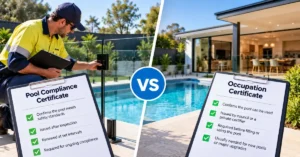
The type of certificate changes the buyer’s position.
| Document | What It Means for a Buyer |
| Certificate of Compliance | Barrier passed the relevant compliance inspection |
| Relevant Occupation Certificate | Recent certificate authorising pool use |
| Certificate of Non-Compliance | Barrier defects have been identified |
| Registration Certificate | Pool is recorded on the NSW register |
These documents should not be treated as interchangeable. A Certificate of Compliance gives you evidence that the barrier complied when inspected.
A Certificate of Non-Compliance tells you there are defects that need attention.
What Is a Compliance Certificate?
A Certificate of Compliance confirms that the swimming pool met applicable NSW pool safety requirements when inspected.
The inspection can cover:
- fencing;
- gates;
- latches;
- openings;
- non-climbable zones;
- boundary barriers;
- relevant access points;
- required safety signage.
A NSW Certificate of Compliance is generally valid for three years from its issue date.
Before relying on an older document, check the date carefully. National Pool Safety’s pool compliance certificate validity guide explains how the validity period works.
What If There Is a Non-Compliance Certificate?
A Certificate of Non-Compliance does not automatically stop the property from being sold. Instead, it can transfer specific compliance responsibilities to the purchaser.
If a valid Certificate of Non-Compliance is attached to the contract, the buyer normally has 90 days from settlement to:
- rectify the listed pool-barrier defects; and
- obtain a Certificate of Compliance.
The NSW Government confirms this 90-day pathway.
However, the normal timeframe does not apply in the same way when the certificate identifies a significant risk to public safety.
Read the defects before exchanging contracts. National Pool Safety’s Pool Certificate of Non-Compliance NSW guide explains what happens after a pool fails inspection.
Should You Inspect Before Buying?
A pre-purchase pool barrier inspection can be valuable, especially when the existing documents identify defects.
The NSW Government recommends checking that a pool is properly fenced and meets applicable requirements when buying a property.
A compliance document tells you the certification status. A physical inspection can help you understand the barrier’s current condition.
For example, check whether:
- the gate closes automatically;
- the latch works consistently;
- fence panels remain secure;
- landscaping has changed;
- new climbable objects are present;
- ground movement has created larger gaps.
National Pool Safety provides swimming pool barrier inspections in NSW across Queanbeyan, Googong, Jerrabomberra, Yass, Bungendore, Murrumbateman and surrounding areas.
What Defects Should Buyers Look For?
You do not need to become a pool certifier before buying a house. However, obvious defects can help you identify when further investigation is sensible.
Look for:
A Gate That Does Not Self-Close
Open the gate and release it without pushing. A faulty self-closing mechanism is a common barrier problem.
Latch Problems
The gate should latch securely after closing. Misalignment, sagging or worn hardware can affect operation.
Excessive Fence Gaps
Check openings under fencing and between barrier components. Ground movement can create new openings over time.
Climbable Objects
Furniture, planters, retaining walls, tree branches and other objects can affect the non-climbable zone.
Recent Renovations
Decks, paving, landscaping and retaining walls can change effective barrier height or accessibility.
These visible checks do not replace a professional inspection.
Does Registration Prove Compliance?
No. Pool registration and pool compliance are separate.
Registration records the swimming pool against the property address on the NSW Swimming Pool Register.
It does not prove that the barrier currently complies. The NSW Government advises recent purchasers to search their property address and check whether the pool is already registered.
If registration has not been completed, see National Pool Safety’s how to register a pool in NSW.
What If Pool Documents Are Missing?
Missing prescribed pool documents can be important during a NSW property purchase.
NSW Government guidance states that when the required pool document is not included in the sale contract, the purchaser may have a right to rescind within 14 days after exchange, provided settlement has not already occurred.
This is a legal contract issue. Speak to your solicitor or conveyancer immediately if required pool documentation appears to be missing.
Do not rely on a verbal assurance that a certificate will be provided later.
What Should You Check Before Exchange?
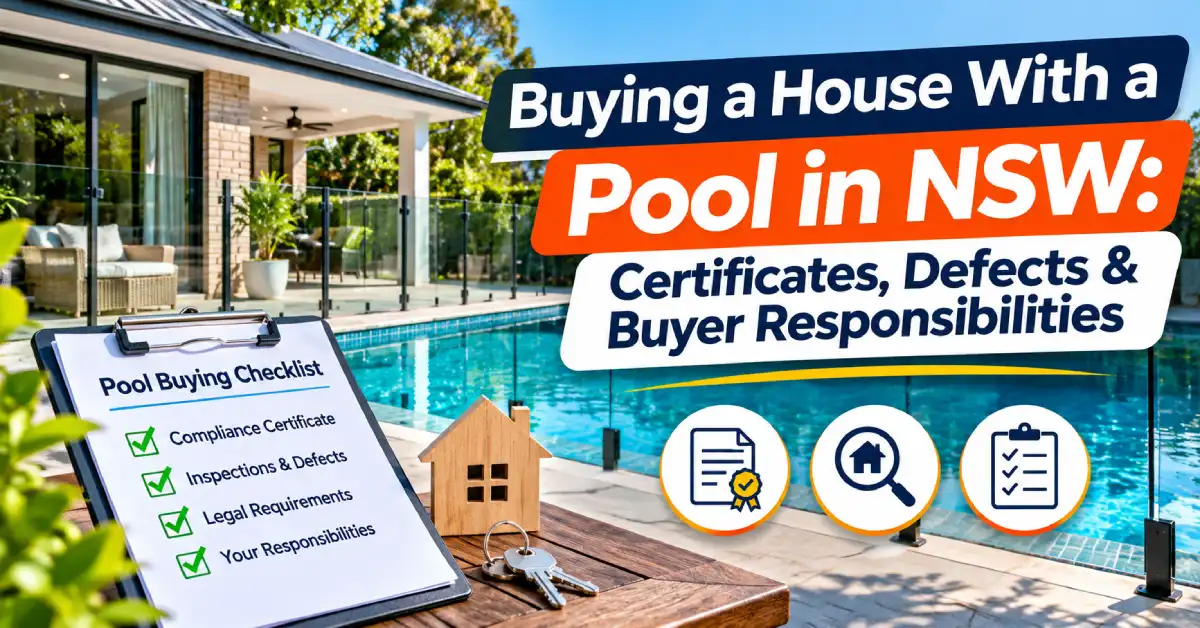
Use this buyer checklist before exchanging contracts.
Pool Document Checklist
- Pool registration certificate
- Compliance Certificate, Occupation Certificate, or Non-Compliance Certificate
- Certificate issue date
- Identified defects
- Previous inspection report, if available
- Pool construction or approval information, where relevant
Physical Barrier Checklist
- Gate closes automatically
- Gate latches correctly
- Fence appears secure
- No obvious large openings
- No obvious climbable objects beside the barrier
- CPR sign is present
- Recent alterations are identified
Ask your conveyancer to review the legal documents.
Use a pool inspector for technical barrier compliance questions.
What Happens After Settlement?
Once settlement occurs, you become responsible for maintaining the pool barrier as the property owner.
If you purchased with a Certificate of Non-Compliance, the 90-day rectification period becomes particularly important.
Plan the work immediately. Do not assume three months is always a long time. Rectification may involve fencing contractors, landscaping changes, gate repairs and a reinspection.
Once the listed issues are corrected, arrange the required inspection. A Certificate of Compliance can then be issued when the pool meets the applicable requirements.
National Pool Safety provides Swimming Pool Certificate of Compliance NSW services for eligible properties.
What If You Plan to Rent the House?
This requires extra attention for investment buyers.
A Certificate of Non-Compliance can be used in certain NSW property sales, but it cannot replace compliant documentation for a new residential tenancy.
For applicable rental properties, the landlord generally needs a valid Certificate of Compliance or relevant Occupation Certificate.
Therefore, an investor buying with a Non-Compliance Certificate should allow enough time for rectification before leasing the property.
Does Every Property Follow These Rules?
There are exceptions.
The standard sale-document provisions do not apply in the same way to:
- certain lots in strata schemes with more than two lots;
- certain community schemes with more than two lots; and
- off-the-plan contracts.
Shared-pool responsibility can also operate differently from a standalone residential pool.
Have your conveyancer confirm which rules apply to the property you are purchasing.
Buyer Decision Table
| Situation | Recommended Action |
| Valid Compliance Certificate | Check issue date and current barrier condition |
| Relevant Occupation Certificate | Confirm it relates to pool use and remains current |
| Non-Compliance Certificate | Review defects and likely rectification before exchange |
| Documents missing | Speak to your conveyancer immediately |
| Barrier recently renovated | Consider a fresh inspection |
| Buying as an investment | Confirm rental compliance before tenancy |
| Unsure about barrier condition | Arrange a professional inspection |
Frequently Asked Questions
Q1: What certificate should I check before buying a house with a pool?
Check for a valid Compliance Certificate, relevant Occupation Certificate, or Certificate of Non-Compliance, together with the required pool registration documentation.
Q2: Can I buy a house with a non-compliant pool in NSW?
Yes, in eligible circumstances. A valid Certificate of Non-Compliance can be attached to the sale contract.
Q3: How long do buyers have to fix a non-compliant pool?
The buyer generally has 90 days after settlement to rectify listed defects and obtain a Certificate of Compliance.
Q4: What if the pool is a serious safety risk?
The normal 90-day pathway does not apply in the same way where significant public-safety risks are identified. Follow the directions applying to the property.
Q5: Should I inspect the pool before settlement?
A pre-purchase barrier inspection can help identify current defects and clarify likely rectification work.
Q6: Does pool registration mean the fence complies?
No. Registration records the pool. Compliance requires assessment of the barrier against applicable safety requirements.
Q7: Can I rent the property with a Non-Compliance Certificate?
No. An applicable residential tenancy requires compliant documentation, such as a valid Compliance Certificate or relevant Occupation Certificate.
Before You Buy
Buying a house with a pool NSW can transfer more than ownership of the swimming pool. It can also transfer responsibility for fixing existing barrier defects.
Read the certificates before exchange, inspect the barrier carefully and understand any required work before settlement.
National Pool Safety provides professional swimming pool barrier inspections and compliance certification across Canberra’s surrounding NSW areas.
Buying a NSW property with a swimming pool? Contact National Pool Safety for a professional pool barrier inspection so you can understand the barrier condition before taking on future compliance responsibilities.