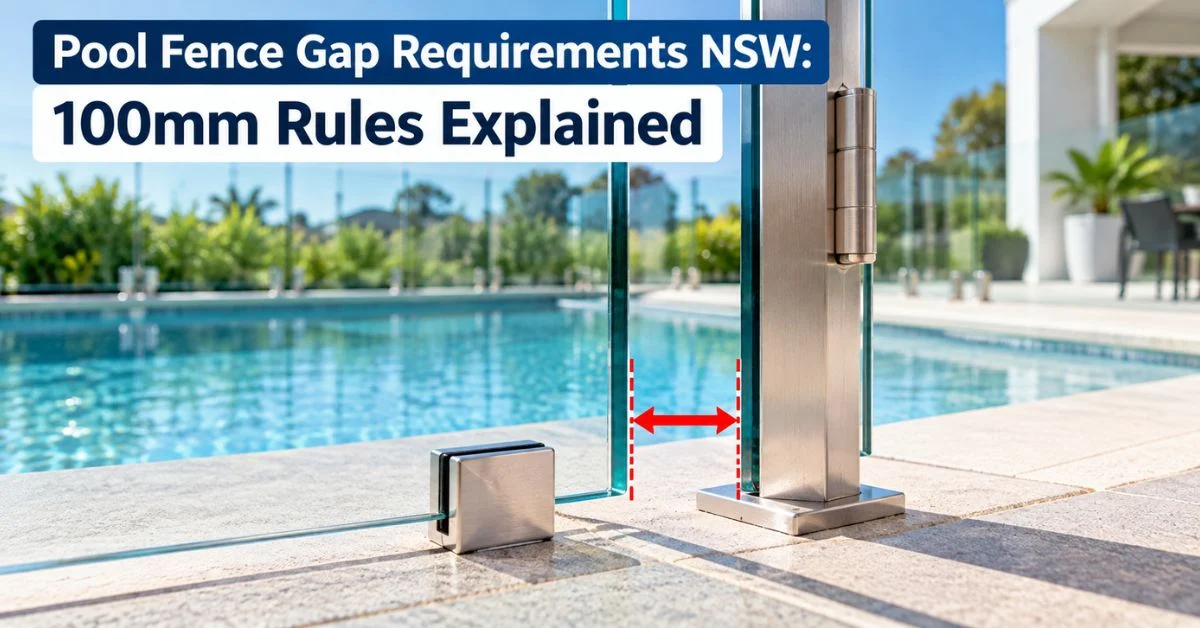
Pool fence gap requirements NSW generally limit the space under a standard pool barrier and gaps between vertical barrier components to no more than 100mm. Mesh and perforated barriers can have different opening limits, while the exact standard applying to an older pool can depend on when the pool or barrier was constructed or altered.
The NSW Government pool safety guidance confirms that a pool fence should not leave a gap greater than 10cm underneath the barrier and should not have gaps greater than 10cm between vertical bars.
At National Pool Safety, we inspect pool fences, gates and safety barriers across Canberra and surrounding NSW areas including Queanbeyan, Googong, Jerrabomberra, Bungendore, Yass and Murrumbateman. This guide explains the main gap measurements owners should check and the common changes that can create a compliance problem.
Key Takeaways
- The gap beneath many NSW pool fences must not exceed 100mm.
- Gaps between vertical fence components generally must not exceed 100mm.
- Gate openings are also part of the barrier and need to meet the applicable requirements.
- Mesh and perforated pool fencing can have different opening limits depending on height and construction.
- Soil erosion, paving movement, landscaping and fence movement can create new gaps over time.
- Gap requirements and non-climbable-zone requirements are separate, so a fence needs to satisfy both.
- Older pools may be assessed under an earlier version of the applicable Australian Standard.
What Are the Pool Fence Gap Requirements in NSW?
For a typical NSW pool barrier, two important measurements are the opening under the fence and the spaces through the fence.
Current NSW Government guidance states that the gap between the bottom of a pool fence and finished ground level must not exceed 100mm. It also states that gaps between vertical bars should not exceed 100mm.
These requirements help prevent a young child from passing underneath or through the child-resistant barrier. The measurements may sound simple, but compliance can change after installation.
Ground can move, soil can wash away, paving can sink and fence panels can shift. Flexible barrier components can also create a larger effective opening than they appear to have during a quick visual check.
For this reason, a pool inspection considers the barrier in its current condition rather than relying on how it looked when originally installed.
How Large Can the Gap Under a Pool Fence Be?
For many NSW pool barriers, the maximum gap between the bottom of the fence and finished ground level is 100mm.
The important point is that this measurement applies around the barrier rather than only at one location.
A fence may have an acceptable clearance across most of the pool area but develop a larger opening in one section. Sloping ground is a common example.
The fence panel may remain level while the ground underneath falls away toward one end. This can create a larger opening below the fence even though nothing appears damaged.
Owners should pay particular attention to areas near:
- slopes;
- garden beds;
- drainage paths;
- retaining walls;
- loose soil;
- mulch;
- paving transitions.
A single excessive opening can affect the overall barrier compliance.
Can Ground Movement Create a Non-Compliant Gap?
Yes.
A pool fence can be installed correctly and later develop an excessive bottom gap because the surrounding ground changes.
Common causes include:
- soil erosion;
- ground settlement;
- drainage changes;
- landscaping;
- excavation;
- paving replacement;
- movement in fence posts.
Heavy rain can also wash soil or mulch away from underneath a barrier.
Owners sometimes try to reduce a gap by placing loose soil, mulch, stones or temporary materials underneath the fence. That may not provide a stable long-term solution because the material can move again.
If the gap has increased, the better approach is to identify why it changed and arrange an appropriate permanent correction. Our guide to why pools fail inspection also explains how ground changes and excessive openings can affect barrier compliance.
What Is the Maximum Gap Between Vertical Pool Fence Bars?
The spaces between vertical bars are another important part of pool fence gap requirements NSW.
Current NSW Government guidance states that gaps between vertical bars should not be greater than 100mm.
The purpose is to stop a young child passing through the barrier. When checking the fence, do not measure only the middle of one panel.
Look closely at:
- spaces beside posts;
- corners;
- panel joins;
- gate frames;
- changes between different materials;
- bent or damaged sections.
The visible resting gap is therefore not always the only factor considered during a compliance inspection.
Do Pool Gates Have Gap Requirements Too?
Yes.
A pool gate forms part of the child-resistant barrier, so openings within and around the gate also matter.
Check the spacing between the gate’s vertical components and the opening between the gate and adjoining post. The gate also has separate operating requirements.
It generally needs to open away from the pool area, close automatically and self-latch without assistance. This means a gate may satisfy the gap requirements but still be non-compliant if its hinges or latch do not operate correctly.
The opposite is also true.A perfectly functioning latch does not compensate for an excessive gap around the gate. For a detailed explanation of gate compliance, see our Pool Gate Requirements NSW guide.
What Are the Gap Rules for Mesh Pool Fencing?
Mesh and perforated barriers require more careful consideration because they contain many smaller openings.
Current NSW Government guidance states that perforated or mesh barriers at a height of 1.2 metres should have openings no greater than 13mm.
For certain mesh or perforated barriers that are 1.8 metres high, openings greater than 13mm may be permitted, but they must not exceed 100mm and additional requirements can apply.
Therefore, homeowners should not simply apply the normal 100mm vertical-bar rule to every type of mesh fence. Barrier height, opening size and construction all matter.
Older mesh fencing may also stretch, loosen or become damaged over time. A barrier that originally met the required opening size can therefore develop larger gaps later.
What About Openings Where Different Fence Sections Meet?
Transition points are easy to overlook.
A pool barrier may include several materials, such as metal fencing, masonry walls, boundary fencing or gate posts.
Where two sections meet, an opening can sometimes develop between them. These transition areas should receive the same attention as the main fence panels.
For example, check:
- between a fence and wall;
- beside gate posts;
- where a fence meets a retaining wall;
- around structural posts;
- where old and newer fencing join.
A barrier is only effective when it remains continuous around the required pool enclosure.
Can Holes Around Pipes or Services Affect Compliance?
Potentially, yes.
Where a wall or other structure legitimately forms part of the pool barrier, later building work can introduce openings.
Examples include penetrations for:
- pipes;
- electrical cables;
- drainage;
- pool equipment;
- irrigation lines.
Owners sometimes focus only on fence panels while overlooking changes made for services after the barrier was originally inspected.
If work near the pool barrier creates a new opening, the effect on barrier compliance should be considered.
How Do Fence Gaps Relate to the Non-Climbable Zone?
Fence gaps and non-climbable zones address different ways a young child might get past the barrier.
Gap limits help prevent access under or through the fence. Non-climbable zones help reduce opportunities to climb over the fence.
A pool barrier therefore needs to satisfy both requirements. Even when every vertical gap is below 100mm, furniture, vegetation or nearby structures can still create a climbing point.
Current NSW requirements commonly use a 900mm non-climbable zone around relevant barriers.
Our guide to the non-climbable zone for pool fences in NSW explains the 900mm zone and related clearance requirements in more detail.
Do Older NSW Pools Have the Same Gap Requirements?
Not every NSW pool is assessed under exactly the same version of the pool barrier standard.
The standard applying to a property can depend on when the swimming pool was constructed and whether the barrier was later altered.
NSW Government guidance currently recognises several versions of the relevant Australian Standard, including standards applying to older pools and newer installations.
This means owners of older pools should avoid assuming that every detail of a modern barrier diagram automatically applies to their property. The common 100mm bottom and vertical gap limits are useful homeowner checks, but a formal inspection considers the actual standard applying to the pool.
This becomes particularly important where an older pool has a historic exemption or unusual barrier arrangement.
Where Should You Check for Pool Fence Gaps?
Walk slowly around the full pool enclosure. Do not stop after measuring one or two easy sections.
Check:
- underneath every fence panel;
- between vertical bars;
- beside gate posts;
- between gate components; around corners;
- where fence panels join;
- near retaining walls; over sloping ground;
- around damaged sections;
- around service penetrations.
The goal is to identify any opening that may have changed since the fence was originally installed.
Why Can a Pool That Passed Before Develop Gap Problems?
Outdoor barriers are exposed to weather and movement throughout the year. Soil can settle. Timber can deteriorate. Metal components can bend. Fence posts can shift.
A previously compliant fence may therefore need maintenance later. This is one reason pool owners should not assume that an old compliance certificate means the physical barrier can be ignored until the next formal inspection.
The barrier needs to remain in good condition. Regular visual checks around the bottom of the fence and gate can identify developing openings before they become more difficult to correct.
Can You Fix an Excessive Pool Fence Gap Before Inspection?
Yes, but the correct repair depends on what caused the gap.
If erosion has lowered the finished ground, a stable ground repair may be necessary.If a fence panel or post has moved, the barrier itself may require adjustment.
Bent or damaged components may need repair or replacement.
Avoid using temporary objects or easily movable materials simply to cover an opening before inspection. The correction should maintain an effective child-resistant barrier after the inspector leaves. For structural work, an appropriate fencing contractor, pool technician or builder may be required.
Owners of older pools should also be cautious about making major barrier alterations without understanding which standard applies to their property.
What Does an Inspector Check?
Gap measurement is one part of a wider barrier inspection.
An inspector may assess:
- bottom clearance; vertical openings;
- gate openings; mesh or perforated sections;
- damaged barrier components;
- transition points;
- fence condition.
Other relevant requirements can include barrier height, gate operation, latch performance and non-climbable zones. National Pool Safety’s Swimming Pool Barrier Inspection NSW service assesses these features as part of the overall pool barrier.
Pool Fence Gap Checklist Before an Inspection
Before your appointment, walk around the barrier and examine every opening. Check whether the bottom gap becomes larger where the ground slopes or has eroded.
Look between vertical bars and beside gate posts. Check mesh, damaged panels and areas where different fencing materials meet.
Then consider anything that has changed since the previous inspection. Landscaping, paving, drainage work and construction around the pool can all alter the relationship between the barrier and ground.
Finally, check the gate and non-climbable zone as well. A few minutes of preparation can identify visible problems before the formal assessment.
Book a Pool Fence Inspection in NSW
Pool fence gaps often develop gradually and can be difficult to notice until the barrier is measured carefully.
National Pool Safety provides pool fence and barrier inspections across Canberra and surrounding NSW areas. We assess openings, gates, latches, barrier condition, non-climbable zones and other relevant compliance requirements.
If you require formal certification for a sale, lease or other property requirement, our Swimming Pool Certificate of Compliance NSW service explains the certification process.
You can arrange an inspection with National Pool Safety to have your pool barrier assessed against the requirements applying to your property.
Frequently Asked Questions
What is the maximum gap under a pool fence in NSW?
Answer: For many NSW pool barriers, the gap between the bottom of the fence and finished ground level must not exceed 100mm.
What is the maximum gap between pool fence bars?
Answer: Current NSW Government guidance states that gaps between vertical bars should not be greater than 100mm.
Do pool gate gaps count?
Answer: Yes. A pool gate forms part of the child-resistant barrier, so openings within the gate and around its adjoining posts can affect compliance.
What size openings can a mesh pool fence have?
Answer: Current NSW guidance states that perforated or mesh barriers at 1.2 metres high should have openings no greater than 13mm. Different provisions can apply to certain 1.8-metre-high mesh barriers.
Can erosion make a pool fence non-compliant?
Answer: Yes. Erosion can increase the opening beneath the barrier beyond the permitted limit even when the fence itself has not visibly moved.
Does a 100mm gap automatically mean every NSW pool is compliant?
Answer: No. Gap measurements are only one part of pool barrier compliance. The applicable standard, fence height, gate operation and non-climbable zones also need to be considered.
Should I measure pool fence gaps before booking an inspection?
Answer: Yes. A simple check can identify obvious excessive openings before an inspection, although formal certification still requires assessment against the requirements applying to the property.