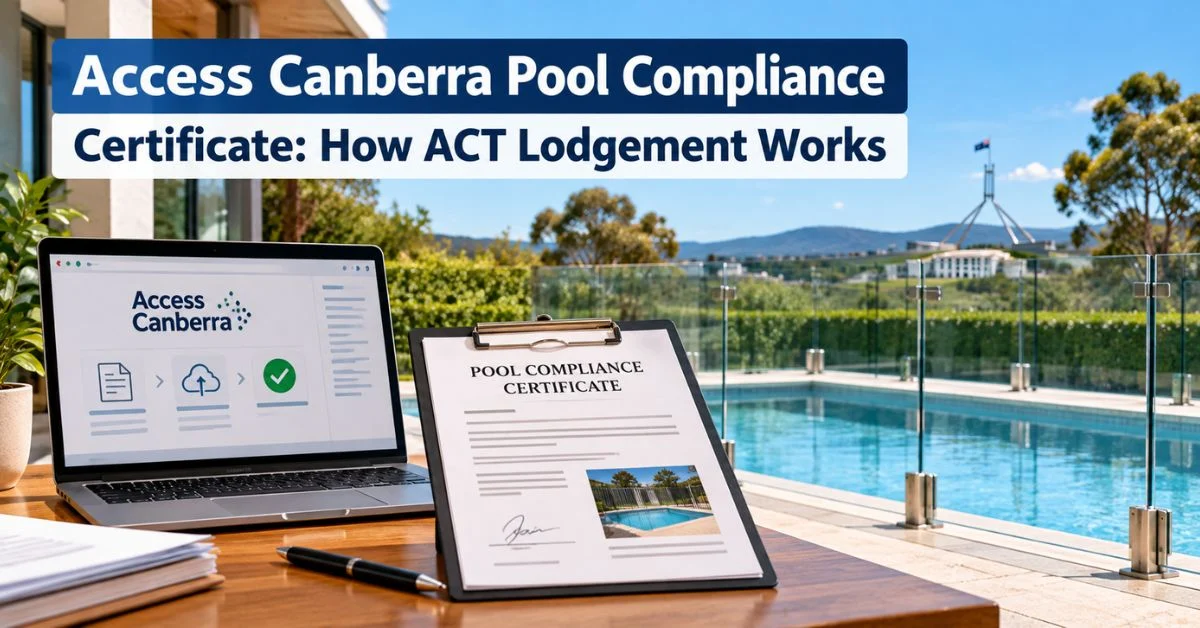
An Access Canberra pool compliance certificate is commonly searched by ACT homeowners who need to prove their pool barrier meets current safety requirements. Under current ACT legislation, the official document is called a “compliance status certificate”, and eligible older pools must lodge it with the ACT Government within the required timeframe.
For pools built before 1 May 2013, a compliance status certificate obtained before the end of the transition period generally needs to be lodged within 30 days of receipt and before the 1 May 2028 compliance deadline. Certificates issued before that date remain in force until 30 April 2032 unless an earlier event ends their validity.
At National Pool Safety, ACT-authorised inspectors assess swimming pool and spa barriers across Canberra and can assist homeowners through the inspection and certification process. National Pool Safety pool compliance certificate service
Key Takeaways
- “Pool compliance certificate” is the common search term, while current ACT legislation uses compliance status certificate.
- Pools built before 1 May 2013 are the main group affected by the current transition-period certification requirement.
- Eligible pre-2013 pools must obtain the required certificate before 1 May 2028.
- Where the current lodgement requirement applies, the owner must lodge the certificate within 30 days after receiving it.
- Compliance status certificates issued before 1 May 2028 generally remain valid until 30 April 2032.
- Certificates issued from 1 May 2028 generally remain valid for five years, unless they end earlier because of substantial alterations or another relevant event.
- The certificate must be issued following an inspection by an ACT authorised person.
- Pools built from 1 May 2013 are treated differently during the transition period and do not automatically need certification by the 2028 deadline.
What Is an Access Canberra Pool Compliance Certificate?
The phrase Access Canberra pool compliance certificate usually refers to the ACT process for obtaining and lodging proof that a regulated residential swimming pool or spa safety barrier complies with prescribed standards.
The current Building Act 2004 uses the term compliance status certificate.
An authorised person must inspect the regulated swimming pool before issuing the certificate. The document states whether the pool complies with the applicable safety standards and records relevant information about any partial Ministerial exemption.
Access Canberra also currently lists Swimming Pool Compliance Certificate among its online payment services, which explains why homeowners commonly associate the certificate and lodgement process with Access Canberra.
The important point is that the certificate is not simply an online form completed by the homeowner. A pool inspection comes first.
Who Needs a Pool Compliance Certificate Before 1 May 2028?
The current transition-period requirement is particularly important for regulated residential pools and spas built before 1 May 2013.
ACT Government guidance states that pools built, altered or installed before this date must obtain the appropriate compliance certificate before 1 May 2028 and lodge it with government within 30 days of issue.
Pools built, altered or installed on or after 1 May 2013 are not required to obtain a certificate simply because the 2028 deadline is approaching. That does not mean newer pools have no safety obligations.
All regulated pools remain subject to barrier maintenance and access-control requirements, and different documentation requirements can apply when properties are sold or leased.
For a complete breakdown of the transition date, see National Pool Safety’s ACT pool compliance deadline guide.
What Happens During the Pool Compliance Inspection?
A compliance status certificate can only be issued after an authorised person assesses the pool.
The purpose of the inspection is to determine whether the safety barrier meets the prescribed ACT requirements applicable to the property.
The assessment can include pool fencing, gate operation, self-closing mechanisms, latches, fence openings, barrier height, non-climbable zones, boundary fencing and relevant doors or windows.
The exact issues that need attention depend on the barrier design and property layout. Older Canberra pools can have configurations that were acceptable under earlier requirements but need upgrading as part of the current reforms.
National Pool Safety provides ACT pool barrier inspections for homeowners, landlords, property managers and other property stakeholders. ACT pool compliance information from National Pool Safety
Who Can Issue an ACT Compliance Status Certificate?
The certificate must be issued by an authorised person under the ACT pool safety scheme.
Licensed building surveyors in the ACT are automatically deemed authorised persons for this purpose, and the ACT Government also appoints additional authorised persons who meet the eligibility requirements.
Current ACT legislation requires the authorised person to inspect the regulated pool before providing a compliance status certificate. Homeowners should therefore confirm that the inspector they engage is authorised under the ACT scheme.
This is different from simply hiring a fencing contractor to visually check the fence.
A contractor may carry out rectification work, but the formal compliance assessment and certificate must follow the legal certification process.
How Does the 30-Day Lodgement Rule Work?
The 30-day requirement is one of the most important parts of the current ACT transition rules.
Under section 83M of the Building Act 2004, where the relevant conditions apply to a pool built before 1 May 2013, the owner must lodge the compliance status certificate with the construction occupations registrar within 30 days after receiving the certificate.
This means obtaining the certificate is not necessarily the final administrative step. The certificate also needs to reach the ACT Government through the applicable lodgement process.
Owners using National Pool Safety can confirm whether government lodgement is included with their inspection and certification service. The National Pool Safety certificate’s current service information states that ACT certificate lodgement is included in its certificate process.
Keeping a copy of the final certificate and lodgement confirmation is also sensible for future property records.
When Is the ACT Pool Compliance Deadline?
The main date is 1 May 2028.
The ACT home swimming pool safety reforms commenced on 1 May 2024 and created a four-year transition period. By 1 May 2028, regulated residential pools and spas must meet the prescribed safety standards unless an applicable exemption exists.
For pools built before 1 May 2013, owners should not interpret the deadline as a date to begin the inspection process.
If the barrier fails its first inspection, rectification and reinspection may be required before compliance can be confirmed.
Starting earlier provides time to address gate, fence, landscaping or structural issues without relying on a last-minute certification process.
How Long Is an ACT Pool Compliance Certificate Valid?
Current ACT legislation separates certificates issued before and after the 2028 transition deadline.
A compliance status certificate issued before 1 May 2028 generally remains in force until 30 April 2032.
A certificate issued on or after 1 May 2028 generally remains in force for five years from the date it begins.
However, validity can end earlier in certain circumstances. For example, substantially altering the swimming pool or its safety barrier can affect the certificate.
This makes certificate validity different from simply saying that every ACT certificate lasts a fixed number of years.
For a comparison with NSW rules, see National Pool Safety’s pool compliance certificate validity guide.
What If the Pool Does Not Pass the Inspection?
A failed initial inspection does not automatically mean the entire pool fence needs replacing.
Where the non-compliance does not create a serious and immediate safety risk, the authorised person can issue a pool rectification notice identifying what needs attention.
Current ACT law requires this notice to be provided within the prescribed timeframe following inspection. A further inspection may then be required before a compliant certificate can be issued.
Common rectification issues can involve gate operation, latch position, gaps, climbable features or sections of the existing barrier. Owners should work from the actual inspection findings rather than replacing components unnecessarily.
Once the required work is complete, the authorised person can reassess the pool.
Is a Certificate of Occupancy an Alternative?
In some circumstances, yes.
ACT Government guidance states that a Certificate of Occupancy covering the swimming pool and safety barrier that is not older than five years can serve as alternative evidence in relevant situations.
This can be particularly relevant to newer pools.However, homeowners should check that the document actually covers both the swimming pool and the safety barrier.
A Certificate of Occupancy for unrelated building work should not be assumed to satisfy the pool requirement.
If you are unsure what documentation already exists for the property, Access Canberra may hold information relating to previous Certificates of Occupancy or inspections.
What Changes From 1 May 2028?
After the transition period, the ACT certificate framework becomes particularly important when a property with a regulated pool is sold or leased.
ACT Government guidance states that compliance certificates will be required for disclosure from 1 May 2028, subject to the applicable alternatives and exemptions.
Certificates issued from that date generally have a five-year validity period. This is another reason owners should keep their pool compliance documents organised.
A certificate can become important not only for current safety obligations but also during a future property transaction.
Do You Still Need to Maintain the Barrier After Certification?
Yes.
A compliance status certificate does not remove ongoing pool barrier responsibilities.
Since the ACT safety reforms commenced, owners have had obligations to maintain pool safety barriers as effective child-resistant barriers.
Gates, doors and covers providing access to the pool should also remain securely closed when not actually in use.
This means a pool can require attention even while its existing certificate remains within its normal validity period. Gate hardware can wear, vegetation can create climbing points and fence conditions can change.
Certification records compliance at a point in time; maintenance keeps the barrier functioning afterward.
Getting Your ACT Pool Certificate and Lodgement Completed
For owners of older Canberra pools, the first useful step is establishing when the pool was built, altered or installed.
If it falls within the pre-May-2013 group, arrange the compliance assessment with enough time to correct any issues before the 2028 deadline.
National Pool Safety provides inspections and certification services across Canberra and the ACT, including assessment of pool barriers, gates, latches and surrounding access conditions.
Once compliance is confirmed, the appropriate certificate can be issued and the required government lodgement completed. To start the process, use National Pool Safety’s Swimming Pool Certificate of Compliance service.
Frequently Asked Questions
What is an Access Canberra pool compliance certificate?
It is the common search term for ACT documentation confirming a regulated pool’s safety-barrier compliance. Under current ACT legislation, the official document is called a compliance status certificate and is issued by an authorised person following inspection.
Do I need to lodge my ACT pool certificate?
If the current transition-period lodgement requirement applies to your pre-1 May 2013 pool, the certificate must be lodged with the construction occupations registrar within 30 days after you receive it.
When is the ACT pool compliance deadline?
The transition deadline is 1 May 2028. Pools built before 1 May 2013 are the main group required to obtain certification before that date.
Who can issue a Canberra pool compliance certificate?
An ACT authorised person can inspect the regulated pool and issue the compliance status certificate. Licensed ACT building surveyors are also deemed authorised persons under the scheme.
How long is an ACT pool compliance certificate valid?
A certificate issued before 1 May 2028 generally remains valid until 30 April 2032. One issued from 1 May 2028 generally remains valid for five years, unless its validity ends earlier for another reason.
What happens if my pool fails inspection?
Where appropriate, the authorised person can issue a rectification notice identifying non-compliant items. The issues can then be corrected and the pool reinspected before compliance is confirmed.
Do pools built after May 2013 need a certificate before the 2028 deadline?
Not simply because of the transition deadline. ACT Government guidance states that pools built, altered or installed on or after 1 May 2013 are not required to obtain and lodge a certificate by 1 May 2028, although other safety and future disclosure requirements still apply.