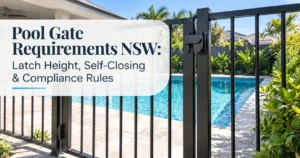
Pool gate requirements NSW generally require a gate to open away from the pool, close automatically from any open position and self-latch securely when it closes. The gate, hinges, latch and surrounding barrier must also remain in good working condition and meet the safety standard that applies to the particular pool. The NSW Government pool safety guidance confirms that pool gates should swing away from the pool area, shut automatically from any open position and self-latch when they close.
A pool gate may look perfectly normal and still fail an inspection. A tired hinge, a latch that catches only when the gate is pushed, ground movement or a nearby object that helps a child reach the latch can all create a compliance problem.
At National Pool Safety, we inspect pool gates, fences and barriers across Canberra and surrounding NSW areas including Queanbeyan, Googong, Jerrabomberra, Bungendore, Yass and Murrumbateman. This guide explains the main NSW pool gate rules, what inspectors look for and what owners can check before arranging an inspection.
NSW Pool Gate Requirements at a Glance
| Requirement | What to Check |
| Gate direction | Opens outward, away from the pool |
| Self-closing | Closes automatically from any open position |
| Self-latching | Latch engages automatically when the gate shuts |
| Latch access | Positioned or protected from young children |
| Gate condition | Hinges, posts and latch remain secure |
| Openings | Gaps meet the applicable barrier standard |
| Non-climbable zone | No climbable objects compromise the barrier |
The exact standard that applies can depend on when the pool was built and whether the barrier has later been altered.
The Pool Gate Must Open Away From the Pool
One of the clearest pool gate regulations NSW owners should check is the direction in which the gate swings.
The gate should open outward, away from the swimming pool area. This reduces the chance of a child pushing against the gate from outside and entering the enclosure.
Stand outside the pool area and open the gate. If it swings toward the pool, it may need attention. The direction is only one part of compliance; the gate must also self-close, self-latch and remain secure.
The Gate Must Self-Close From Any Open Position
A compliant pool gate should not rely on someone remembering to pull it closed.
The self-closing pool gate NSW requirement means the gate should return to the closed position automatically. Do not test it only from fully open. A gate may close strongly from 90 degrees but fail when released from a small opening.
Test it from fully open, halfway open and only a few centimetres open. Each time, it should return to the closed position without help.
Common causes of self-closing problems include reduced hinge tension, loose fittings, gate sagging, corrosion, ground movement or latch misalignment.
If you are preparing for certification, also review our guide to the most common reasons pools fail inspection.
The Gate Must Self-Latch Automatically
Closing is only half of the requirement. The latch must also engage automatically when the gate shuts.
A gate should not need to be pushed, lifted or slammed to latch. Once it closes, gently pull it without operating the release. It should stay securely closed. If it does not latch reliably every time, arrange a repair before relying on it as a secure barrier.
What Is the Required Pool Gate Latch Height in NSW?
The pool gate latch height NSW requirement is intended to make the release mechanism difficult for a young child to operate.
A common compliant arrangement places the latch release at least 1.5 metres above finished ground level. Other compliant configurations may position the latch lower on the pool side of the barrier, provided the release is positioned and shielded according to the applicable standard.
That is why the rule should not be simplified to “every latch must sit at exactly 1.5 metres.” The correct arrangement depends on the gate design and standard applying to the property.
Also check for chairs, planter boxes, storage containers, ladders or pool equipment nearby that could give a child extra height.
The Pool Gate Must Not Be Propped Open
A self-closing gate cannot protect the pool if it is deliberately held open.
Pool gates should remain securely closed whenever they are not in actual use. Do not prop the gate open with bricks, pot plants, chairs, hooks, ropes or wedges.
Check Gaps Around the Gate
The gate forms part of the complete child-resistant barrier, so inspectors assess more than hinges and latches.
For many NSW barriers, openings between vertical members and gaps below the fence or gate are limited to 100 mm. Pool fences are generally required to be at least 1.2 metres high, while boundary fences can have different requirements.
Pay particular attention to the bottom of the gate. Ground can erode, paving can move and posts can shift over time.
If you are unsure whether the gate and surrounding fence comply, a professional swimming pool fence inspection can assess the gate, fence, openings and surrounding barrier together.
Keep the Non-Climbable Zone Clear
Pool gate compliance also depends on the area around the gate.
NSW pool barrier requirements use non-climbable zones to reduce access to footholds and handholds. A 900 mm non-climbable zone is commonly relevant around pool barriers.
Look for outdoor furniture, BBQs, pot plants, tree branches, pool toys, bins, pumps or stacked materials close to the barrier.
Which Australian Standard Applies to Your Pool Gate?
Not every NSW pool is assessed against the same version of the Australian Standard.
| Pool Construction Period | Standard That May Apply |
| Before 30 August 2008 | AS 1926-1986 |
| 1 September 2008 to 30 April 2013 | AS 1926.1-2007 |
| From 1 May 2013 | AS 1926.1-2012 |
Older pools may also involve exemptions or property-specific circumstances, so confirm the applicable standard before significant barrier changes.
If you are unsure about the pool’s construction history, our guide on how to register a pool in NSW explains the registration process and information owners should have available.
Common Reasons Pool Gates Fail an Inspection
Gate Does Not Close From a Small Opening
A gate may close from fully open but remain ajar when released from only a few centimetres.
Latch Does Not Catch Every Time
Slight misalignment can cause the latch to work only when the gate is pushed or slammed.
Gate Has Dropped
Heavy gates can sag over time, affecting latch alignment or creating larger gaps.
Hinge Tension Has Reduced
A tired hinge may no longer provide enough force to return the gate to the latch.
Nearby Objects Make the Barrier Climbable
Furniture, pots, toys or landscaping can create a foothold or make the latch easier to reach.
Pool Gate Pre-Inspection Checklist
Before booking an inspection, test the gate yourself.
Open it fully, halfway and slightly. Each time, confirm that it closes without assistance, reaches the latch, latches automatically and cannot be pulled open without operating the release.
Then check that the gate opens away from the pool. Inspect hinges, screws, posts and latch components for looseness or damage. Look underneath and beside the gate for changing gaps, and remove objects that may compromise the non-climbable zone.
Do You Need a Professional Pool Gate Inspection?
A DIY check is useful, but it does not replace a formal compliance inspection when certification is required.
An inspector considers the whole barrier system, including the applicable Australian Standard, gate direction, self-closing and self-latching performance, latch accessibility, fence openings, height, non-climbable zones and overall condition.
National Pool Safety’s pool fence inspection service checks the gate together with the complete barrier.
If you need formal certification for a property transaction or compliance requirement, you can also review our Swimming Pool Certificate of Compliance service.
What Happens if the Gate Is Non-Compliant?
A non-compliant gate does not always mean the full fence must be replaced. Many defects involve hinge tension, latch alignment, loose fasteners or nearby climbable objects.
Avoid making random changes before understanding the defect. A professional inspection can identify the problem so rectification work can be targeted.
Maintaining a Compliant Pool Gate
Check the gate regularly, particularly after severe weather, landscaping, paving work, fence repairs or ground movement. Open it slightly, release it and watch what happens. If it does not close and latch by itself, investigate the problem.
Frequently Asked Questions
Question: What are the main pool gate requirements in NSW?
Answer: A NSW pool gate generally needs to open away from the pool, self-close from any open position and self-latch automatically. The latch must also be positioned or protected so a young child cannot easily operate it.
Question: How high does a pool gate latch need to be in NSW?
Answer: A common compliant setup places the latch release at least 1.5 metres above finished ground level. Lower or internally positioned latches can be permitted when they meet the applicable positioning and shielding rules.
Question: Does a NSW pool gate have to open outwards?
Answer: Yes. Pool gates are generally required to swing outward, away from the pool enclosure.
Question: Does a pool gate need to self-close from every position?
Answer: Yes. The gate should close and latch without assistance when released from different open positions, including when it is only slightly open.
Question: Can I leave my pool gate propped open?
Answer: No. Pool gates should remain securely closed whenever they are not in actual use.
Question: Can an old pool have different gate requirements?
Answer: Yes. The applicable barrier standard can depend on when the pool was built and whether the barrier has later been altered.
Question: Who can check whether my pool gate is compliant?
Answer: A local council or appropriately registered certifier can assess pool barrier compliance. National Pool Safety provides pool fence, gate and barrier inspections across Canberra and surrounding NSW areas.
Book a Pool Gate and Fence Inspection in NSW
National Pool Safety provides pool fence and barrier inspections for homeowners, property managers and other property stakeholders across Canberra and surrounding NSW communities.
We assess the gate as part of the complete barrier system, including self-closing performance, latching, fence openings, non-climbable zones and other relevant compliance points.
If you are preparing for a sale, lease, compliance inspection or simply want to know whether your barrier meets the applicable requirements, book a pool inspection with National Pool Safety.