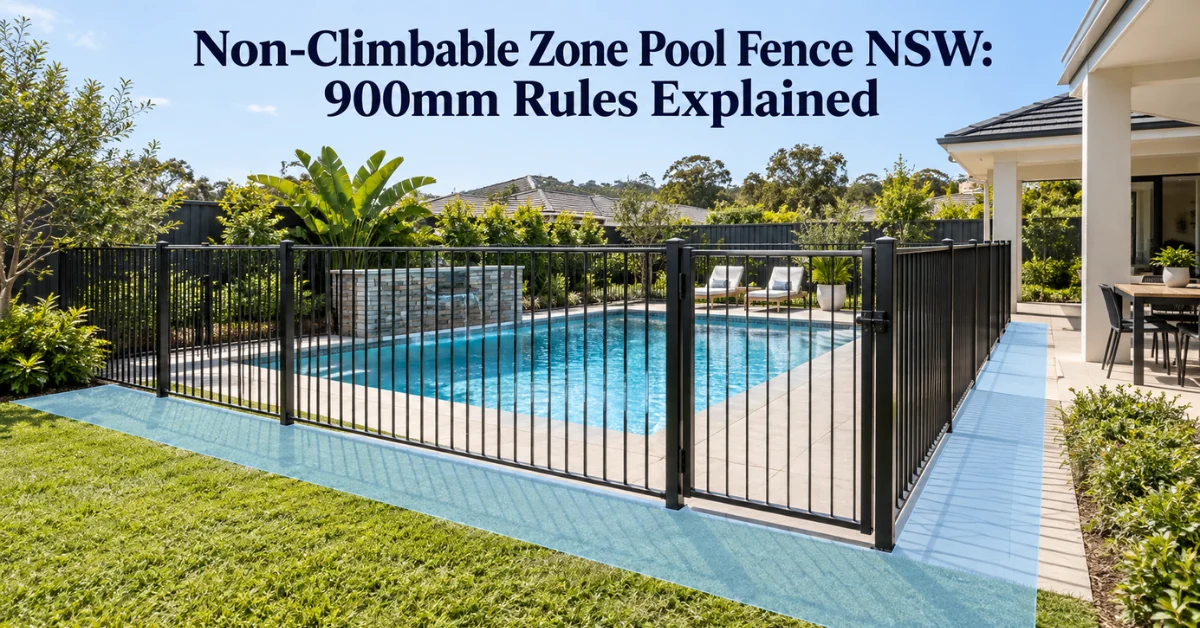
Non-climbable zone pool fence NSW requirements generally mean keeping a 900mm area around relevant parts of the pool barrier free from anything a young child could use as a handhold or foothold. Furniture, plants, retaining walls, steps, toys and other objects can all create a compliance problem if they intrude into the required zone.
The NSW Government pool safety guidance requires pool owners to maintain a non-climbable zone around the barrier and keep potential climbing objects outside it.
At National Pool Safety, we inspect pool barriers across Canberra and surrounding NSW areas including Queanbeyan, Googong, Jerrabomberra, Bungendore, Yass and Murrumbateman. This guide focuses on what the 900mm rule means and what owners should check before a pool compliance inspection.
Key Takeaways
- A 900mm non-climbable zone is central to current NSW pool barrier requirements.
- The zone must remain free of potential handholds, footholds and climbable objects.
- Trees, shrubs, BBQs, chairs, pots, ladders, toys and retaining walls can affect compliance.
- Where barrier openings are greater than 10mm, an additional 300mm area on the pool side may also apply.
- Boundary fences use a different non-climbable-zone arrangement from ordinary internal pool fences.
- Landscaping or furniture changes can make a previously compliant barrier non-compliant.
- The standard applying to a pool can depend on its construction date and later barrier alterations.
What Is a Non-Climbable Zone Around a Pool Fence?
A non-climbable zone, or NCZ, is an area on or next to a pool barrier that must remain free from features that could help a young child climb over the barrier.
A fence can meet the required height and still become easier to climb if a chair, large pot, retaining wall or horizontal surface sits beside it. For example, a raised planter next to a 1200mm fence can reduce the effective height a child has to climb.
NSW Government pool-owner guidance identifies a 90cm, or 900mm, non-climbable zone and specifically tells owners to keep trees, shrubs, BBQs, pot plants, toys, ladders and chairs outside it.
How Does the 900mm Non-Climbable Zone Work?
The 900mm rule is often simplified as “keep everything 900mm away from the fence.” That is a useful homeowner check, but the Australian Standard uses defined non-climbable zones depending on the barrier configuration.
For a typical barrier under 1800mm high, the standard uses a 900mm zone on the outside face with associated arc-shaped areas to restrict access to handholds and footholds.
The NSW Government describes the main zone as an arc measured from the top of the pool fence towards the ground. Potential climbing objects should not intrude into this 90cm area.
Check the full outside face and surrounding space. Anything that could help a child step higher, grip the fence or reach the top may affect compliance.
What Is the 300mm Inside Clearance?
The pool side of the barrier can also matter.
Where a barrier has openings greater than 10mm, the applicable standard includes an additional non-climbable area extending 300mm into the pool side of the barrier. NSW Government guidance also tells owners to keep this space free from potential footholds and handholds.
Owners often check only the outside, but a bench, raised garden edge or other surface immediately inside the barrier can also matter.
This is why checking only whether furniture is 900mm away from the outside of the fence may not provide a complete picture.
What Objects Can Make a Pool Fence Climbable?
Many NCZ problems are caused by ordinary outdoor items rather than the fence itself.
Common examples include outdoor chairs, tables, BBQs, planter boxes, ladders, pool toys, storage boxes, bins, tree branches, shrubs, pool equipment, lighting, rocks, decks and retaining walls.
The issue is whether the item’s position or shape could help a child gain height or grip.
National Pool Safety’s guide to why pools fail inspection identifies climbable objects within the non-climbable zone as a common barrier defect.
Something as simple as moving outdoor furniture closer to the pool fence can therefore change the barrier’s compliance position.
How Can Landscaping and Level Changes Affect the NCZ?
Landscaping can affect compliance even when the fence itself has not changed. Tree branches, sturdy shrubs, raised planters, retaining walls, steps and decks can create footholds or reduce the barrier’s effective height.
This often becomes an issue after landscaping or paving work. If you plan to change ground levels or build near the fence, check the compliance impact first and keep vegetation trimmed away from the required zone.
A small plant can also become a different issue several years later as its trunk and branches grow.
Raised garden beds deserve particular attention because the structure itself may provide a platform close to the barrier.
Does the NCZ Apply to Pool Gates?
Yes. A pool gate forms part of the child-resistant barrier, so the area around it must not create an easy climbing route.
Furniture, pots and other items beside the gate can help a child reach the latch or climb the barrier. Gate components can also create footholds depending on their design.
The gate must separately meet its closing and latching requirements. Clearing the non-climbable zone does not compensate for a gate that fails to self-close or self-latch.
A professional swimming pool fence inspection assesses the gate, fence and surrounding area together rather than looking at the fence height alone.
What About a Boundary Fence Used as the Pool Barrier?
Boundary fences use a different arrangement from typical internal pool fencing.
Where a boundary fence forms part of the pool barrier, current NSW guidance generally requires a height of 1800mm. The relevant non-climbable zone is positioned on the pool side of the boundary barrier and extends from the top area of the fence.
Do not assume the ordinary outside 900mm clearance applies in exactly the same way. Boundary-fence height and the pool-side NCZ should be considered together.
This distinction is particularly important on properties where one side of the pool enclosure is also the boundary between neighbouring properties.
Can a Previously Compliant Pool Fail Because of the NCZ?
Yes. This is one of the easiest ways for a barrier to become non-compliant without any damage to the fence.
A chair, raised planter, BBQ or growing tree can create a new climbing point. A previous inspection only reflects the barrier condition at that time.
Pool owners should therefore check the space around the fence regularly rather than waiting until another formal inspection is required. This is especially useful after landscaping, renovations or changes to outdoor furniture.
For other areas worth reviewing before an inspection, see National Pool Safety’s Swimming Pool Compliance Checklist NSW.
Does Every NSW Pool Use the Same NCZ Rules?
Not always.
NSW recognises different versions of the Australian pool barrier standards depending on when a pool was constructed.
The NSW Government currently identifies AS 1926-1986, AS 1926.1-2007 and AS 1926.1-2012 as standards that may apply depending on the pool’s construction history.
Barrier alterations can also change which requirements apply. Owners of older pools, unusual layouts or historic exemptions should establish the applicable standard before redesigning the barrier.
This matters because a measurement that applies to one pool should not automatically be used to assess every older barrier in NSW.
A registered inspector can determine the relevant standard as part of a property-specific compliance assessment.
How to Check the Non-Climbable Zone Before an Inspection
Start outside the pool barrier and walk the full perimeter.
Move obvious climbable items such as chairs, pots, storage boxes and toys away from the fence. Trim branches and shrubs that provide a foothold or handhold.
Then look at fixed features including retaining walls, decks, raised garden beds, lighting, pool equipment and permanent structures. These may need a more detailed assessment because they cannot simply be moved.
Check the pool side as well, particularly where the barrier has openings greater than 10mm. Look for benches, ledges or other surfaces close to the fence.
Finally, test the gate and confirm the surrounding space is clear.
The goal is not only to clear the obvious 900mm ground area. Look at the complete climbing path from the ground toward the top of the barrier.
What Happens if an Inspector Finds an NCZ Problem?
The solution depends on what is creating the climbing point.
A movable chair or pot may only need relocation, while vegetation may need trimming. Fixed structures can require a more considered solution. An NCZ issue does not automatically mean the entire fence needs replacing.
The important point is that the correction should restore the effectiveness of the barrier.
Temporarily moving an object for an inspection and then returning it to the same position does not provide an ongoing solution.
Where a formal compliance certificate is required, relevant defects must be resolved before the pool can be confirmed as compliant.
National Pool Safety can identify the barrier issue during inspection so owners understand which part of the pool area requires attention.
Why the NCZ Should Be Checked Regularly
Non-climbable-zone problems often develop gradually.
A tree grows. Outdoor furniture is rearranged. A new BBQ arrives. Someone builds a garden bed or installs pool equipment beside the fence.
None of these changes necessarily look like pool fence work, but they can change the effectiveness of the child-resistant barrier.
Regular visual checks help identify these changes before a property is being sold, leased or prepared for certification.
Checking the NCZ also takes only a short amount of time compared with discovering a problem during a formal inspection.
Frequently Asked Questions
What is the non-climbable zone for a pool fence in NSW?
The non-climbable zone is the area on and around a pool barrier that must remain free from potential handholds, footholds and objects that could help a young child climb the fence. A 900mm zone is central to current NSW requirements.
How far should furniture be from a pool fence in NSW?
Furniture and other climbable objects should remain outside the applicable 900mm non-climbable zone so they do not create a step or handhold beside the barrier.
Can plants be inside the 900mm pool fence zone?
Plants can create a compliance issue when trunks, branches, pots or raised garden structures provide a useful foothold or handhold. Landscaping should be maintained so it does not compromise the NCZ.
Is there a 300mm non-climbable zone inside a pool fence?
For barriers with relevant openings greater than 10mm, an additional 300mm non-climbable area can apply on the pool side. It should remain clear of potential footholds and handholds.
Does the 900mm rule apply to a boundary fence?
Boundary fences have a different NCZ arrangement. Where a boundary fence forms part of the pool barrier, the relevant zone is generally assessed on the pool side near the top of the boundary barrier.
Can outdoor furniture cause a pool inspection to fail?
Yes. Chairs, tables, BBQs, pots, storage boxes and similar items can create climbable points when positioned within the required non-climbable zone.
Book a Pool Fence Inspection in NSW
The non-climbable zone is easy to overlook because the fence itself may appear strong and correctly sized.
National Pool Safety provides pool fence and barrier inspections across Canberra and surrounding NSW. We assess fence condition, gates, latches, gaps, non-climbable zones and other features relevant to pool barrier compliance.
If you are preparing to sell or lease a property, renewing compliance documentation or simply want to know whether the current barrier meets the applicable requirements, our Swimming Pool Certificate of Compliance NSW service explains the certification pathway.
You can also book a pool inspection with National Pool Safety to have your barrier assessed against the requirements that apply to your property.