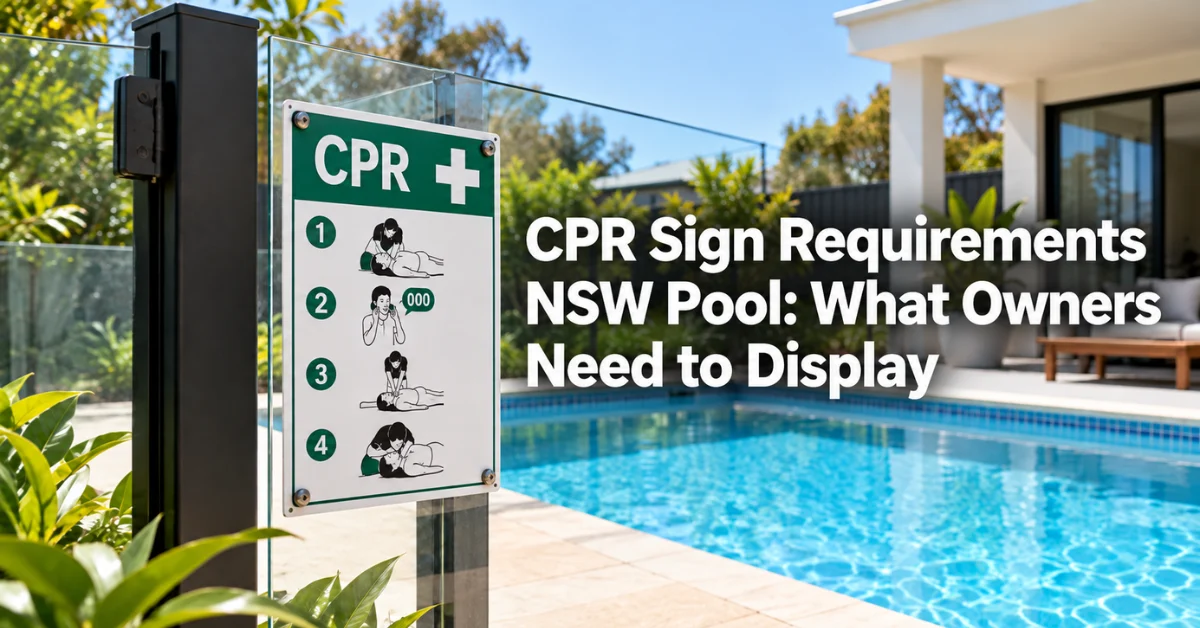
CPR sign requirements NSW pool rules require pool owners to display an appropriate cardiopulmonary resuscitation sign in a prominent position near the swimming pool. The sign must be kept in good condition and be easily readable from at least three metres away.
The NSW Government pool safety guidance confirms that CPR signage is a legal requirement and applies to relevant pools, including portable pools. Updated CPR signage requirements took effect on 1 September 2019, with specific rules applying to new pools and older existing signs.
At National Pool Safety, we inspect residential swimming pool barriers across Canberra and surrounding NSW areas including Queanbeyan, Googong, Jerrabomberra, Bungendore, Yass and Murrumbateman. CPR signage is one of the items that should be checked when preparing a NSW pool for compliance inspection.
Key Takeaways
- NSW swimming pools require an appropriate CPR or resuscitation warning sign near the pool.
- The sign must be positioned prominently in the immediate vicinity of the pool.
- It must be easily readable from at least 3 metres away.
- The sign needs to remain in clearly legible and good condition.
- Updated CPR signage requirements came into effect on 1 September 2019.
- New pools must use signage complying with the updated requirements.
- An older compliant sign installed on or before 31 August 2019 may continue to comply unless the pool is substantially altered or rebuilt.
- Portable pools covered by NSW swimming pool laws also require CPR signage.
- A damaged, faded or unreadable sign should be replaced rather than left until a compliance inspection.
Is a CPR Sign Mandatory for a Swimming Pool in NSW?
Yes. NSW swimming pool legislation requires an appropriate resuscitation warning notice to be displayed in the immediate vicinity of a swimming pool.
This is not simply an optional safety accessory.
Section 17 of the Swimming Pools Act 1992 and the supporting Swimming Pools Regulation set requirements for warning notices associated with swimming pools.
The purpose is straightforward. If a drowning or near-drowning emergency occurs, CPR instructions should be readily available to people near the pool.
However, displaying a CPR chart does not replace supervision, pool barriers or CPR training. It forms one part of the broader NSW swimming pool safety requirements.
Where Should the CPR Sign Be Displayed?
The sign should be displayed in a prominent position in the immediate vicinity of the swimming pool.
That means it should be positioned where someone in or around the pool area can locate and read it quickly.
A CPR sign should not be hidden:
- behind outdoor furniture;
- behind vegetation;
- inside a cupboard;
- around a corner away from the pool;
- behind pool equipment;
- where another structure blocks the instructions.
Many signs are mounted on a pool fence or gate because these locations can provide good visibility. However, the main compliance issue is that the sign is prominently positioned near the pool and satisfies the required visibility and legibility standards.
When deciding where to place the sign, stand within the pool area and consider whether the instructions can be located quickly during an emergency.
How Far Away Must a Pool CPR Sign Be Readable?
One of the clearest CPR sign requirements NSW pool owners need to know is the three-metre rule.
Under the NSW Swimming Pools Regulation, the required warning notice must be legible from a distance of at least 3 metres and maintained in a clearly legible condition.
A sign may therefore create a compliance problem even when it is physically present.
Common issues include:
- faded printing;
- weather damage;
- peeling graphics;
- text obscured by dirt;
- very small print;
- damaged surfaces;
- objects blocking the sign.
If the chart has faded significantly or sections cannot be read, replacement is usually the practical solution.
What Information Should a NSW Pool CPR Sign Contain?
A compliant sign is more than a generic poster containing the letters “CPR.”
The Swimming Pools Regulation requires the warning notice to contain safety warnings and a simple flow chart showing resuscitation techniques consistent with relevant resuscitation guidance.
The required content includes warnings covering:
- active supervision of young children;
- keeping pool gates closed;
- keeping articles, objects and structures clear of the pool fence.
The notice also needs to include resuscitation guidance and information identifying the organisation or body responsible for publishing the sign.
Because the required content is prescribed, homeowners should purchase signage specifically intended to comply with NSW swimming pool requirements rather than designing their own informal CPR notice.
Appropriate signs are commonly available through pool suppliers, councils and recognised safety organisations.
What Changed on 1 September 2019?
The current NSW CPR signage requirements took effect on 1 September 2019.
From that date, new swimming pools are required to use signage complying with the updated requirements.
This change is important because some properties still have older CPR charts installed beside pools constructed many years ago.
According to current NSW Government guidance, owners of existing pools are not automatically required to replace an older compliant sign simply because the new signs commenced in 2019.
An older sign can continue to be accepted in certain circumstances. However, this changes if the pool is substantially altered or rebuilt.
Does an Older CPR Sign Need to Be Replaced?
Not necessarily.
The Swimming Pools Regulation provides transitional recognition for certain signs erected on or before 31 August 2019 that complied with the earlier signage rules.
This means an existing pool does not automatically fail simply because its compliant CPR sign predates September 2019.
However, the older sign still needs to remain clearly legible and in suitable condition.
If the swimming pool is substantially altered or rebuilt, the current signage requirements apply.
The simplest test is practical: can someone clearly read and understand the chart from three metres away?
Do Portable Pools Need CPR Signs in NSW?
Yes, relevant portable and inflatable swimming pools can also be subject to NSW pool safety laws.
The NSW Government states that portable pools capable of holding more than 30 cm of water are subject to pool fencing and safety requirements, including CPR signage.
Owners sometimes assume that rules apply only to permanent in-ground pools. That can create compliance problems.
If a portable pool falls within the swimming pool requirements, owners need to consider the barrier, registration requirements where applicable and CPR signage just as they would for another regulated swimming pool.
The CPR sign should remain near the pool, visible and readable from three metres.
Do Spa Pools Need CPR Signage?
Spa pools are also covered by NSW swimming pool safety legislation in relevant circumstances.
A spa may have different barrier arrangements from a conventional swimming pool. For example, particular spa pools may use a compliant lockable child-resistant cover instead of a surrounding barrier where the requirements are satisfied.
Owners should therefore avoid assuming that a lockable spa lid removes every other compliance obligation.
Where there is uncertainty about a spa’s barrier or signage requirements, a property-specific inspection is preferable to relying on general assumptions.
Is the CPR Sign Checked During a Pool Compliance Inspection?
Yes. CPR signage is one of the items commonly reviewed when assessing a pool for compliance. The inspector is not assessing only whether a sign exists.
They may check whether the sign is:
- present;
- positioned near the pool;
- clearly visible;
- legible from the required distance;
- maintained in good condition;
- appropriate for the pool’s circumstances.
The sign is only one part of the inspection. The pool fence, gate, latch, gaps, non-climbable zones and other relevant barrier features also need to satisfy the applicable requirements.
National Pool Safety’s Swimming Pool Compliance Checklist NSW provides a broader overview of items owners can review before an inspection.
Can a Missing CPR Sign Affect Pool Certification?
Yes.
If required CPR signage is missing or does not meet the relevant requirements, it can need attention before the pool is confirmed as compliant.
Fortunately, signage is generally one of the simpler issues for an owner to check before an inspection.
Before booking, confirm that the CPR sign is present and readable. Doing this does not guarantee that the entire pool barrier will pass. It simply removes one obvious compliance issue that can be identified in advance.
Other common problems may involve the gate, latch, fence gaps or climbable objects around the barrier.
You can review the common reasons pools fail inspection for other issues worth checking.
CPR Signs for Pools Under Construction
Pools under construction have an additional signage requirement.
The Swimming Pools Regulation requires a warning notice stating that the swimming pool is not to be occupied or used while construction is underway.
That sign must remain prominently displayed until the relevant Occupation Certificate or Certificate of Compliance has been issued. This construction notice is separate from the standard CPR warning sign requirements applying to completed pools.
Owners building a new pool should therefore make sure they are following the correct signage requirements for each stage of the project.
How to Check Your CPR Sign Before an Inspection
Checking the sign takes only a few minutes.
First, confirm that a CPR sign is actually installed in the immediate vicinity of the pool. Then move roughly three metres away.
Make sure the instructions remain clear and that sunlight, weather damage or fading has not made sections difficult to read.
Next, check that plants, pool equipment and furniture do not obstruct the sign. Look for cracks, peeling surfaces, corrosion or water damage that affects legibility.
If you recently constructed, substantially altered or rebuilt the pool, confirm that the sign meets the updated requirements introduced from September 2019..
For a professional assessment, National Pool Safety provides swimming pool safety inspections in NSW covering the barrier, access points and relevant pool safety requirements.
Does a CPR Sign Replace CPR Training?
No.
A CPR sign provides emergency instructions, but NSW regulations also require the notice to communicate that formal instruction in resuscitation is important. The sign should therefore be viewed as an emergency reference, not as a substitute for learning CPR.
From a pool compliance perspective, the owner’s immediate responsibility is to ensure that the required warning notice is displayed and maintained correctly.
Keep the Sign Visible After Certification
Receiving a pool compliance certificate does not mean the CPR sign can later be removed or allowed to deteriorate.
Weather exposure can fade signs over time. Furniture and landscaping can also be moved into positions that obstruct them.
Include the CPR sign when doing routine visual checks of the pool barrier. If it becomes difficult to read from three metres, replace it before the condition worsens.
This helps keep the pool area aligned with the requirements that applied when it was inspected.
Frequently Asked Questions
Is a CPR sign required for a swimming pool in NSW?
Yes. NSW swimming pool laws require an appropriate CPR or resuscitation warning notice to be displayed in a prominent position near the swimming pool.
How far away must a pool CPR sign be readable?
The sign must be legible from at least 3 metres away and maintained in a clearly legible condition.
Where should a CPR sign be placed around a pool?
It should be in a prominent position in the immediate vicinity of the swimming pool. It should not be hidden behind plants, furniture or pool equipment.
Does an old CPR sign need to be replaced in NSW?
An older compliant sign installed on or before 31 August 2019 may continue to comply in certain circumstances. However, current signage requirements apply when the swimming pool is substantially altered or rebuilt.
Do portable pools need CPR signs in NSW?
Relevant portable pools are also covered by NSW pool safety requirements. NSW Government guidance confirms that CPR signage requirements apply to portable pools covered by the legislation.
Can a faded CPR sign cause a compliance problem?
Yes. The sign needs to remain clearly legible and readable from at least three metres. A badly faded, damaged or obstructed sign may need replacement.
Is a CPR sign checked during a NSW pool inspection?
Yes. CPR signage is one of the safety items that can be checked alongside the pool fence, gate, latch, non-climbable zones and other relevant barrier requirements.
Book a NSW Pool Compliance Inspection
A CPR sign is a relatively small part of a pool area, but it remains an important requirement during a compliance assessment.
National Pool Safety provides pool barrier inspections across Canberra and surrounding NSW areas. We assess relevant features including CPR signage, pool fencing, gates, latches, openings and non-climbable zones.
If you need formal certification for a sale, lease or other property requirement, see our Swimming Pool Certificate of Compliance NSW service.
You can also book a pool inspection with National Pool Safety to have the pool barrier and associated safety requirements assessed.