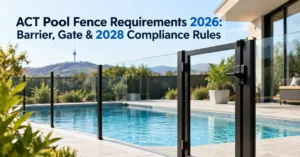
ACT pool fence requirements require residential swimming pools and spas covered by the scheme to have an effective child-resistant safety barrier, with gates that close and latch automatically and access points that restrict young children from entering the pool area. Under the ACT’s home swimming pool safety reforms, all regulated residential pools and spas must meet the prescribed safety standards by 1 May 2028, unless an applicable exemption applies.
The rules apply to pools capable of containing water more than 30 cm deep and associated with residential properties such as houses, units, townhouses and apartment buildings. The requirements can cover permanent pools, above-ground pools, demountable pools, some portable pools and spas.
At National Pool Safety, we provide pool compliance inspections across Canberra and the ACT. This guide explains what the current pool fence rules mean for homeowners, what inspectors look for and what may need attention before the 2028 compliance deadline.
Key Takeaways
- ACT residential pools and spas capable of holding water more than 30 cm deep are generally covered by the current safety scheme.
- From 1 May 2028, regulated pools must have a barrier meeting the prescribed safety standards unless an exemption applies.
- Gates must be self-closing and self-latching, including when released from a slightly open position.
- Gate latches must be positioned or shielded to make them difficult for young children to operate.
- Pool barriers must remain effective, maintained and free from access hazards.
- Pools built or altered before 1 May 2013 are a major focus of the transition because many older barriers may require upgrades.
- Pool owners should not wait until 2028 to check whether an existing barrier meets the current standard.
What Are the Current ACT Pool Fence Requirements?
The ACT Government introduced updated home swimming pool safety reforms that commenced on 1 May 2024.
The reforms created a four-year transition period ending on 1 May 2028. During this period, owners of regulated pools have time to bring existing safety barriers up to the prescribed standards or obtain an applicable exemption.
The official ACT Government Home Swimming Pool Safety Reforms guidance explains that a compliant barrier must restrict access by young children and operate as an effective safety barrier around the pool or spa.
The barrier should be considered as a complete system rather than simply a fence.
Inspectors may need to consider the fence itself, gates, latches, openings, non-climbable areas, nearby structures, boundary fencing and any doors or windows that form part of the access arrangement.
Which Pools Need a Safety Barrier in the ACT?
The ACT reforms apply to a regulated swimming pool associated with a residential building where the pool is capable of containing water to a depth greater than 30 cm.
That can include in-ground pools, above-ground pools, permanent pools, demountable pools, portable pools, wading pools, children’s pools and spas, depending on their construction and equipment.
This means pool owners should not assume that a pool is exempt simply because it is above ground or temporary.
Some specific exclusions and exemptions exist, including particular inflatable pools without filtration systems, but these depend on how the pool is constructed and used.
If you are uncertain whether your pool falls within the scheme, a professional ACT swimming pool compliance inspection can help establish which requirements apply.
Which Safety Standard Applies to an ACT Pool?
The applicable safety standard partly depends on when the swimming pool or spa was built, altered or installed.
For pools built or altered before 1 May 2023, the prescribed standards include the Building Code requirements together with AS 1926.1-2012, covering swimming pool safety barriers, and AS 1926.2-2007, dealing with the location of safety barriers.
For pools built, altered or installed on or after 1 May 2023, the applicable requirements are the Building Code and Australian Standards referenced by the Building Code at the time the work is undertaken.
This distinction is important because owners of older pools should not assume that a barrier installed decades ago automatically satisfies the modern requirements.
Pool Gate Requirements in the ACT
The gate is one of the most important moving parts of a pool barrier.
Under the modern safety requirements, a pool gate should close and latch automatically. ACT Government guidance specifically notes that a gate should be self-closing and self-latching from any open position, including when it is only slightly ajar.
That means testing a gate only when it is fully open is not enough.
Open the gate slightly and release it. It should travel back to the closed position and engage the latch without needing to be pushed, lifted or slammed.
Official ACT guidance for older pools being upgraded also states that gates may need to swing outward, away from the pool area.
A gate that works inconsistently can still create a compliance issue.
How High Should a Pool Gate Latch Be?
Latch accessibility is another important part of ACT pool fence requirements.
ACT Government guidance states that a pool gate latch should generally be positioned more than 1.5 metres from the ground, or, where a lower latch arrangement is used, it needs to be appropriately shielded to restrict access by young children.
Owners should also look at the area surrounding the latch.
A latch may technically be positioned correctly but become easier to reach if a chair, planter, storage box or other climbable item is placed beside the gate.
This is why inspectors assess the entire access arrangement rather than checking the latch measurement alone.
How Large Can the Gap Under a Pool Barrier Be?
The bottom of the barrier is another common area where problems develop.
ACT Government guidance gives an example under AS 1926 that the gap beneath a pool barrier should be no more than 100 mm from the ground.
Ground movement, paving changes, soil erosion and fence movement can increase a gap long after the original fence was installed.
Owners should therefore inspect the bottom of the fence and gate periodically, particularly after landscaping, paving or drainage work.
Pool Barriers Must Be Non-Climbable
A pool barrier must not provide an easy climbing route into the pool area.
Modern requirements include non-climbable zones around barriers, and different requirements can apply where boundary fencing, adjoining structures or other features interact with the pool enclosure. ACT Government upgrade guidance specifically identifies non-climbable zones as an area where many older barriers may need changes.
Furniture, BBQs, storage containers, pot plants, pool equipment and vegetation can all affect the effectiveness of a barrier if they provide a convenient foothold or handhold.
Even a correctly installed fence can become non-compliant if the surrounding environment changes.
Can the House Form Part of the Pool Barrier?
The relationship between the house and pool enclosure is particularly important for older ACT pools.
Modern requirements place tighter restrictions on using building walls containing doors as part of an outdoor pool barrier.
ACT Government guidance for older pools explains that a door generally cannot form part of an outdoor pool barrier in the same way some historic arrangements allowed. Different provisions apply to indoor pools and child-resistant doorsets.
Windows opening onto pool areas can also require specific child-resistant measures depending on their height, location and configuration.
This is an area where property-specific advice is valuable because the correct solution depends heavily on the building layout.
What About Above-Ground Pools?
Above-ground pools are not automatically exempt from the ACT pool safety requirements.
The ACT Government’s upgrade guidance states that an above-ground pool wall may function as an effective barrier in certain circumstances where it meets relevant construction, non-climbability and height requirements.
For some above-ground pools, a factory-fabricated wall of at least 1200 mm from the outside may form part of the barrier if the other requirements are satisfied. Permanent ladders and access points still require appropriate protection.
Owners should therefore avoid relying on the height of the pool wall alone.
Do Pool Barriers Need to Be Maintained Before 2028?
Yes.
The 2028 date does not mean owners can ignore barrier problems until then.
Since 1 May 2024, ACT requirements include obligations relating to maintenance of pool safety barriers and preventing access when the pool or spa is not in use. Gates, doors and other access points need to remain securely closed and the barrier should continue functioning as an effective child-resistant barrier.
A gate that no longer self-closes or a damaged section of fencing should therefore be addressed when the issue becomes apparent.
Which Pools Need a Compliance Certificate Before 2028?
Pools built, altered or installed before 1 May 2013 have additional requirements during the transition period.
Those pools generally need to obtain a compliance certificate before 1 May 2028 and lodge it with the ACT Government within 30 days of issue. Certificates obtained during the transition period remain valid until 1 May 2032.
Pools built on or after 1 May 2013 are treated differently during the transition period.
For the full timeline rather than barrier specifications, see our guide to the ACT pool compliance deadline.
Common ACT Pool Fence Problems to Check
Before arranging an inspection, check the barrier in normal operating conditions.
Pay particular attention to a gate that stays slightly open, a latch that requires manual pressure, loose hinges, excessive gaps, damaged panels, unstable posts and objects that make the barrier easier to climb.
Also consider whether renovations have changed the barrier.
A new deck, landscaping, retaining wall, outdoor furniture arrangement or building alteration can affect a barrier that previously functioned correctly.
For older pools, the differences between historic and current standards can be more substantial, so guessing which repairs are required may lead to unnecessary work.
Should You Arrange an ACT Pool Fence Inspection Now?
For owners of older pools, checking the barrier well before the 2028 deadline gives more time to understand any rectification work required.
National Pool Safety provides swimming pool compliance inspections in the ACT for homeowners, landlords, property managers, real estate professionals and body corporate managers.
An inspection can assess the gate, latch, fence, non-climbable areas, surrounding structures and other relevant access points against the applicable requirements.
Where formal certification is required, you can also review our Swimming Pool Certificate of Compliance ACT service.
Prepare for the ACT Pool Safety Changes Before 2028
The main purpose of the current reforms is to bring residential pool and spa barriers across the ACT toward modern safety standards.
Owners of pools built before May 2013 should pay particular attention because older barrier arrangements are more likely to require assessment or upgrading before certification.
Rather than waiting until the transition period is close to ending, checking the barrier early can provide time to identify problems, arrange appropriate rectification and complete the certification process where required.
For a summary of how the rules apply by construction date, visit National Pool Safety’s ACT properties compliance guide or arrange an ACT pool compliance inspection.
Frequently Asked Questions
What are the main ACT pool fence requirements?
A regulated residential pool generally needs an effective child-resistant safety barrier that meets the applicable prescribed standards. Gates should self-close and self-latch, access points must restrict young children and the barrier must remain properly maintained.
When do ACT pool barriers need to comply with the new requirements?
The transition period ends on 1 May 2028. From that date, regulated residential swimming pools and spas need to have barriers compliant with the prescribed safety standards unless an exemption applies.
Do ACT pool gates need to self-close?
Yes. The modern standard requires gates to close and latch automatically, including when released from a slightly open position.
How high should an ACT pool gate latch be?
ACT Government guidance states that a latch should generally be more than 1.5 metres above ground level, or a lower latch must be appropriately shielded so young children cannot readily operate it.
Does an above-ground pool need a fence in Canberra?
Above-ground pools are covered by the ACT scheme where they meet the definition of a regulated swimming pool. In some circumstances the pool wall can form part of the barrier if it satisfies the relevant requirements, but ladders and access points still need appropriate protection.
Do older ACT pools have to be upgraded?
Many pools built or altered before 1 May 2013 may require changes to meet the prescribed modern standards. The exact work depends on the existing barrier, property layout and construction history.
Who can inspect an ACT pool for compliance?
Compliance certificates must be issued by an authorised person. National Pool Safety provides ACT pool compliance inspections and has ACT authorised persons who can assess residential pool barriers against the applicable requirements.