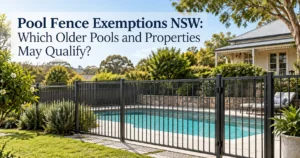
Pool fence exemptions NSW may apply to certain older swimming pools and particular properties, but an exemption does not automatically mean a pool can be left without effective child-resistant access controls. Eligibility depends on factors such as when the pool was built, the size or location of the property, whether the barrier has since been altered and whether access to the pool continues to meet the applicable requirements.
Under the NSW Swimming Pools Act 1992, specific provisions exist for some pools built before 1 August 1990 and certain pools on small, large or waterfront properties constructed before 1 July 2010. Local councils may also consider individual exemption applications under Section 22 in particular circumstances.
At National Pool Safety, we assess pool fences and barriers across Canberra and surrounding NSW areas. If you own an older pool and are unsure whether an exemption still applies, the safest approach is to establish the pool’s construction and alteration history before assuming that current fencing rules do not apply.
Key Takeaways
- Some NSW pools built before 1 August 1990 may be subject to older exemption provisions.
- Pools built before 1 July 2010 on properties smaller than 230 m², properties of 2 hectares or more, or waterfront properties may have specific legacy exemptions.
- Pools constructed from 1 July 2010 onward generally cannot rely on those automatic property-size or waterfront exemptions.
- An exemption does not remove the responsibility to restrict access to the pool.
- Altering, rebuilding or replacing an older barrier may affect an existing exemption.
- Councils may consider a separate exemption under Section 22 of the Swimming Pools Act 1992 where normal requirements are impracticable or unreasonable, or an equally effective alternative exists.
- If you are unsure which rules apply, a professional inspection can help determine the relevant compliance pathway.
What Is a Pool Fence Exemption in NSW?
A pool fence exemption is an exception to particular barrier requirements under NSW swimming pool legislation.
An exemption is not simply permission to have an unsafe or unrestricted pool. In many older-property situations, the exemption relates to how the pool is separated from the house or how access from the dwelling is restricted.
NSW pool laws have changed over time. As a result, a pool built decades ago may have different barrier circumstances from a pool installed today.
The NSW Government’s pool owner guidance explains that the requirements applying to a pool can depend on its construction date and the type of property.
This is why the date of construction is often one of the first things an inspector needs to establish.
Which Pools May Have an Exemption in NSW?
There are several common categories associated with legacy pool fence exemptions NSW.
| Pool or Property Type | Key Date / Condition |
| Older swimming pool | Construction commenced before 1 August 1990 |
| Small property | Less than 230 m² and pool built before 1 July 2010 |
| Large property | 2 hectares or more and pool built before 1 July 2010 |
| Waterfront property | Pool built before 1 July 2010 |
| Special individual circumstances | Council may consider Section 22 application |
These categories should be treated as a starting point rather than proof that a particular property is exempt.
The history of the pool and barrier still matters.
Pools Built Before 1 August 1990
Pools constructed before 1 August 1990 can fall within older provisions of the Swimming Pools Act.
For these pools, the child-resistant barrier may not necessarily have to separate the pool completely from the residential building in the same way required for many newer pools.
However, access from the house must still be restricted in accordance with the requirements applying to that pool.
That may involve compliant doors, windows or other access-control measures depending on the property’s configuration and applicable standard.
Therefore, saying:
“My pool was built before 1990, so I do not need pool safety measures”
would be incorrect. The exemption relates to specific barrier arrangements, not to the overall responsibility to prevent unrestricted access.
Small Property Pool Exemptions
Some older pools on very small properties can also fall within exemption provisions.
A relevant small property is generally one with an area of less than 230 square metres, where the pool construction or installation commenced before 1 July 2010.
Historically, small lots could make it difficult to install a conventional four-sided pool barrier while preserving practical use of the property.
However, pools constructed from 1 July 2010 do not receive the same automatic small-property exemption.
Pool Exemptions on Properties of 2 Hectares or More
Another well-known category involves pools on large properties.
Under the Swimming Pools Act, certain pools constructed before 1 July 2010 on premises measuring 2 hectares or more may qualify for legacy arrangements.
These older provisions can allow a pool not to be surrounded in the same way by a child-resistant barrier, provided access from the residential building remains restricted as required.
This is sometimes misunderstood by owners of rural properties.Owning more than two hectares does not automatically exempt a new pool.
If the pool was constructed after 1 July 2010, the large-property exemption generally does not apply in the same way.
For owners in regional NSW who are uncertain about an existing pool, reviewing the broader NSW pool compliance requirements can help clarify the next steps.
Waterfront Property Pool Exemptions
Certain older pools on waterfront properties may also qualify.
The legislation refers to premises having frontage to a large body of water, which can include a river, creek, canal, lake, reservoir, estuary or the sea.
For the legacy waterfront exemption to be relevant, the pool generally needs to have been constructed or installed before 1 July 2010.
Again, waterfront location by itself does not mean every pool on the property is exempt.
Newer pools are expected to meet the applicable child-resistant barrier requirements.
Owners should establish both the property’s waterfront status and the pool construction date before relying on this exemption.
What Changed on 1 July 2010?
The date 1 July 2010 is particularly important when discussing NSW pool fence exemptions.
Before that date, specific exemptions could apply to pools on:
- very small properties
- properties of 2 hectares or more
- waterfront properties
Those automatic exemptions were removed for pools constructed from 1 July 2010 onward.
This means a waterfront home or a two-hectare rural property does not automatically allow a newly constructed pool to avoid the standard barrier arrangement.
For many owners, checking documentation from the original pool installation, development approval or previous compliance records can help establish the relevant construction date.
If the pool has not yet been properly recorded, our guide on how to register a pool in NSW explains the registration process.
Can an Existing Pool Fence Exemption Be Lost?
Yes. An older exemption should not automatically be treated as permanent regardless of what happens to the property.
Barrier alterations are particularly important.
If an owner voluntarily installs a new barrier, substantially modifies an existing barrier or undertakes changes that affect how access to the pool is restricted, the previous exemption may no longer apply in the same way.
Some councils specifically warn owners that once an exempt barrier arrangement is removed or substantially changed, the property may need to meet the current applicable barrier requirements.
This can become important during:
- major renovations
- house extensions
- new decks or outdoor areas
- replacement of an old fence
- changes to doors or windows providing pool access
- relocation of the pool barrier
Before making significant changes around an older exempt pool, it is sensible to establish the current compliance position first.
What Is a Section 22 Pool Barrier Exemption?
Legacy exemptions based on pool age or property type should not be confused with a Section 22 exemption.
Section 22 of the Swimming Pools Act 1992 allows a local council to consider an application for exemption from particular barrier requirements in specific circumstances.
Council may consider an exemption where complying with the normal requirement would be impracticable or unreasonable because of factors such as:
- the physical nature of the premises
- the design or construction of the pool
- relevant special circumstances
An exemption may also be considered where an alternative method of restricting pool access is no less effective than the normal requirement.
This is not an automatic exemption. The property owner generally needs to apply to the relevant local council, provide supporting information and allow the council to assess the individual circumstances.
Council may also impose conditions on an exemption.
Does Disability Access Qualify for an Exemption?
Disability or physical impairment can be relevant in some Section 22 cases.
For example, normal barrier requirements may significantly restrict an adult resident’s ability to access the pool because of a physical disability.
That does not mean a disability automatically results in approval.
Council still needs to assess the circumstances and determine whether an exemption or alternative arrangement can provide effective pool access control while addressing the resident’s needs.
Owners considering this route should contact their local council before changing the existing barrier.
Do Exempt Pools Still Need to Be Registered?
Yes. Pool registration and pool fence exemption status are different matters.
Swimming pools in NSW must generally be registered on the NSW Swimming Pool Register.
Registration records information about the pool and property, but registration does not prove that a pool complies with safety requirements.
This distinction is particularly important for older pools.
An owner may correctly register a pool while still needing an inspection to determine whether a claimed exemption applies and whether the access arrangements remain compliant.
What Happens When You Sell or Lease a Property With an Exempt Pool?
An older exemption does not mean compliance documentation can automatically be ignored during a property transaction.
Different certificate requirements can apply when selling or leasing residential property with a swimming pool.
If you are preparing a property transaction, it is useful to establish the exemption position before the sale or lease process reaches the final stages.
National Pool Safety can assess the existing barrier and advise on the inspection pathway. You can also review our Swimming Pool Certificate of Compliance service for information about certification.
How Can You Check Whether Your Pool Exemption Still Applies?
Start by gathering as much property history as possible.
Useful records can include:
- approximate pool construction date;
- original development or building approvals;
- previous inspection reports;
- previous exemption certificates;
- pool registration details;
- records of renovations or barrier changes.
A professional swimming pool fence inspection can help identify the current barrier configuration and whether further confirmation from council is required.
Do Not Assume an Old Pool Is Automatically Exempt
One of the biggest mistakes an owner can make is relying only on the age of the house or a statement from a previous owner.
Pool compliance is property-specific.
A pool may originally have qualified for a legacy exemption but later have undergone substantial barrier work. Alternatively, the construction date may be different from what the current owner believes.
If you are preparing for an inspection, our guide to common reasons pools fail inspection can also help identify issues that should be checked before certification.
Frequently Asked Questions
Question: Are old swimming pools exempt from fencing laws in NSW?
Answer: Some older pools may qualify for specific legacy barrier exemptions, particularly pools constructed before 1 August 1990. However, access to the pool must still be restricted according to the requirements applying to the property. Being an old pool does not mean there are no safety obligations.
Question: Is a pool on a 2-hectare property exempt from fencing in NSW?
Answer: Certain pools on properties of 2 hectares or more may qualify if construction commenced before 1 July 2010. Pools built from 1 July 2010 generally cannot rely on that automatic large-property exemption.
Question: Are waterfront pools exempt from pool fencing requirements?
Answer: Some pools on waterfront properties constructed before 1 July 2010 may qualify for legacy exemption provisions. Waterfront location alone does not exempt a newer pool.
Question: Are pools on properties under 230 square metres exempt?
Answer: Certain pools on properties smaller than 230 square metres may qualify where construction commenced before 1 July 2010. Newer pools generally need to comply with the standard barrier requirements.
Question: Can I apply for a pool fence exemption in NSW?
Answer: Yes. Section 22 of the Swimming Pools Act allows an owner to apply to the local council in particular circumstances where normal requirements are impracticable or unreasonable, or where an alternative arrangement provides no less effective restriction of pool access.
Question: Can renovating my pool area affect an existing exemption?
Answer: Yes. Rebuilding, substantially altering or replacing a barrier can affect an older exemption. Owners should confirm the applicable requirements before carrying out major barrier or access changes.
Question: Who can confirm whether my pool fence exemption is valid?
Answer: Your local council can confirm council-issued or Section 22 exemption matters. A pool compliance inspection can also help establish the current barrier condition, construction history and whether council clarification is required before certification.
Book a Pool Fence Inspection in NSW
If you believe your pool has an existing exemption, do not make unnecessary barrier changes until you understand how the current rules apply.
National Pool Safety provides swimming pool fence and barrier inspections across Canberra and surrounding NSW areas including Queanbeyan, Googong, Jerrabomberra, Bungendore, Yass and Murrumbateman.
We can assess the existing pool barrier, construction history and current access arrangement and help identify whether additional council confirmation or rectification may be required.
If you need to confirm your pool’s compliance before selling, leasing or carrying out barrier work, book a pool inspection with National Pool Safety.