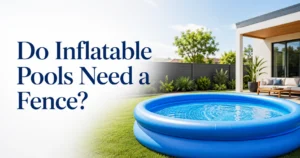
Yes. In NSW, an inflatable or portable pool that can hold water to a depth of 300mm (30cm) or more generally needs a compliant pool safety barrier. The fact that a pool is inflatable, temporary, portable or above ground does not automatically remove the fencing requirement.
This catches many homeowners by surprise. A blow-up pool bought for summer may look very different from an in-ground swimming pool, but once it reaches the relevant water-depth threshold, NSW pool safety requirements can apply.
The same principle can affect portable pools, frame pools, wading pools and some above-ground pools. Pool owners also need to consider registration, barrier condition, gates and other safety requirements.
National Pool Safety provides swimming pool compliance inspections across NSW areas surrounding Canberra, including Queanbeyan, Googong, Jerrabomberra, Bungendore, Yass and Murrumbateman.
This guide explains do inflatable pools need a fence, how the 300mm water depth rule works, the key portable pool rules NSW owners should know and what to check before setting up an above-ground or blow-up pool.
Key Takeaways
- Inflatable pools capable of holding 300mm (30cm) or more of water can require a compliant pool barrier in NSW.
- A pool being temporary or portable does not automatically exempt it from pool safety requirements.
- Above-ground pools can also be subject to pool fencing requirements.
- NSW pool barriers generally need to meet minimum height, gap, gate and non-climbable-zone requirements.
- Swimming pools in NSW need to be registered on the NSW Swimming Pool Register.
- A pool gate must be self-closing and self-latching.
- Climbable objects near a pool barrier can cause compliance problems.
- NSW rules should not be confused with the separate ACT framework for inflatable and demountable pools.
Do Inflatable Pools Need a Fence in NSW?
Yes, if the inflatable pool can hold 300mm or more of water, you should treat it as a pool that is subject to NSW safety requirements.
National Pool Safety’s NSW compliance guidance specifically identifies inflatable and portable pools as pools that may fall within the rules depending on their water depth.
The important questions are:
- How much water can the pool contain?
- How deep can that water be?
- Is it being used for swimming, wading or paddling?
- Does the pool area have an appropriate child-resistant barrier?
A large inflatable family pool therefore cannot simply be treated like a children’s toy because it can be deflated after use. Once it meets the relevant threshold, pool safety requirements become important.
What Is the 300mm Water Depth Rule?
The 300mm water depth rule is one of the most useful numbers for owners of inflatable and portable pools to understand. 300mm is the same as 30cm.
National Pool Safety’s NSW guidance states that inflatable pools holding more than 30cm of water require a safety barrier or pool fence.
The rule means you should look at the pool’s water-holding capability rather than assuming that a temporary design removes the need for fencing.
Simple Examples
Consider these situations:
Small shallow paddling pool: If the pool cannot hold water to the relevant 300mm depth, it may fall outside the pool fencing threshold discussed in National Pool Safety’s NSW guidance.
Large inflatable family pool: If it can hold 300mm or more of water, pool fencing requirements should be considered.
Portable frame pool: A metal-frame or similar portable pool capable of holding water beyond the threshold should not be treated differently simply because it can eventually be dismantled.
Above-ground swimming pool: Being raised above ground does not itself remove the pool safety obligations.
If you are uncertain about your setup, a professional pool barrier inspection can establish whether the barrier meets the requirements that apply.
Portable Pool Rules NSW Owners Should Know
Portable pools create confusion because owners often focus on how long the pool will stay in the yard.
A pool may be:
- inflatable
- temporary
- framed
- demountable
- above ground
- installed only during summer
and still need an appropriate barrier if it falls within the NSW swimming pool requirements. Ask whether the pool reaches the 300mm threshold and whether the proposed location allows a compliant barrier to be maintained.
You should also consider objects around the pool. Tables, chairs, pot plants, storage boxes, pool equipment and other items positioned close to a barrier may create climbable points. National Pool Safety’s guide to why pools fail inspection explains the common barrier and access problems inspectors identify.
Above Ground Pool Fence Requirements
Above-ground pools are not automatically exempt from pool fencing rules. National Pool Safety includes above-ground pools within its pool safety guidance, while its NSW fencing pages explain the barrier standards pool owners need to consider.
For a typical NSW pool barrier, important requirements include:
Pool Fence Height
An internal pool barrier generally needs to be at least 1200mm high, measured from the finished ground level.
Where a boundary fence forms part of the pool barrier, different height requirements can apply, including a 1800mm requirement for relevant installations.
Gaps in the Barrier
The gap beneath the pool fence should generally not exceed 100mm.
Gaps between vertical members also need to remain within the applicable limits.
Non-Climbable Zone
National Pool Safety’s NSW guidance identifies a 900mm non-climbable zone around pool barriers.
Objects that could help a child climb the fence should not be placed within this area.
This is particularly important with portable pools because the surrounding yard may not have originally been designed as a pool area.
Pool Gates
Pool gates need to be:
- self-closing
- self-latching
- able to latch securely
- maintained so that they continue operating correctly
A compliant fence does not provide an effective barrier if its gate no longer closes or latches correctly.
For a more detailed checklist, see National Pool Safety’s swimming pool fence regulations NSW guidance.
Does a High Above-Ground Pool Wall Replace a Fence?
Do not assume the height of an above-ground or portable pool automatically removes the need to consider a compliant barrier. Pool safety compliance considers the complete access arrangement around the water. Steps, ladders, pumps, decks, furniture and nearby structures can all affect access.
For that reason, judging compliance from the pool wall alone can be misleading.
The better approach is to assess the whole barrier arrangement against the applicable pool safety requirements.
National Pool Safety’s pool compliance inspections assess barriers, gates and access points to identify issues that need attention.
Do Inflatable Pools Need to Be Registered in NSW?
NSW swimming pools are required to be registered. An inflatable or portable pool that falls within the applicable swimming pool requirements should therefore not be overlooked simply because it is not a permanent in-ground installation.
Registration and fencing are separate responsibilities.
A fence does not replace registration, and registration does not confirm that the barrier itself is compliant. If you have not completed registration, follow our step-by-step guide on how to register a pool in NSW.
Registration is particularly important if the property will later be sold or leased because pool documentation becomes part of the compliance process.
What Commonly Makes a Portable Pool Area Non-Compliant?
Setting up the pool is only one part of compliance. The surrounding area matters just as much.
Common issues identified in National Pool Safety’s inspection guidance include:
Climbable Objects Near the Fence
Outdoor furniture, pots, equipment, retaining walls and other objects may provide climbing opportunities if positioned too close to the barrier.
Gates That Do Not Self-Close
A gate may appear functional but fail to close completely from every open position.
Faulty Latches
A worn, misaligned or incorrectly positioned latch can prevent the gate from securing itself.
Excessive Gaps
Gaps beneath the barrier or between barrier components can create a compliance issue.
Changes Around the Pool
Landscaping, new structures, storage items and other changes can alter a barrier that previously appeared compliant.
Before arranging an inspection, see why pools fail inspection for a more complete overview of common defects.
Do You Need a CPR Sign for a Portable Pool?
National Pool Safety’s NSW pool fencing guidance includes CPR signage as part of pool safety compliance.
A CPR sign should be clearly displayed near the pool area and positioned so that it can be easily seen.
This is another reason portable pools should not be viewed purely as temporary recreational equipment once they fall within swimming pool requirements.
Barrier compliance, gates, registration and safety signage all need to be considered as part of the pool area.
Blow Up Pool Laws Australia: Are the Rules the Same Everywhere?
No. Pool fencing requirements can vary between Australian states and territories.
National Pool Safety services both NSW and the ACT, and its own guidance demonstrates why owners should not assume the rules are identical on both sides of the border.
This article focuses primarily on portable pool rules in NSW.
NSW Inflatable Pools
National Pool Safety’s NSW guidance states that inflatable pools reaching the relevant 30cm water-depth threshold require a safety barrier.
ACT Inflatable Pools
The ACT framework is different.
National Pool Safety’s ACT guidance explains that an inflatable pool that can simply be inflated and deflated and does not have a filtration system is excluded from the ACT scheme.
If it has a filtration system, it can be treated as a demountable swimming pool.
The ACT also has a specific exemption for certain temporary or demountable pools that are in place for no more than three consecutive days.
These ACT provisions should not be applied automatically to an NSW property.
If you own properties on both sides of the border, work from the rules applying to the location of each pool.
What if You Are Selling a House With an Inflatable or Portable Pool?
Pool compliance becomes particularly important when selling an NSW property.
The required pool documentation should be addressed before the sale progresses rather than assuming a portable pool will simply be ignored.
National Pool Safety’s guide Do I Need a Pool Certificate to Sell My House? explains the NSW sale requirements and the different documents that can be used.
If the portable pool is removed permanently before the property is marketed, discuss the property’s pool registration and documentation position with the relevant professionals handling the sale.
If the pool remains at the property, establish its compliance position early.
When Should You Arrange a Pool Inspection?
Consider arranging an inspection when:
- you install a new portable or above-ground pool
- you are unsure whether the pool needs a fence
- your existing barrier has been altered
- the gate no longer closes correctly
- landscaping has changed around the fence
- you are preparing to sell or lease
- you need a pool compliance certificate
- you are unsure which standard applies to your pool
A professional inspection gives you a clear assessment of the pool barrier rather than relying on assumptions based on the pool’s appearance or product description.
For information about inspection and certification pricing, see how much a pool compliance certificate costs.
Inflatable and Portable Pool Compliance Checklist
Before filling an inflatable or portable pool, work through this simple checklist.
1. Check the Water Depth
Can the pool contain 300mm or more of water?
If yes, do not assume it is exempt simply because it is portable.
2. Check the Barrier
Confirm that the pool area has an appropriate child-resistant barrier.
3. Check Fence Height and Gaps
Look for inadequate height, excessive gaps or damaged components.
4. Test the Gate
The gate should self-close and self-latch correctly.
5. Clear the Non-Climbable Zone
Move furniture, pot plants, boxes and other climbable objects away from the barrier.
6. Check Registration
Make sure the pool has been dealt with correctly through the NSW Swimming Pool Register where required.
7. Check Safety Signage
Make sure the required CPR signage is displayed and readable.
For a broader assessment, use National Pool Safety’s NSW swimming pool compliance checklist.
Frequently Asked Questions
Do Inflatable Pools Need a Fence?
Yes, in NSW an inflatable pool capable of holding around 300mm or more of water can require a compliant pool safety barrier. The fact that it can be deflated does not automatically remove NSW pool safety requirements.
What Is the 300mm Pool Rule?
300mm equals 30cm. National Pool Safety’s NSW guidance uses this water-depth threshold when explaining whether inflatable and similar pools fall within pool fencing requirements.
Do Portable Pools Need Fencing in NSW?
Portable pools that fall within the applicable swimming pool requirements need to be treated like other pools for barrier safety purposes. Being temporary or portable does not automatically provide an exemption.
Do Above Ground Pools Need a Fence?
Yes, above-ground pools can require compliant barriers. Pool owners should consider the full barrier and access arrangement rather than assuming the height of the pool wall alone is sufficient.
Does a Kids’ Blow-Up Pool Need a Fence?
It depends on how much water the pool can hold. A very shallow paddling pool may be different, but once an inflatable pool reaches the relevant 300mm water-depth threshold, NSW fencing requirements need to be considered.
Do Inflatable Pools Need to Be Registered?
NSW swimming pools that fall within the relevant requirements need to be registered. See our guide on how to register a pool in NSW.
Can I Put Furniture Next to a Pool Fence?
Climbable objects close to a pool barrier can create compliance problems. National Pool Safety’s NSW guidance requires a non-climbable zone around the barrier, so furniture and similar objects should be kept clear.
Are NSW and ACT Inflatable Pool Rules the Same?
No. The ACT has specific rules for certain inflatable and demountable pools that differ from the NSW position. Do not apply an ACT exemption to an NSW property.
Conclusion: Check the Depth Before You Fill the Pool
If you are asking “do inflatable pools need a fence?”, the key NSW number to remember is 300mm, or 30cm.
An inflatable, portable or above-ground pool capable of holding water to that depth should not be treated as exempt simply because it can be packed away later. For portable pools, this is particularly important because many yards were never originally designed as swimming pool areas. A pool may be easy to set up, while creating a compliant barrier arrangement can require more planning.
National Pool Safety provides swimming pool compliance inspections across Canberra and surrounding NSW.If you already have an inflatable, portable or above-ground pool and are uncertain about the fencing requirements, establishing the compliance position early is easier than discovering an issue when selling, leasing or arranging certification.
Not sure whether your portable pool needs a compliant barrier? Book your pool compliance inspection or call National Pool Safety on 02 6189 8455.