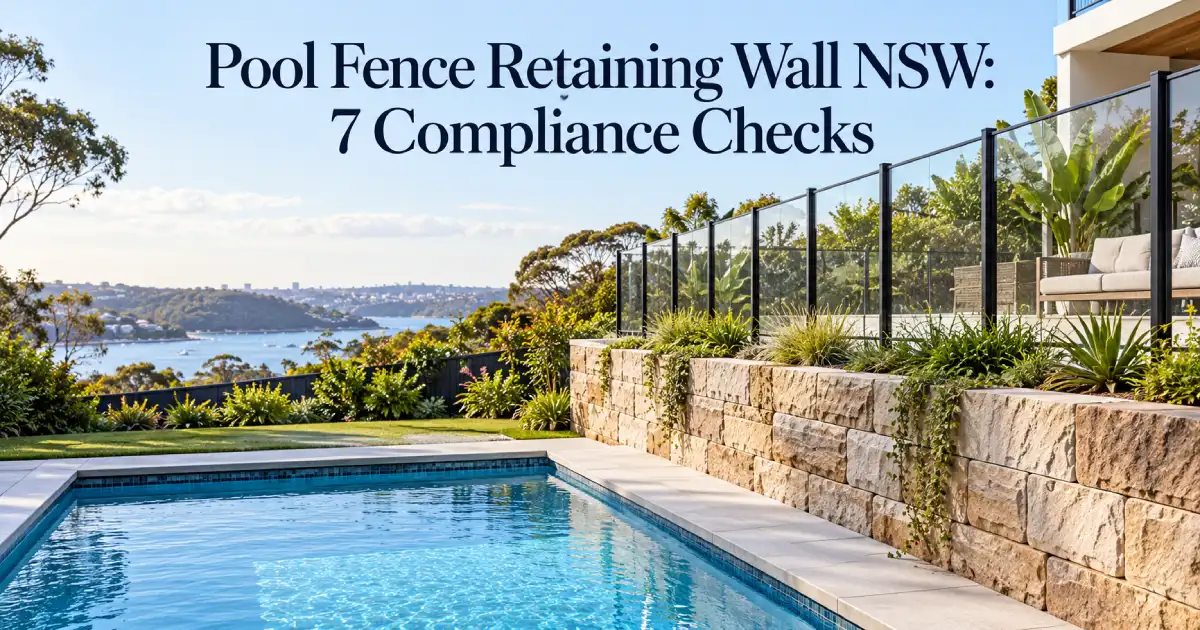
Pool fence retaining wall NSW requirements allow a retaining wall to form part of a pool barrier only when the complete barrier meets the standard that applies to the property. Height, wall position, gaps, non-climbable zones and any fence fixed above the wall all matter. A retaining wall is not automatically compliant because it is solid or difficult to climb.
Current NSW Government guidance says a standard pool barrier is generally at least 1200mm high, while a boundary barrier is generally 1800mm high. It also requires a 900mm non-climbable zone. These measurements become more complex where ground levels change beside a retaining wall.
This guide is for NSW pool owners planning landscaping, repairs or an inspection. National Pool Safety is NSW licensed and inspects pool barriers across Queanbeyan, Googong, Jerrabomberra, Yass, Bungendore and nearby NSW areas.
Key Takeaways
- A retaining wall can form part of a pool barrier if the full barrier complies.
- There is no single retaining-wall height that suits every pool layout.
- Internal barriers are generally at least 1200mm high.
- Boundary barriers are generally at least 1800mm high.
- A 900mm non-climbable zone must stay clear of climbable features.
- Steps, decks and level changes can reduce effective barrier height.
- Major barrier changes can trigger current NSW requirements.
Pool Fence Retaining Wall NSW Rules
Can a Retaining Wall Be a Pool Barrier?
Yes. A retaining wall can form part of a child-resistant pool barrier when its height, surface, position and surrounding layout meet the applicable standard.
NSW law requires an effective child-resistant barrier to be maintained around relevant swimming pools. The retaining wall therefore needs to work as part of one continuous barrier system.
Current Eurobodalla Shire Council guidance lists retaining walls among structures that can form barriers below 1800mm or barriers of 1800mm and above. The correct treatment depends on the actual configuration.
For the wider standard framework, see National Pool Safety’s AS 1926.1 pool fence requirements NSW guide.
Which Barrier Height Applies?
A retaining wall does not have one universal pool-barrier height. The required effective height depends on how the wall functions within the enclosure.
| Situation | Main Compliance Check |
| Internal barrier | Generally maintain at least 1200mm effective barrier height |
| Boundary barrier | Generally maintain at least 1800mm from the pool side |
| Wall plus fence | Combined arrangement must meet applicable barrier requirements |
| Sloping or stepped ground | Measure from relevant finished ground levels |
NSW Government guidance measures standard pool-fence height from finished ground level. This matters because raised paving, garden beds or steps can reduce the effective height of the barrier.
A wall and fence that appear high enough from one position may fail elsewhere after the ground rises.
How Does the NCZ Affect Retaining Walls?
The non-climbable zone, or NCZ, is often the main issue around retaining walls. Current NSW guidance uses a 900mm non-climbable zone around relevant barriers.
A retaining wall can become a foothold when it sits too close to a fence. The same problem can occur with steps, planter boxes, lighting and raised garden edges.
Check for:
- a wall that lets a child step closer to the fence top;
- horizontal ledges wide enough to stand on;
- garden beds built against the barrier;
- steps entering the NCZ;
- fence fittings reachable from the wall.
For the detailed NCZ measurements, use National Pool Safety’s non-climbable zone pool fence NSW guide.
What if the Wall Is Above or Below the Pool?
The side of the retaining wall matters because the accessible ground level changes.
Retaining Wall Above the Pool
A wall on the higher side can create a direct drop toward the pool area. The barrier must still restrict access to the pool and address fall protection where required.
Do not assume wall height alone solves both issues. Pool-barrier compliance and fall protection can involve different requirements.
Retaining Wall Below the Pool
Where the wall sits below the pool level, the wall and a fence above it may work together as the barrier.
Current NSW council guidance says the wall-and-fence combination should achieve the required effective barrier height. Some configurations also involve slope limits, which is why unusual walls should be measured rather than judged by eye.
Can a Pool Fence Sit on a Retaining Wall?
Yes. A pool fence can sit on a retaining wall when the completed system meets pool-barrier and structural requirements.
The pool-safety assessment focuses on effective height, openings, climbability and continuity. The retaining wall must also be suitable to support the fence.
Before fixing posts, aluminium panels or glass fencing into an existing wall, confirm that the wall and fixings are structurally suitable. Structural design may require a builder or engineer.
If the installation creates openings at the base or joins, compare them with National Pool Safety’s pool fence gap requirements NSW guide.
What Happens Where the Fence Meets the Wall?
Transitions are common problem areas. The wall-to-fence junction must not create a gap, foothold or shortcut through the barrier.
Check where:
- the fence starts or ends on the wall;
- ground levels step up;
- the barrier turns a corner;
- a gate sits beside the wall;
- landscaping fills the transition.
A compliant fence panel does not correct a weak transition beside it. This is especially important on sloping or tiered properties, where effective barrier height can change within only a few metres.
Can Renovations Change the Rules?
Yes. NSW Government guidance states that modifying or altering a pool barrier can cause current requirements to apply. Previous exemptions may also cease.
Replacing a retaining wall, adding a deck or moving a pool fence can therefore change the compliance position.
Before major work, confirm which standard applies to the property. This matters most for older pools or barriers relying on a previous exemption.
5-Minute Retaining Wall Self-Check
Use this quick template before booking an inspection:
- Walk the complete wall and fence line.
- Check effective height from accessible finished ground.
- Look for steps, ledges or raised surfaces inside the NCZ.
- Check gaps where the wall meets fencing or gates.
- Confirm the barrier is stable and in good repair.
- Remove movable climbable objects.
- Note recent landscaping or renovation work.
This is a screening check, not a compliance certificate. A pool with complex level changes should be assessed against the standard that applies to that property.
Frequently Asked Questions
Q1: Can a retaining wall be used as a pool fence in NSW?
Yes. It can form part of the barrier when the complete arrangement meets the applicable NSW pool-safety requirements.
Q2: How high must a retaining wall be around a pool?
There is no single height for every layout. Internal barriers are generally at least 1200mm, while boundary barriers are generally 1800mm.
Q3: Can I put a pool fence on top of a retaining wall?
Yes. The combined system must meet barrier requirements, and the retaining wall and fixings must be structurally suitable.
Q4: Does a retaining wall affect the 900mm NCZ?
Yes. A wall, ledge, step or raised garden can create a foothold within the required non-climbable zone.
Q5: Can landscaping make the barrier non-compliant?
Yes. Raised paving, garden beds, steps and new retaining walls can reduce effective barrier height or introduce climbable features.
Book a Pool Barrier Inspection in NSW
Retaining walls make pool barriers harder to assess because effective height can change over a short distance. A small level change can also create a new foothold.
National Pool Safety provides Swimming Pool Barrier Inspection NSW services across Canberra’s surrounding NSW region. Inspectors can assess retaining walls, fence transitions, gates, gaps and non-climbable zones as one complete barrier system.
If formal certification is required once the barrier complies, National Pool Safety also provides Swimming Pool Certificate of Compliance NSW services.
Book a professional pool barrier inspection with National Pool Safety and get clear guidance on what your property needs to comply.