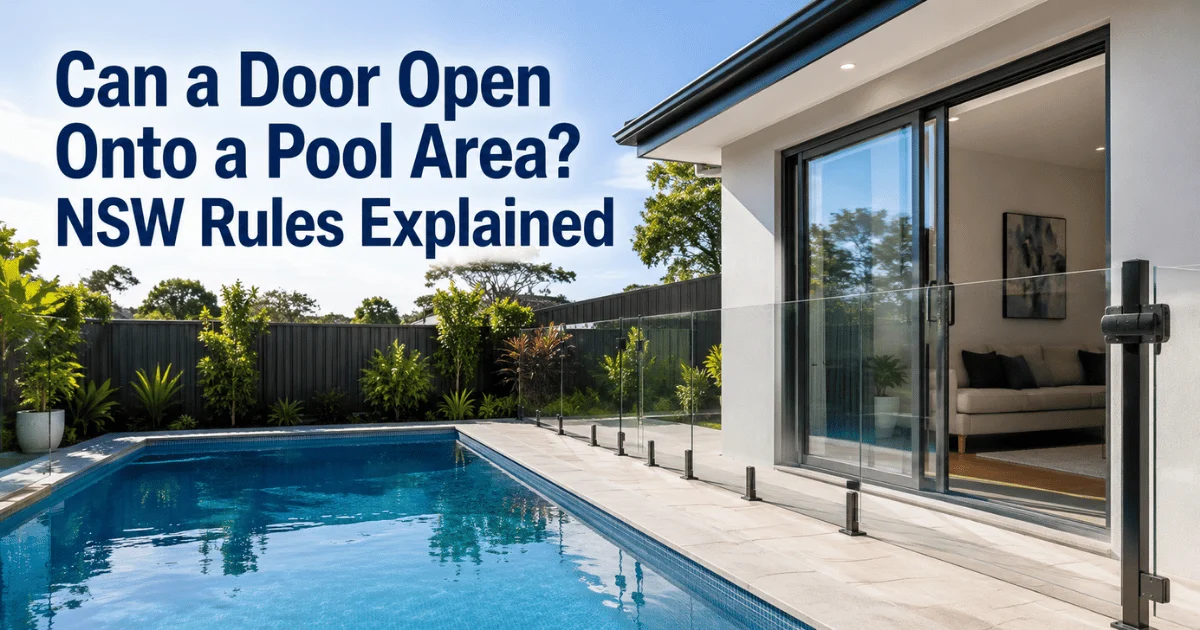
A door can open onto a pool area in NSW only where the pool was built or installed before 1 July 2010 and the house forms part of an approved barrier. In that case every door entering the pool area needs a latch at least 1500mm above floor level, must open away from the pool and be self-latching, and every window opening to the pool area has to be restricted. For pools from 1 July 2010 onward, the pool must be fenced separately from the house and no door arrangement is permitted.
Before 1 July 2010, some NSW owners had a genuine choice: fence the pool, or restrict access using latchable doors and limited window openings. Plenty of older homes across Queanbeyan, Goulburn, Yass and the Southern Tablelands still run on that second option.
At National Pool Safety, we inspect pool barriers across Canberra and the surrounding NSW region, and doors and windows are where older properties most often come unstuck. The barrier itself is usually fine. What fails is a laundry door with a low handle, a bedroom window that slides fully open, or a pet flap installed years after the original approval.
Can a Door Open Onto a Pool Area in NSW?
Yes, but only under a legacy arrangement. Section 19 of the Swimming Pools Act 1992 allows a house wall to be used as part of a required child-resistant barrier. Where an exemption applies and the pool was built or installed before 1 July 2010, that wall can include doors and windows, provided they meet the restriction requirements.
The NSW Swimming Pool Register publishes a self-assessment section specifically headed “Swimming Pools built/installed with door and window as barrier before 1 July 2010.” Its own wording is that prior to 1 July 2010, property owners had the choice of either fencing their pools or having latchable doors and restricted window openings as their pool barrier.
What it is not is a loophole. A door forming part of a barrier is treated exactly like a gate, and the standard for what counts as compliant has tightened considerably since these arrangements were first approved.
The Date That Decides Everything: 1 July 2010
NSW applies three broad barrier eras, and yours is set by when the pool was built.
| Pool built | Barrier position |
| Before 1 August 1990 | Access from the house must be restricted at all times. Windows and doors may form part of the barrier, provided they are compliant. |
| 1 August 1990 to 30 June 2010 | The pool must be fenced so it is separated from the house. Exemptions may apply on properties under 230 square metres, properties of two hectares or more, and waterfront properties. |
| From 1 July 2010 | All new pools must be fenced separately from the house. No exemptions. |
Where the door and window option actually applies
This is the detail most guides blur. The door and window arrangement is not automatically available to every pool built before 1 July 2010. It applies where an exemption applies to your property:
- Pools built before 1 August 1990, under the general pre-1990 rule
- Pools on properties under 230 square metres, properties of two hectares or more, or waterfront properties, where construction commenced before 1 July 2010
That is why the register publishes the door and window checklist inside its category-specific checklists rather than as a standalone rule.
If your pool went in after 1 July 2010, stop here. You need a fence, and a door onto the pool area is a defect regardless of how good the latch is. Our pool barrier inspection service covers what that fence has to meet.
Indoor pools are handled under a separate division of the Act and Regulation and have their own rules for doors. If your pool is enclosed, confirm the position with your certifier rather than applying the outdoor rules above.
Door Requirements Where the House Forms Part of the Barrier
Where doors are part of an approved pre-2010 barrier, the NSW Swimming Pool Register checklist sets three requirements.
- There is a latch on the door at least 1500mm above floor level on every door entering the pool area. Every door, not the main one. Laundry doors, garage side doors, sliding doors, French doors and rarely-used back doors all count.
- Doors open away from the pool area and are self-latching. The door must swing away from the water and must latch by itself on closing.
- There are no pet doors or openings to the pool area greater than 100mm.
What catches owners out
A standard door handle at roughly 1000mm is not a compliant latch. A separate high latch has to be fitted.
A key lock does not satisfy the self-latching requirement. A lock that depends on someone choosing to lock it is not a barrier, which is exactly why the checklist asks for self-latching rather than lockable.
A door that has been rehung, replaced or widened is new work, and new work is assessed against the current standard. Under current NSW guidance, child-resistant doorsets are no longer permitted in new barriers. Existing compliant arrangements can remain, but you cannot create a new one.
If you are unsure whether your doors still satisfy the checklist, a compliance inspection will tell you in one visit.
Window Requirements Where the House Forms Part of the Barrier
Any window that opens to the pool area must satisfy one of three options. You only need one, not all three.
| Option | Requirement |
| Restrict the opening | The window can open to a maximum of 100mm |
| Screen it | The window is totally covered by bars or a metal or mesh screen |
| Height | The sill of the lowest opening panel is at least 1800mm above the floor |
Two things that decide the outcome
First, the restriction has to be permanent. Fixing screws or a permanently installed restrictor is acceptable. A window lock that relies on someone remembering to use it is not, for the same reason a key lock fails on a door.
Second, this applies to every openable window facing the pool area, including bedroom windows, bathroom windows and louvres. Louvre windows are a frequent failure because the blades themselves usually cannot be restricted to 100mm, so a fixed screen is generally the only workable fix.
The checklist asks for bars or a metal or mesh screen that totally covers the window. An ordinary insect flyscreen, which lifts out or pushes through, will not satisfy that.
Pet Doors, Wall Openings and the 100mm Rule
Where a wall forms part of the barrier, there must be no wall openings greater than 100mm anywhere in it. That includes pet doors, vents, cat flaps, and gaps left after a pipe or cable was run through.
Pet doors are the single most common retrofit failure we see on older properties. The original approval predates the pet door by a decade, nobody thought of it as a barrier alteration, and it fails immediately on inspection. The fix is straightforward, which is a permanent seal, but it needs doing before the certificate can be issued rather than after.
The same 100mm limit applies to gaps under a fence or gate and between vertical members elsewhere in the barrier. See our guide to pool barrier height requirements for the rest of those figures.
The Renovation Trap That Cancels Your Exemption
This is the part worth reading twice. If a pool barrier is modified or altered, and NSW guidance is explicit that this can include ordinary house and yard renovations, then the current Swimming Pools Act 1992, Swimming Pools Regulation 2018 and AS 1926.1-2012 apply, and any previous exemption ceases.
In plain terms: renovate, and the door and window arrangement you have relied on for twenty years can disappear. You are then required to meet the current standard, which does not allow doors in a new barrier at all. That usually means a physical fence between the house and the pool.
The work that triggers it is ordinary
Rebuilding a deck. Replacing a fence line. Extending the back of the house. Adding a pergola, garage, carport or shed. New structures are required to sit outside the enclosed pool area, even where the property holds a complying existing exemption.
If you are planning work near the pool, get the barrier assessed before you start. Building the compliant barrier into the project is far cheaper than retrofitting one after the landscaping is finished.
Boundary Fences: 1200mm or 1800mm?
Where a boundary fence forms part of the pool barrier, the required height depends on the pool’s build date.
- Pools built before 1 September 2008: the boundary fence must be at least 1200mm high
- Pools built after 1 September 2008: the boundary fence must be at least 1800mm high
This surprises owners on older properties who assume 1200mm is the number everywhere. It is worth checking, because a boundary fence is usually shared, and any change involves your neighbour. Our pool fence inspection service covers boundary fence assessment as part of the barrier check.
What This Means if You Are Selling or Leasing
None of these arrangements matter to a buyer or tenant until a certifier signs off on them, and that is where older properties get held up.
To sell a NSW property with a pool you need a certificate of registration plus a certificate of compliance, a relevant occupation certificate, or a certificate of non-compliance. To lease, a certificate of non-compliance is not enough. A certificate of compliance is valid for three years.
A door or window defect is usually cheap to fix and quick to reinspect. The problem is timing. Discovering a non-compliant laundry door the week before exchange means a rectification, a reinspection and a delay, all under pressure. Discovering it two months out means a tradesperson visit and nothing else.
If you have not yet registered the pool, start there. Our guide on how to register a pool in NSW covers the form.
How the ACT Handles Doors and Windows
If your property is in Canberra rather than across the border, do not apply the NSW dates. The ACT operates its own home swimming pool safety reforms, commenced 1 May 2024, with compliance certificates lodged through Access Canberra. Pools and spas built before 1 May 2013 must meet the prescribed safety standard by 1 May 2028.
There is no ACT equivalent of the NSW pre-2010 door and window arrangement. The ACT’s standing exemptions are narrow: a demountable pool in place for no more than three consecutive days, a spa secured by a lockable child-resistant cover, and a spa on an apartment balcony where self-closing and self-latching doors or windows restrict access. Doors and windows as a house-wall barrier is not among them.
What the ACT does offer older properties is a ministerial exemption where the pool area physically cannot accommodate a barrier complying with the prescribed safety standard. That is available for pools built before 1 May 2013 and is assessed case by case, not claimed automatically.
So an arrangement that satisfies a NSW council will not carry across the border. Our page on ACT pool compliance requirements sets out what applies on that side.
Frequently Asked Questions
Q1. Can a door open onto a pool area in NSW?
Answer: Only where an exemption applies, the pool was built or installed before 1 July 2010, and the house forms part of an approved barrier. Every such door needs a latch at least 1500mm above floor level, must open away from the pool area, and must be self-latching. For pools from 1 July 2010, the pool must be fenced separately and doors are not permitted.
Q2. Can a house wall be part of a pool fence in NSW?
Answer: Yes. Section 19 of the Swimming Pools Act 1992 allows a house wall to form part of a child-resistant barrier. The wall must have no openings greater than 100mm, and any doors and windows in it must meet the restriction requirements.
Q3. How high does a pool door latch need to be?
Answer: At least 1500mm above floor level, on every door entering the pool area. A standard door handle is not a compliant latch.
Q4. How far can a window open onto a pool area?
Answer: A maximum of 100mm, unless the window is totally covered by bars or a metal or mesh screen, or the sill of the lowest opening panel is at least 1800mm above the floor.
Q5. Are pet doors allowed in a pool barrier?
Answer: No. There must be no pet doors or openings greater than 100mm where a wall forms part of the barrier. Pet doors installed after the original approval are a common cause of failure.
Q6. Does a flyscreen count as a compliant window screen?
Answer: No. The checklist requires the window to be totally covered by bars or a metal or mesh screen. An ordinary insect flyscreen does not meet that.
Q7. Will renovating cancel my door and window exemption?
Answer: It can. If the barrier is modified or altered, including through house and yard renovations, the current Act, Regulation and AS 1926.1-2012 apply and previous exemptions cease. Get the barrier assessed before work begins.
Q8. Can I fit a new child-resistant door instead of a fence?
Answer: No. Child-resistant doorsets are not permitted in new barriers under current NSW guidance. Existing compliant arrangements can remain, but a new one cannot be created.
Summary: The Barrier Is Usually Fine, the Doors Are Not
Most owners of older NSW properties assume that if their pool passed once, it passes forever. In practice the fence rarely changes, but the house around it does. A pet door goes in. A window gets replaced. A deck gets rebuilt. Each of those is a small job that nobody flags as a barrier alteration, and any one of them can turn a legal arrangement into a defect.
That is why doors and windows are worth checking on their own terms rather than assuming the pool fence question is settled. It is also why the cost of finding out is so lopsided. A door latch is a tradesperson’s afternoon. The same defect found mid-transaction is a delayed exchange.
National Pool Safety inspects the whole barrier, house wall included, against the standard that actually applies to your pool’s build date. We tell you plainly whether your pre-2010 door and window arrangement still stands or whether a fence is now required, and we issue your Certificate of Compliance through the NSW Swimming Pool Register once it passes. Where it does not, you get a written report listing exactly what needs rectifying, so the reinspection is not a guess.
We work with homeowners, real estate agents, property managers, conveyancers and body corporate managers across the ACT and surrounding NSW, with inspections from $295 and reports back within 24 hours. If you are renovating, book before the work starts. If you are selling or leasing, book before you list.
Not sure whether your doors and windows still comply? Book your pool compliance inspection or call National Pool Safety on 02 6189 8455.
This article covers NSW door and window barrier requirements current at the date of last update. Exemptions are assessed by your local council or certifier against your pool’s build date and property type. This is general information, not legal advice.