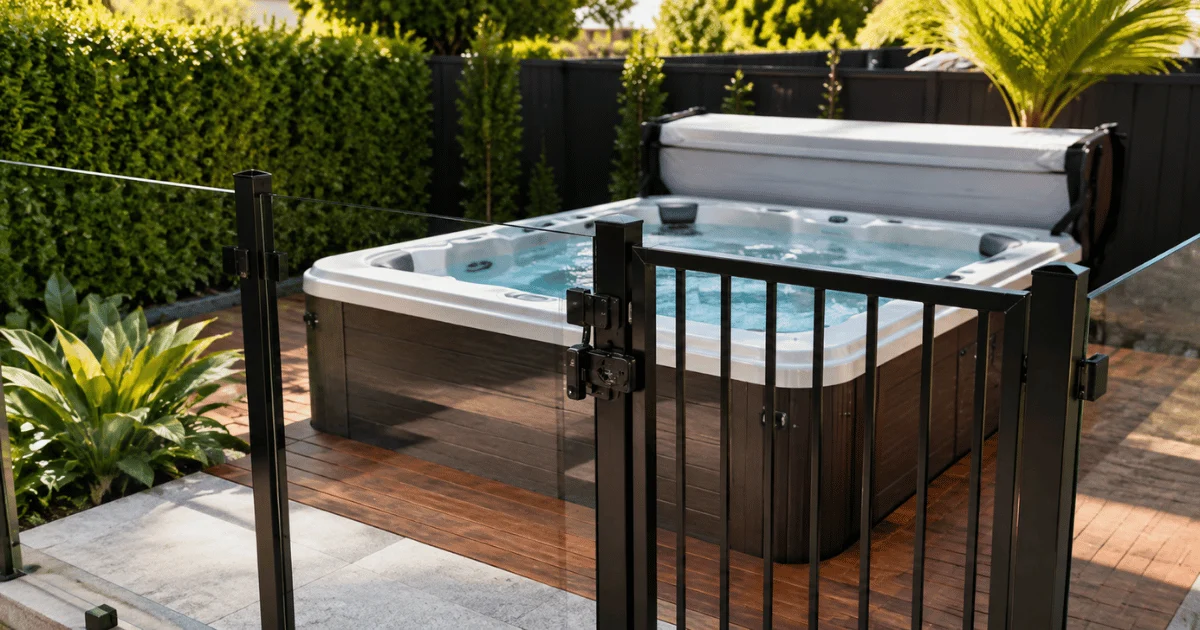
Spas in NSW do need a pool fence, unless the spa is covered and secured by a lockable child-resistant structure at all times when it is not in use. That alternative is set out in section 20 of the Swimming Pools Act 1992, and it is the only lawful way to skip the barrier.
The catch is that the exemption applies to a spa pool, and plenty of products sold as spas are not spa pools in the eyes of the law. Swim spas and plunge pools are the usual casualties.
At National Pool Safety, we inspect pool and spa barriers across Canberra, Queanbeyan, Googong, Jerrabomberra, Bungendore, Yass and Murrumbateman. Spa classification is the argument we have most often with owners, and it almost always starts the same way. A retailer told them a lockable cover was all they needed, and nobody checked whether their unit actually qualified as a spa pool.
Do Spas Need a Pool Fence in NSW?
Yes, unless a compliant lockable cover is fitted. Under section 20 of the Swimming Pools Act 1992, a spa pool is not required to be surrounded by a child-resistant barrier so long as access to the water is restricted, in accordance with the standards prescribed by the regulations, at all times when the spa pool is not in actual use.
That leaves two lawful routes:
- Fence the spa with a child-resistant barrier that complies with the Australian Standard applying to your installation, or
- Fit a lockable child-resistant structure such as a door, lid, grille or mesh, and keep it locked whenever the spa is not in use.
There is no third option. A spa cover that simply sits on top for heat retention is not a compliance measure. Neither is a spa on a raised deck, a spa inside a courtyard, or a spa that “the kids never go near”.
What the Lockable Cover Exemption Actually Requires
Clause 9 of the Swimming Pools Regulation 2018 sets the construction test. The lockable child-resistant structure must be well constructed and must not have an opening that a testing apparatus can pass through, and it must be securely fastened by a device that is itself well constructed and has no such opening.
What councils and certifiers look for
In practice, an assessment of a cover comes down to these points:
- It fully covers the water surface, with no gap a small child could get through
- It is rigid enough to bear weight without a child slipping underneath
- It has a genuine lock, not a clip, strap or buckle
- It can be removed, replaced and locked by one person, so it actually gets used
- It is locked every single time the spa is not in use
That last point is the one that fails in real life. A cover only provides protection while it is locked. An unlocked spa with a compliant cover is a non-compliant spa.
The material does not have to be hard. Mesh and fabric structures can qualify if they are child-resistant, load-bearing and cannot be lifted by a child. What matters is construction and child-resistance, not what the cover is made of.
Spa Pool or Swimming Pool? The Test That Decides Your Answer
This is the part most guides skip, and it is where the real answer lives. The exemption is available to a spa pool. If your installation is legally a swimming pool, you get no exemption and you must fence it.
Classification turns on design and use, not on the product name or the water volume. Assessors look at whether the unit is used for relaxation or hydrotherapy rather than swimming, whether it has swim jets or a swim current, whether it is large enough to swim, wade or paddle in, and whether it is a permanent installation or relocatable.
How one council applies the test
Some councils publish specific thresholds. Sutherland Shire Council will accept a lockable lid where:
- the spa is not for swimming, wading, paddling or any other aquatic activity
- the spa has no swim jet facilities and is not intended for swimming
- the spa is limited to a water surface area of 6.5 square metres, with no dimension at the water line greater than 3 metres
- the lid can be installed and locked in place by one person
Those are one council’s assessment criteria, not a statewide rule. Different councils apply different thresholds, and classification is decided locally. If your unit sits anywhere near the line, get it assessed before you install rather than after.
Swim Spas and Plunge Pools: The Trap Most Owners Fall Into
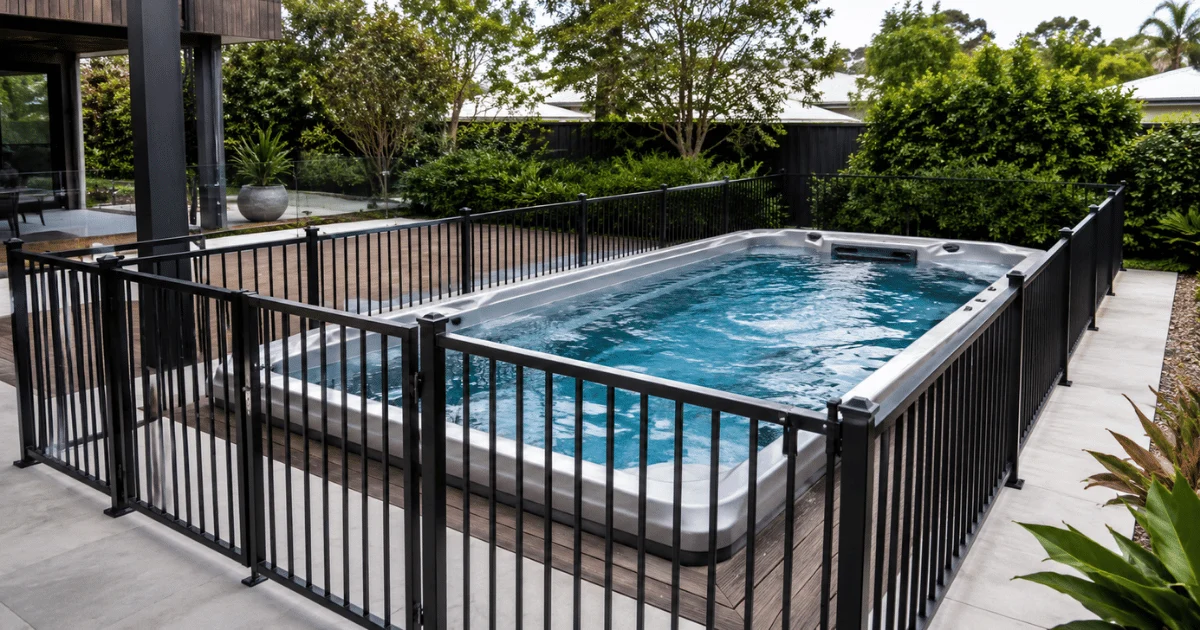
Swim spas almost never qualify for the exemption. A swim spa contains an area for swimming or aquatic play in addition to seating, so it can be used in much the same way as an above-ground swimming pool. That puts it in the swimming pool category, and it must be surrounded by a fully compliant child-resistant barrier.
The same logic applies to plunge spas and plunge pools marketed as spas. NSW council guidance is blunt on this point. Sutherland Shire states directly that swim spas and plunge pools do not qualify for a lockable lid under section 20 and require a four-sided barrier. Blue Mountains City Council puts it the same way. The word “spa” in a product name does not grant the exemption. It is the activity that can be undertaken in the water that decides.
This matters commercially, because a swim spa is often bought on the basis that no fence is needed. Owners discover otherwise at inspection, at sale, or when a council officer attends after a neighbour complaint. By then the spa is installed, the landscaping is finished, and retrofitting a compliant barrier costs far more than building it in from the start.
If you are shopping now, ask the retailer to put the classification in writing, then have it checked before you commit.
If You Fence Your Spa, What the Barrier Must Meet
Where a barrier is required, the spa is treated like any other regulated pool. The standard that applies depends on when the installation was built, with AS 1926.1-2012 applying to installations from 1 May 2013.
| Element | Requirement |
| Barrier height | At least 1200mm measured from finished ground level on the outside |
| Gap under the barrier | No more than 100mm |
| Gaps between vertical members | No more than 100mm |
| Non-climbable zone | 900mm clear of climbable objects |
| Gate | Self-closing and self-latching from any open position, swinging away from the spa area |
| Latch release height | At least 1500mm above ground, unless shielded |
Failures that are specific to spas
Spas are often placed on decks, next to retaining walls, or beside garden beds, and each of those can create a climbable point inside the non-climbable zone. Pergola posts, spa steps, pumps, heaters and storage boxes all count if they fall in the wrong place.
For a full breakdown, see our guides to pool barrier inspections and pool fence inspections, or the detail on pool barrier height requirements.
Do Spas Need a CPR Sign in NSW?
Yes. A resuscitation warning notice is required and must be legible from a distance of at least 3 metres. This applies whether your spa is fenced or relies on a lockable cover.
One narrow exception is worth knowing. The construction-phase sign reading “This swimming pool is not to be occupied or used”, required under clause 10 of the Swimming Pools Regulation 2018 while a pool is being built, specifically does not apply to spa pools. The resuscitation signage requirement still does.
A missing or faded CPR sign is one of the cheapest items on a defect list and one of the most common. Check yours is current, legible and correctly positioned before an inspection.
Do I Still Need to Register My Spa?
Yes. The lockable cover exemption removes the fence requirement. It does not remove anything else.
Every spa in NSW that can hold 30cm or more of water must be registered on the NSW Swimming Pool Register, and an unregistered spa attracts a $220 penalty notice. Registration is free and takes about 10 minutes. Our guide on how to register a pool in NSW walks through the form.
To sell a property with a spa you need a certificate of registration plus a certificate of compliance, a relevant occupation certificate or a certificate of non-compliance. To lease, a certificate of non-compliance is not enough. In NSW a certificate of compliance stays valid for three years.
Spa Rules if You Live Near the ACT Border
If you own property on both sides of the border, do not assume your arrangement travels with you.
The ACT runs its own home swimming pool safety reforms, commenced 1 May 2024, and spas are explicitly covered. Any spa associated with a residential building that can hold water deeper than 300mm falls within the scheme.
The ACT has a similar cover exemption, but it expires by build date
The ACT does provide a standing exemption for a spa that is covered and secured by a lockable child-resistant structure such as a door, lid, grille or mesh meeting the prescribed requirements. The wording closely tracks NSW. The difference is timing:
- Spa built before 1 May 2013: exemption available
- Spa built between 1 May 2013 and 30 April 2023: exemption available
- Spa built on or after 1 May 2023: exemption not available as a standing exemption, though a building certifier may approve a Performance Solution with a lockable child-resistant structure if it satisfies the National Construction Code
So a new spa installed in Canberra in 2024 cannot rely on a lid the way an identical spa in Queanbeyan can. That is the trap for cross-border owners.
Two things the ACT does that NSW does not
The ACT also offers a standing exemption for a spa on an apartment balcony where self-closing and self-latching doors or windows restrict access. NSW has no equivalent.
And on sale or lease, ACT owners relying on a standing exemption must disclose a statutory declaration of the standing exemption circumstances alongside the other prescribed information. Compliance certificates are lodged through Access Canberra, and spas built before 1 May 2013 must meet the prescribed safety standard by 1 May 2028.
If your spa is in the Territory, work from the ACT framework. Our page on ACT pool compliance requirements covers it.
Frequently Asked Questions
Q1. Do spas need a pool fence in NSW?
Answer: Yes, unless the spa is covered and secured by a lockable child-resistant structure at all times when it is not in use. That alternative comes from section 20 of the Swimming Pools Act 1992.
Q2. Does a spa cover count as a barrier?
Answer: Only if it is a lockable child-resistant structure that is well constructed, has no opening a testing apparatus can pass through, and is securely fastened by a compliant locking device. A standard insulating cover held on by clips or straps does not qualify.
Q3. Do swim spas need a fence in NSW?
Answer: Almost always yes. A swim spa contains an area for swimming or aquatic play, which places it in the swimming pool category, so a fully compliant child-resistant barrier is required.
Q4. Do plunge pools need a fence in NSW?
Answer: It depends on classification. A plunge pool designed and used for swimming or aquatic play must be fenced. Classification is assessed on design and use, not on the product name, so have it confirmed by your council or certifier.
Q5. Does a lockable cover mean I do not need to register my spa?
Answer: No. Registration is separate. Every spa holding 30cm or more of water must be registered on the NSW Swimming Pool Register, and a $220 penalty notice applies if it is not.
Q6. Do the same spa rules apply in the ACT?
Answer: Not quite. The ACT has a comparable lockable-cover exemption, but it is not available as a standing exemption for spas built on or after 1 May 2023. The ACT also has a balcony spa exemption that NSW does not.
Summary
Most of the confusion around spa fencing in NSW comes from one small mistake, which is treating “spa” as a legal category when it is really a marketing word. The law asks a different question: can this thing be swum in? If the honest answer is yes, you are fencing it, whatever the box said.
That is worth resolving before you spend money in either direction. Owners fence spas that never needed a fence, and skip fences on swim spas that always did, and both mistakes cost more to unwind than to prevent.
This is where an inspection earns its fee. National Pool Safety assesses your spa against the standard that actually applies to it, tells you plainly whether it qualifies for the section 20 cover exemption or needs a barrier, and issues your Certificate of Compliance through the NSW Swimming Pool Register once it passes. If it does not pass, you get a written report listing exactly what needs rectifying, so you are not guessing before the reinspection.
We work with homeowners, real estate agents, property managers, conveyancers and body corporate managers across the ACT and surrounding NSW, with inspections from $295 and reports back within 24 hours. If you are about to install a spa, book the assessment before the landscaping goes in. If you are selling or leasing, book before you list, because a barrier fault found the week before exchange is the most expensive way to find it.
Not sure which category your spa falls into? Book your spa and pool compliance inspection online, or call National Pool Safety on 02 6189 8455 and we will tell you straight.
This article covers NSW and ACT spa barrier requirements current at the date of last update. Classification is assessed by your local council or certifier and thresholds vary. This is general information, not legal advice.