To register a pool in NSW, go to the NSW Swimming Pool Register at swimmingpoolregister.nsw.gov.au, select Register Your Pool, enter your email address, and complete the property and pool details. Registration is free, and most owners finish the form in under 10 minutes.
Every pool and spa in NSW holding 30cm or more of water must be registered, including inflatable and portable pools, and unregistered pools attract a $220 penalty notice. Royal Life Saving Australia recorded 183 drowning deaths of children aged 0 to 4 across Australia between 2015 and 2025, with around 65 per cent occurring in swimming pools.
At National Pool Safety, we inspect pool barriers across Canberra, Queanbeyan, Googong, Bungendore, Yass and Murrumbateman. Registration is the question we field most often, and the one owners are most likely to get half right. They register, assume the job is done, then find at contract stage that a registration certificate is not a compliance certificate.
What Is the NSW Swimming Pool Register?
The NSW Swimming Pool Register is the state government database that records every backyard pool and spa in New South Wales. It was introduced under the Swimming Pools Amendment Act 2012 and is administered through Building Commission NSW.
The register does three jobs. It records the existence and basic details of your pool. It generates the official certificate of registration you need for a sale or lease. And it is the only place a valid certificate of compliance, certificate of non-compliance or registration certificate can be issued from.
Councils and registered certifiers use the register too. They look up inspection history, previous non-compliance reasons and current certificate status before attending a property. The answers you give at registration follow the property.
Do I Need to Register My Pool or Spa?
Yes. If the structure can be filled with water to a depth greater than 300mm and is used for swimming, wading, paddling or other aquatic activity, it must be registered in NSW. There is no exemption for size, price or how often you use it.
Pools and Spas That Must Be Registered
- In-ground swimming pools
- Above-ground swimming pools
- Spa pools, swim spas and plunge pools
- Portable and inflatable pools that hold 30cm or more of water
- Indoor pools
The portable pool rule catches the most people out. A $200 inflatable pool from a hardware store that holds more than 30cm of water is a regulated swimming pool under the Swimming Pools Act 1992, with the same registration and barrier obligations as a $60,000 in-ground pool.
The Spa Barrier Exemption Explained
Spas have one narrow difference. Under section 20 of the Swimming Pools Act 1992, a spa pool does not need to be surrounded by a child-resistant barrier as long as access to the water is restricted at all times when the spa is not in use. Clause 9 of the Swimming Pools Regulation 2018 sets the standard: the spa must be covered or secured by a child-safe structure such as a door, lid, grille or mesh, fastened by a device and free of any opening a 105mm test object can pass through.
That is a barrier exemption, not a registration exemption. The spa still has to be registered.
How to Register a Pool in NSW, Step by Step
Follow these six steps to register your pool or spa on the NSW Swimming Pool Register.
- Go to the register: Visit swimmingpoolregister.nsw.gov.au and select Register Your Pool.
- Enter your email address: The register emails you a link to the registration form. If you do not use email, ask a family member to receive the link on your behalf, or contact your council.
- Enter the property address: Use the address as it appears on your rates notice so the record matches council data.
- Answer the property and pool questions: These cover property type, land size, waterfront status, and the construction and modification dates for your pool. The full list is in the next section.
- Complete the safety self-assessment: You are asked to indicate whether, to the best of your knowledge, your pool complies with the standard that applies to it. The register provides a checklist for your pool type to help you answer.
- Download your certificate of registration: The register generates it immediately. Save a copy, because you will need it for any future sale or lease.
If You Cannot Register Online
Registration through the website is free. If you cannot use the online register, your council can register the pool on your behalf, though a fee of up to $10 may apply.
What Details Do You Need Before You Start?
Have these ready before you open the form.
| What the form asks | Why it matters |
| Property address | Links the pool to the correct council area |
| Property type: private residence, multi-occupancy such as units, or tourist and visitor accommodation | Multi-occupancy and tourist accommodation pools face mandatory council inspection at least every three years |
| Is the property on the waterfront | Waterfront properties may hold an older barrier exemption |
| Is the land larger than two hectares, or smaller than 230 square metres | Both sizes may hold an older barrier exemption |
| When the pool was built, from three date ranges | Determines which version of AS 1926 applies |
| Whether the barrier has been substantially modified or rebuilt, and when | A modification can cancel an older exemption |
Why the Build Date Matters Most
Getting the dates wrong is the most common reason a registration has to be corrected later, because the dates decide which safety standard your barrier is measured against.
The modification question deserves the same attention. If your pool barrier has been modified or altered, and this can include ordinary house or yard renovations, the current Swimming Pools Act 1992, Swimming Pools Regulation 2018 and AS 1926.1-2012 apply, and any previous exemption ceases. Owners routinely lose an exemption they did not know they had by rebuilding a deck or replacing a fence line.
Does Registering My Pool Make It Compliant?
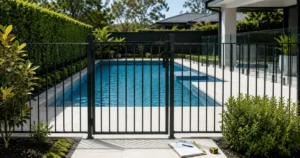
No. Registration and compliance are two separate things, and this is the single biggest misunderstanding about the NSW system.
Registration is a self-declaration. You tell the register your pool exists and give your own view on whether it meets the standard. Nobody inspects anything, and the register does not verify your answer.
Compliance is assessed separately, through a physical inspection by your local council or a registered private certifier. If the barrier passes, the certifier must issue a Certificate of Compliance within three days of the inspection. If it fails, they must issue a written notice under section 22E of the Swimming Pools Act 1992 and a certificate of non-compliance within seven days.
So a registered pool can be a non-compliant pool. Plenty are. A registration certificate on its own will not let you exchange contracts or sign a tenancy agreement.
In our inspection work across the ACT and southern NSW, the faults that most often stop a barrier passing are gate latches that no longer catch from every open position, gaps that have opened under a fence line as ground has moved, and climbable objects that have crept into the non-climbable zone. All three are things an owner can miss on a self-assessment, and none of them show up on the register.
Which Barrier Standard Applies to Your Pool?
The build date you enter at registration decides the standard your barrier is judged against. NSW currently runs three standards in parallel.
| Pool constructed | Standard that applies |
| Before 30 August 2008 | AS 1926-1986 |
| 1 September 2008 to 30 April 2013 | AS 1926.1-2007 |
| After 1 May 2013 | AS 1926.1-2012 |
If you are unsure which version your barrier was built to, a swimming pool barrier inspection in NSW will establish it against your construction date.
Barrier Rules by Construction Date
- Pools built before 1 August 1990: access to the pool from the house must be restricted at all times. Windows and doors can form part of the barrier, but they must be compliant.
- Pools built after 1 August 1990 but before 1 July 2010: the pool must be surrounded by a fence that separates it from the house. Exemptions may apply on properties under 230 square metres, properties of two hectares or more, and waterfront properties.
- Pools built from 1 July 2010: all new pools must be surrounded by a fence that separates the pool from the house, with no exemptions.
A Note on AS 1926.1:2024
AS 1926.1:2024 was approved on 7 August 2024 and published by Standards Australia on 23 August 2024. It is not in force in NSW.
Building Commission NSW has confirmed that under clause 5 of the Swimming Pools Regulation 2018 and the National Construction Code, certifiers must still assess against AS 1926.1:2012 including the NSW variations, and that use of the 2024 standard to assess compliance is not permitted. If an inspector quotes the 2024 standard at you, ask them to check.
What Happens if You Don’t Register?
An unregistered pool in NSW attracts a penalty notice of $220. Registration itself is free, so the fine is entirely avoidable.
The registration deadline for existing pools was 29 October 2013, so any pool that has never been registered is already overdue. Councils issue these notices during inspection programs, after complaints, and when a property transaction exposes the gap.
The bigger cost is usually the delay rather than the fine. Because a certificate of registration has to be attached to a contract for sale or a residential tenancy agreement, an unregistered pool discovered late in a sale can hold up exchange while registration, inspection and any rectification work are completed.
Registering a Pool Near the ACT Border
If you live in the NSW communities around Canberra, registration goes through the same statewide register regardless of your council. Knowing your council still matters for the inspection that follows.
Which Council Covers You
- Queanbeyan, Googong, Jerrabomberra, Karabar, Bungendore, Carwoola and Royalla sit in the Queanbeyan-Palerang Regional Council area.
- Yass, Murrumbateman and Gundaroo sit in the Yass Valley Council area.
- Sutton is split. The village sits in Yass Valley, while the surrounding area south of the Federal Highway falls under Queanbeyan-Palerang. Check your rates notice if you are unsure.
- Goulburn sits in the Goulburn Mulwaree Council area.
- Cooma sits in the Snowy Monaro Regional Council area.
ACT Properties Follow a Different Scheme
If you own property on both sides of the border, ACT rules are not the same as NSW rules. The ACT runs its own home swimming pool safety reforms, which commenced on 1 May 2024 with a four-year transition period. The ACT uses a separate compliance certificate framework lodged with government through Access Canberra, and all residential pools and spas must have a barrier meeting the prescribed safety standard by 1 May 2028.
A NSW registration does nothing for an ACT pool, and an ACT certificate does nothing for a NSW one. If your property is in the Territory, see our page on ACT pool compliance requirements.
What to Do After You Register
Registration is step one of three.
- Self-assess your barrier: Use the checklist the register provides for your pool type. Check the pool barrier height requirements, gaps under and between panels, the non-climbable zone, and that the gate self-closes and self-latches from any open position.
- Fix the obvious problems first: Gates and latches are the most common failure point, and they are usually the cheapest thing to fix before an inspector attends. A pool fence inspection will identify them before they cost you a certificate.
- Book a compliance inspection: A registered private certifier or your council inspects the barrier and issues the certificate. In NSW a certificate of compliance is valid for three years.
Selling or Leasing: What You Must Provide
If you are selling, you need a certificate of registration plus one of a certificate of compliance, a relevant occupation certificate, or a certificate of non-compliance.
If you are leasing, you need a certificate of registration plus a certificate of compliance or a relevant occupation certificate. A certificate of non-compliance is not enough to lease.
These sale and lease rules do not apply to properties with more than two lots and a shared pool, such as units in a strata complex or community scheme. Shared pools follow their own process, which we cover under strata and body corporate pool compliance.
Frequently Asked Questions
Q1. Is it free to register a pool in NSW?
Answer: Yes. Registering a pool or spa on the NSW Swimming Pool Register is free. If you cannot register online, your council can do it for you, and a fee of up to $10 may apply for that service.
Q2. Do I need to register an inflatable pool in NSW?
Answer: Yes. Any pool that can hold 30cm or more of water must be registered, including portable and inflatable pools. The same barrier requirements apply to them as to permanent pools.
Q3. Do I need to register a spa in NSW?
Answer: Yes. A spa must be registered even if it qualifies for the barrier exemption under section 20 of the Swimming Pools Act 1992. The lockable lid exemption removes the fence requirement, not the registration requirement.
Q4. How long does pool registration take?
Answer: Most owners complete the online form in under 10 minutes if they have their address, build date and property details ready. The certificate of registration is generated immediately.
Q5. Do I need to re-register my pool?
Answer: No. Registration is a one-off. What expires is your certificate of compliance, which is valid for three years in NSW. Update the register if ownership or pool details change.
Q6. How do I check if my pool is already registered?
Answer: Use the search function on the NSW Swimming Pool Register. It will show whether the property has a registration and whether a certificate has been issued.
Q7. How much does a pool compliance inspection cost in NSW?
Answer: Costs vary by certifier and location. National Pool Safety carries out barrier inspections from $295 across the ACT and surrounding NSW, with the report returned within 24 hours.
Summary
Registering a pool in NSW is free, takes about 10 minutes, and covers every pool or spa holding 30cm or more of water, inflatable and portable pools included. Skip it and you risk a $220 penalty notice.
But registration only tells the state your pool exists. It is a self-declaration with no inspection behind it, which is why a registered pool can still be a non-compliant pool. The certificate that actually clears a sale, a lease or a council inspection program is the Certificate of Compliance, and that comes from a physical barrier inspection by your council or a registered private certifier. In NSW it stays valid for three years.
That inspection is what we do. National Pool Safety inspects pool barriers, fences, gates and CPR signage against the standard that applies to your pool’s build date, and issues your Certificate of Compliance through the NSW Swimming Pool Register. If your barrier does not pass, you get a clear written report listing exactly what needs rectifying, so you are not guessing before the reinspection.
We work with homeowners, real estate agents, property managers, conveyancers and body corporate managers across the ACT and surrounding NSW, with inspections from $295 and reports back within 24 hours. If you are selling or leasing, book early. A barrier fault found the week before exchange is the most expensive way to discover it.
Ready to move from registered to certified? Book your pool compliance inspection online or call National Pool Safety on 02 6189 8455.
This article covers NSW registration and compliance requirements current at the date of last update. Requirements differ in the ACT. It is general information, not legal advice. For advice on your specific property, contact a registered certifier or your local council.