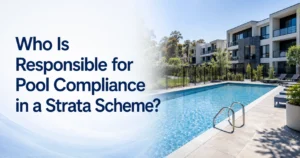
In a NSW strata or community scheme, the owners corporation is responsible for pool compliance when the swimming pool or spa is located on common property. The owners corporation must make sure the shared pool barrier, gate, fencing and required safety features are maintained and comply with the NSW Swimming Pools Act 1992.
For strata managers and committees, the practical challenge is keeping registration, inspections, maintenance and certificate dates organised. National Pool Safety provides strata and body corporate pool inspections across Canberra and surrounding NSW.
This guide explains responsibility, the three-year inspection cycle, certificate validity, sale and lease exemptions, and the different ACT framework.
This article is general guidance only and is not legal advice. For advice about a particular strata scheme, speak with an appropriately qualified strata professional or lawyer.
Key Takeaways
- The owners corporation is responsible for a pool or spa located on common property.
- Pool fencing, gates, CPR signage and surrounding safety areas form part of that compliance responsibility.
- NSW strata schemes with more than two lots must have common-property pools and spas inspected by the local council at least every three years.
- NSW pool compliance certificates are generally valid for three years.
- Pools and spas on common property must be registered.
- Lot owners in strata or community schemes with more than two lots are generally exempt from attaching the usual pool certificate documents when selling or leasing an individual lot.
- A certificate of non-compliance must not be issued for a common-property pool in a strata or community scheme with more than two lots.
- ACT strata and unit-title properties operate under a different pool safety framework.
Who Is Responsible for Pool Compliance in a Strata Scheme?
Where the swimming pool or spa is on common property, responsibility sits with the owners corporation.
The owners corporation represents all lot owners collectively and is responsible for managing and maintaining common property. That includes shared facilities such as swimming pools and spas.
For a common-property pool, the compliance responsibility can include:
- the pool fence or barrier
- gates and self-closing mechanisms
- gate latches
- CPR signage
- non-climbable zones
- surrounding common-property areas that affect the barrier
- maintenance of the barrier over time
The NSW Government’s official strata pool safety guidance confirms that owners corporations are responsible for shared pools and spas, and that these pools must be registered and inspected on the required cycle.
Where the pool sits wholly within an individual lot rather than common property, responsibility can be different. The strata plan should be checked before assuming the owners corporation is responsible for every pool within the development.
What Does the Owners Corporation Need to Maintain?
Pool compliance is an ongoing common-property responsibility. A barrier that passed several years ago can later develop problems through use, weather, landscaping or changes around the pool.
Common issues include self-closing gate failures, misaligned latches, damaged fencing, excessive gaps, climbable furniture or planters, vegetation and unreadable CPR signage.
Routine visual checks between formal inspections can help identify these problems early. National Pool Safety’s guide on why pools fail inspection explains the most common barrier and gate defects.
The Three-Year Strata Pool Inspection Rule
NSW strata schemes with more than two lots must have any swimming pool or spa inspected by the local council at least once every three years. This is one of the most important dates for strata committees and managers to track.
A practical approach is to keep the pool inspection cycle in the same compliance calendar used for other recurring building obligations. A current certificate of compliance also provides important evidence of the pool’s status.
If your committee is unsure when its current certificate expires, see our guide on how long a pool compliance certificate is valid.
In NSW, a Certificate of Compliance is generally valid for three years from its issue date.
Keeping the certificate period and inspection cycle visible makes it much easier to avoid discovering an expired certificate or overdue inspection at the wrong time.
Pool Registration: Who Is Responsible?
Shared swimming pools and spas also need to be registered.
For a pool on common property, registration is handled for the scheme rather than separately by every individual lot owner.
The registration certificate should be retained with the owners corporation’s other important compliance records.
Keep the registration certificate, current compliance certificate, inspection reports, rectification records and next inspection date together in the scheme records.
If the pool has not been registered or the committee is unsure of the process, see our guide on how to register a pool in NSW.
Registration records the pool; certification relates to whether the barrier met the applicable safety requirements when inspected.
How Long Is a Strata Pool Compliance Certificate Valid?
A NSW swimming pool Certificate of Compliance is generally valid for three years from the date of issue.
That means a strata committee should record the issue date as soon as the certificate is received and schedule a review well before it reaches the end of its validity period.
Certificate expiry does not mean the pool becomes unregistered. Registration and certification are separate. It also does not automatically mean the pool barrier has failed. It means the existing certificate is no longer within its normal validity period. Where current certification is needed, a new inspection may be required.
Our dedicated guide on pool compliance certificate validity explains NSW expiry, renewal and the different ACT validity rules in more detail.
Selling or Leasing a Lot in a Strata Scheme
This is one of the areas that causes the most confusion. For ordinary NSW residential properties with pools, prescribed pool documents are important when selling or leasing. However, there is an exemption for individual lots in certain strata and community schemes.
Where a strata or community scheme contains more than two lots, the usual requirement to attach pool-related compliance documentation to the individual lot’s sale contract does not apply in the same way.
However, this exemption does not remove the owners corporation’s responsibilities. The shared pool still needs to be registered, maintained, inspected on the required cycle and kept compliant. For a broader explanation of NSW property-sale requirements, see our guide on whether you need a pool certificate to sell a house.
Can a Certificate of Non-Compliance Be Issued for a Strata Pool?
For a pool on common property in a strata or community scheme with more than two lots, a certificate of non-compliance must not be issued. This is different from the pathway available when selling many ordinary residential properties.
For a standard house, a certificate of non-compliance can in certain circumstances be used as part of a sale, with rectification responsibility transferring to the purchaser after settlement.
That transfer mechanism does not fit a common-property pool because the pool remains collectively owned and managed by the owners corporation.
This makes early inspection useful. The committee can identify the required work, obtain quotes and approve expenditure before the issue becomes urgent.
What Happens if a Strata Pool Fails Inspection?
A failed inspection does not necessarily mean major reconstruction is required.
Common issues include gate or latch problems, climbable objects, excessive gaps, damaged fencing, vegetation and CPR signage.
The inspection report gives the owners corporation a starting point for rectification, after which the pool can be reassessed as required.
See why pools fail inspection for common defects, and our pool compliance certificate cost guide when planning inspection and certification expenses.
Section 106 and Common-Property Maintenance
The owners corporation’s pool responsibilities sit within its broader duty to maintain common property.
Section 106 of the Strata Schemes Management Act 2015 requires an owners corporation to properly maintain and keep common property in a state of good and serviceable repair.
For a shared pool, this means committees should treat the barrier as an ongoing safety asset rather than something checked only when a certificate is needed.
Good records-inspection reports, certificates, repair invoices, photographs and committee decisions-help show that the scheme is actively managing the barrier.
What About Strata and Unit-Title Pools in the ACT?
Canberra schemes operate under a different framework from NSW strata properties.
The ACT home swimming pool safety reforms commenced on 1 May 2024 and include regulated pools and spas associated with residential properties. A major transition date is 1 May 2028.
For relevant older pools, particularly those built, altered or installed before 1 May 2013, certification requirements need to be considered before the end of the transition period. ACT certificate validity also differs from the NSW three-year rule.
If your scheme is in Canberra, use our complete ACT pool compliance deadline guide rather than applying NSW strata rules.
Practical Strata Pool Compliance Checklist
A simple system can prevent administrative gaps:
- Confirm ownership: check whether the pool and barrier are common property.
- Confirm registration: keep registration evidence in the scheme records.
- Record certificate expiry: NSW compliance certificates are generally valid for three years.
- Schedule inspections: add the next inspection date to the compliance calendar.
- Check gates regularly: self-closing and self-latching faults can develop gradually.
- Watch the non-climbable zone: residents may move furniture or planters near the barrier.
- Keep rectification records: store reports and evidence that identified defects were addressed.
- Budget for maintenance: treat gates, latches, fencing and signage as planned common-property items.
National Pool Safety’s strata and body corporate inspection service is designed for managers and owners corporations responsible for shared pools.
Frequently Asked Questions
Q1: Who Is Responsible for Pool Compliance in a Strata Scheme?
The owners corporation is responsible where the pool or spa is located on common property. Where a pool is located within an individual lot, responsibility may sit with that lot owner.
Q2: How Often Must a NSW Strata Pool Be Inspected?
Strata schemes with more than two lots must have the pool or spa inspected by the local council at least once every three years.
Q3: How Long Is a NSW Pool Compliance Certificate Valid?
A NSW Certificate of Compliance is generally valid for three years from the date of issue.
Q4: Who Registers a Strata Pool?
Where the pool is on common property, registration is handled for the scheme and the registration documentation should be retained by the owners corporation.
Q5: Do I Need a Pool Certificate to Sell a Strata Unit?
If the strata or community scheme contains more than two lots, the usual pool-document requirement does not apply to an individual lot sale in the same way.
Schemes with two lots or fewer should confirm their position.
Q6: Can a Certificate of Non-Compliance Be Issued for a Common-Property Pool?
Not where the common-property pool is in a strata or community scheme containing more than two lots.
Q7: Does the Three-Year NSW Rule Apply in the ACT?
No. ACT pools operate under a different compliance framework. Canberra owners corporations should follow the ACT requirements rather than applying NSW certificate and inspection rules.
Q8: What Should a Strata Manager Keep on File?
Keep registration documents, current and previous certificates, inspection reports, rectification records and the next scheduled inspection date.
Conclusion: Make Pool Compliance Part of the Strata Calendar
For a swimming pool or spa on common property, the owners corporation is responsible for keeping the pool compliant.
NSW strata schemes with more than two lots need to track the three-year council inspection cycle, keep the pool registered and maintain the barrier between inspections. The individual-lot sale or lease exemption does not remove the owners corporation’s duty to manage the common-property pool.
National Pool Safety works with strata managers, owners corporations, body corporate managers, real estate agents and property managers across Canberra and surrounding NSW. We inspect shared pool and spa barriers and provide clear information about any rectification required.
If you manage a strata or body corporate property with a pool, National Pool Safety’s strata and body corporate inspection service can help you keep the inspection cycle organised.
Ready to check your shared pool barrier? Book your strata pool inspection or call National Pool Safety on 02 6189 8455.