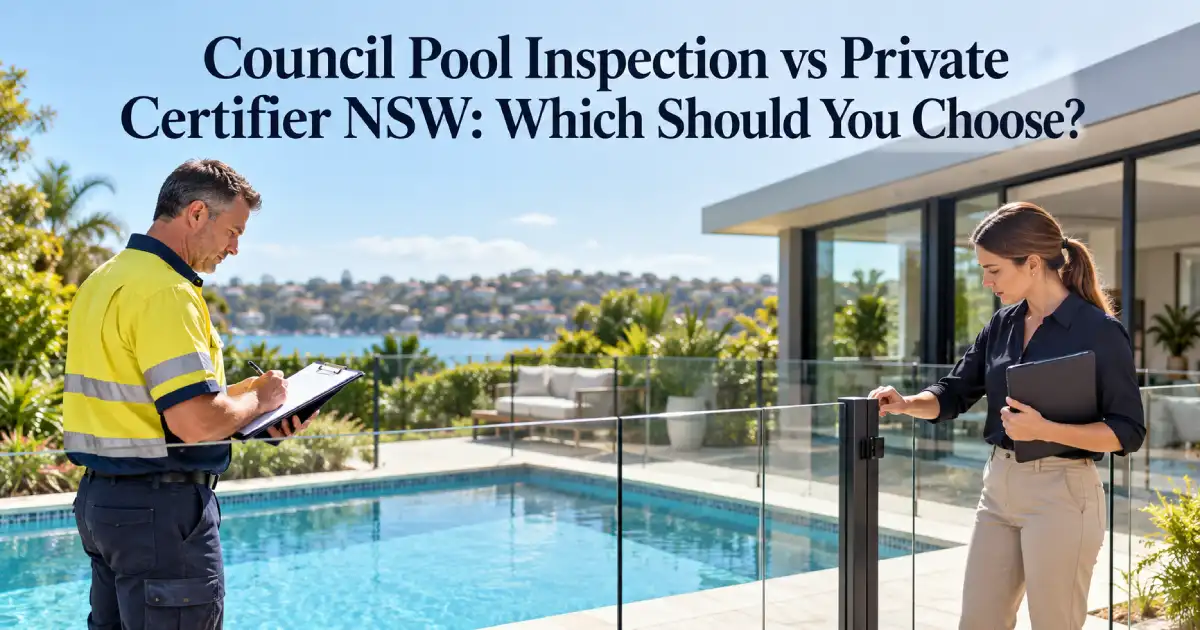
Both a council and a registered private certifier can inspect an existing NSW pool and issue a Certificate of Compliance. Council usually suits owners prioritising regulated inspection fees. A private certifier can suit owners wanting to choose their inspector and arrange an owner-requested inspection.
The right choice also depends on your pool. Certain performance solutions require council or a private certifier with a suitable building-surveyor registration.
The NSW Government pool safety guidance confirms both pathways. This guide compares their authority, fees, non-compliance process and practical differences.
National Pool Safety provides registered pool barrier inspections across Canberra’s surrounding NSW areas.
Key Takeaways
- Both councils and appropriately registered private certifiers can issue NSW pool compliance certificates.
- Council inspection fees are legally capped.
- Private certifier fees are set by the provider.
- Both must assess the applicable NSW pool safety requirements.
- A private certifier remains an independent public official.
- Some performance-solution pools need a higher class of certifier.
- Private non-compliance can still be referred to the local council.
- Check a private certifier’s registration before appointing them.
Council vs Private Certifier
Here is the main difference between the two inspection pathways.
| Factor | Council | Private Certifier |
| Can inspect pool barriers | Yes | Yes, with correct registration |
| Can issue compliance certificate | Yes | Yes |
| First inspection fee | Maximum $150 | Provider sets fee |
| Later inspection fee | Maximum $100 under current regulation | Provider sets fee |
| Choose individual inspector | Usually limited | Yes |
| Booking arrangements | Council dependent | Provider dependent |
| Performance solutions | Council can assess | Registration class matters |
| Non-compliance enforcement | Council has enforcement powers | May refer unresolved matters to council |
Neither pathway provides an easier safety standard. The pool must meet the requirements applying to its construction date and barrier configuration.
What Does Council Inspect?
A council pool inspection assesses whether the swimming pool barrier complies with NSW legislation and the applicable safety standard.
The inspection can include:
- pool fencing;
- gates and latches;
- fence openings;
- non-climbable zones;
- boundary barriers;
- doors or windows where applicable;
- required safety signage.
Councils also have broader regulatory responsibilities. They investigate complaints, operate inspection programs and can direct owners to address non-compliant barriers.
Choosing council therefore means dealing directly with the local authority responsible for pool-safety enforcement.
What Does a Private Certifier Do?
A registered swimming pool certifier can inspect a pool at the owner’s request and issue the required certificate.
The NSW Government certifier guidance says existing swimming pools can be certified by a swimming pool inspector or local council.
Private certifiers are not simply consultants hired to approve whatever an owner wants.
NSW considers registered certifiers independent public officials. They must act in the public interest and only certify work that satisfies the applicable requirements.
Before booking, check the inspector through the NSW Building Certifiers Public Register.
National Pool Safety provides swimming pool barrier inspections in NSW for properties across Queanbeyan, Googong, Jerrabomberra, Yass, Bungendore and surrounding areas.
Which Option Costs Less?
Council generally has the lower regulated headline fee.
Under the current Swimming Pools Regulation 2018, a local authority can charge a maximum of:
- $150 for the relevant first inspection; and
- $100 for relevant subsequent inspections.
Private certifier charges are not subject to that council inspection cap. Each provider sets its own pricing.
Price should still be compared on the complete service.
Ask whether the quoted fee includes the inspection, report, certificate, register lodgement and any reinspection.
National Pool Safety’s guide to pool compliance certificate costs explains these costs separately.
Is a Private Certifier Faster?
There is no NSW rule guaranteeing that private certifiers are faster than councils.
Actual timing depends on availability, location and the provider.
However, private certification lets the owner select a registered provider and contact them directly for an appointment. Council availability depends on that council’s inspection process and workload.
For an upcoming sale or tenancy, contact your chosen inspector early.
Do not wait until exchange, settlement or a tenancy start date before finding out whether the barrier needs repairs.
Is Council More Strict?
No official standard says council should be stricter than a private certifier.
Both pathways assess compliance against the law and safety requirements applying to the pool.
An inspector should not pass:
- a gate that fails to self-close;
- an ineffective latch;
- excessive barrier gaps;
- prohibited climbing opportunities;
- another material barrier defect.
The better question is whether the inspector holds the right authority and applies the correct standard. For common defects, see why pools fail inspection.
What if the Pool Fails?
Both pathways can result in a finding of non-compliance.
A private certifier must provide the required documentation when the pool fails. If the problems remain unresolved, the matter can later reach the local council.
NSW Government guidance says a private certifier must notify council immediately where the pool presents a significant public-safety risk.
For other unresolved non-compliance, notification requirements apply after the statutory rectification period.
Our guide to a pool Certificate of Non-Compliance NSW explains the process after a failed private inspection.
Using a private certifier therefore does not provide a way to avoid council involvement indefinitely.
What About Performance Solutions?
This is an important exception.
A registered swimming pool inspector cannot certify a pool where compliance relies on a performance solution.
NSW Government guidance says these pools may require:
- the local council;
- a building surveyor unrestricted;
- a building surveyor restricted for all building classes; or
- in limited cases, another permitted building-surveyor class.
The exact private-certifier authority depends on the performance solution involved.
If your pool uses an unusual barrier design or documented performance solution, explain this before booking.
Do not assume every private pool inspector has authority to certify every pool.
When Should You Choose Council?
Council can be a sensible choice when:
- regulated inspection cost is your main concern;
- you are not working to a tight transaction schedule;
- council is already inspecting the pool;
- the pool has a performance solution requiring suitable authority;
- you prefer to work directly with the local authority.
Check your council’s actual fee and booking process first.
The legislation sets maximum inspection fees, not identical service arrangements across every council.
When Should You Choose a Private Certifier?
A private certifier can be a practical choice when:
- you want to select your inspector;
- you need an owner-requested compliance inspection;
- you want to discuss appointment availability directly;
- you are preparing for a sale or lease;
- you want one provider handling inspection and certification.
Registration remains essential.
The Service NSW swimming pool certifier requirements confirm that a person must hold appropriate registration to inspect pool barriers and issue compliance certificates.
National Pool Safety is listed on the NSW Swimming Pool Register’s private certifier list under swimming pool inspector registration BDC 3002.
How Should You Choose?
Use these five questions before appointing anyone:
- Is the inspector authorised for my pool?
Check their registration and any restrictions. - What does the fee include?
Ask about reports, certificates and reinspections. - When can the inspection occur?
Confirm availability before relying on a transaction deadline. - Does my pool use a performance solution?
If yes, confirm the certifier’s registration class. - What happens if the pool fails?
Understand the rectification and reinspection process beforehand.
The cheapest initial appointment is not always the most useful option for every owner.
Getting a Compliance Certificate
Whichever pathway you choose, the goal remains the same.
The pool barrier must satisfy the requirements applying to that property before a Certificate of Compliance can be issued.
NSW compliance certificates generally remain valid for three years, provided no event causes the certificate to cease earlier.
National Pool Safety provides Swimming Pool Certificate of Compliance NSW services for eligible NSW properties after a successful inspection.
Frequently Asked Questions About Council Pool Inspection vs Private certifier
Q1: Can a private certifier issue a pool certificate in NSW?
Yes. An appropriately registered swimming pool certifier can inspect an existing pool and issue a Certificate of Compliance when it passes.
Q2: Is council cheaper than a private pool certifier?
Council inspection fees are legally capped at specified amounts. Private certifiers set their own fees, so compare the full service before choosing.
Q3: Is a private certifier less strict than council?
No. Both must assess the pool against the applicable legal safety requirements.
Q4: Can council inspect after a private certifier?
Yes. Council can become involved in unresolved non-compliance, complaints or significant safety risks.
Q5: Can any private certifier inspect my pool?
No. The person needs the appropriate registration. Pools using performance solutions can require a different certifier class.
Which Should You Choose?
For council pool inspection vs private certifier NSW, neither option is automatically better for every property.
Choose council when regulated fees or direct council involvement suit your situation. Choose a registered private certifier when selecting your own inspector and arranging an owner-requested service matters more.
Need your NSW pool barrier professionally assessed? National Pool Safety can inspect the barrier, explain any identified compliance issues and complete the certification process where the pool meets the applicable requirements.