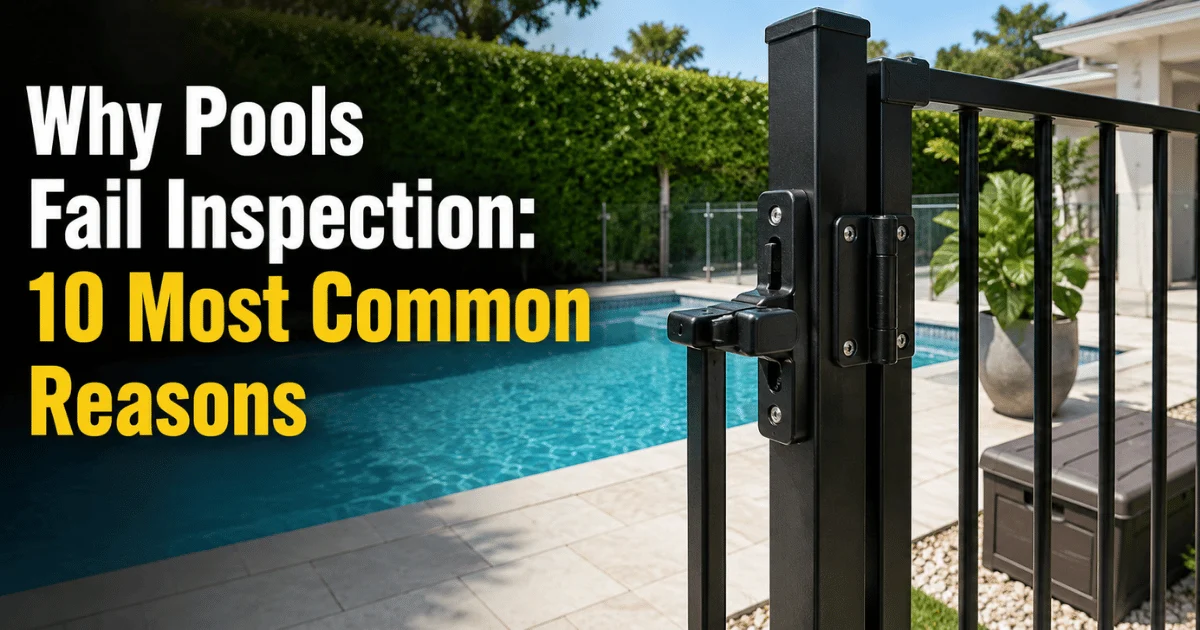
Pools fail inspection most often on the gate. Self-closing and self-latching faults top almost every certifier’s defect list, followed closely by climbable objects sitting inside the non-climbable zone. Both are usually fixable in an afternoon, and both are avoidable before an inspector attends.
That is the frustrating part. The overwhelming majority of failures are not structural. The fence is fine. The barrier is the right height. What fails is a hinge that loosened over a summer, a pot plant that moved six months ago, or a CPR sign faded past legible.
There is a legal reason this happens. Under section 15 of the Swimming Pools Act 1992 a child-resistant barrier must be kept in good repair, and under section 16 access to the pool must be kept securely closed. Most failures breach one of those two, not the original design. That is why a pool that passed three years ago can fail today with nothing visibly changed.
At National Pool Safety, we inspect pool and spa barriers across Canberra, Queanbeyan, Googong, Jerrabomberra, Bungendore, Yass, Murrumbateman, Goulburn and the surrounding NSW region. We would rather you passed on the first visit than paid us twice, so this guide is written to be used before you book.
The 10 Most Common Reasons Pools Fail Inspection
1. The gate does not self-close from every position: A gate must close and latch from any open position, including pushed to just a few centimetres. Most owners test from wide open, where gravity does the work. Certifiers test from barely open, where a tired hinge gives up. This is the leading failure we see, and a hinge tension adjustment is usually a short job.
2. The latch is too low or does not engage reliably: The release must sit at a height a small child cannot reach, and it must catch every time rather than most times. A latch needing a lift or a nudge is a fail.
3. Climbable objects inside the non-climbable zone: The 900mm zone outside the barrier must stay clear. BBQs, pot plants, garden beds, storage boxes, deck chairs, firewood, air conditioning units and children’s toys all cause failures. This is the most common owner-created defect and it costs nothing to fix.
4. A gap under the fence: Ground settles and mulch washes away, so a gap that was compliant when the fence went in gradually opens past the 100mm limit. Erosion on a sloping yard is the usual cause. Our pool fence inspection service covers what is assessed.
5. New structures built inside the barrier line: A pergola, shed, carport or deck added after the original approval often ends up inside the pool area or creates a climbing point. Worse, building work that alters the barrier can cancel an older exemption entirely and bring the current standard into effect.
6. Windows that open too far onto the pool area: Where a house wall forms part of the barrier, openable windows must be restricted to 100mm, fully screened, or have their lowest sill at least 1800mm above the floor. Louvres and insect flyscreens are the usual culprits. Our guide on whether a door can open onto a pool area covers the detail.
7. Pet doors and wall openings: A pet door installed years after approval is an immediate fail. So is a gap left after a pipe or cable was run through a wall forming part of the barrier. Nothing over 100mm is permitted.
8. Missing, faded or badly placed CPR sign: The resuscitation warning notice must be present, legible and readable from at least 3 metres. Sun-faded signs are extremely common and among the cheapest items to replace.
9. Boundary fence height: Where a boundary fence forms part of the barrier, pools built before 1 September 2008 need at least 1200mm and pools built after that date need at least 1800mm. Owners routinely assume 1200mm applies everywhere. This one is harder to fix because it involves a shared fence and a neighbour, so start on it first.
10. Spa covers that are not actually lockable: Where a spa relies on a cover instead of a fence, the cover must be a lockable child-resistant structure and it must be locked. A cover held on by clips or straps is not a compliance measure. Our guide on spa pool fence rules in NSW explains the exemption.
For the measurement requirements behind these items, see our post on pool barrier height requirements.
What Happens if Your Pool Fails
Nothing dramatic happens on the day. If your barrier does not comply, the certifier must issue a written notice under section 22E of the Swimming Pools Act 1992 and a certificate of non-compliance within seven days of the inspection. The notice lists the specific defects that need rectifying.
That is not a fine and it is not an enforcement action. It is a defect list. You fix the items and arrange a reinspection.
One exception applies. If the inspector forms the view that the pool poses a significant risk to public safety, the local council must be notified immediately. In practice that means an unsecured pool with no working barrier, not a low latch.
If your pool passes, the certifier must issue the certificate of compliance within three days. In NSW it stays valid for three years.
The Six-Week Window Most Owners Do Not Know About
Where an owner fails to rectify the non-compliances, a copy of the section 22E notice goes to the local council within five days after the expiry of six weeks from the date of inspection.
Read that in reverse. From the day of your inspection you have roughly six weeks to fix the defects and get reinspected before your council receives a copy. Fix them inside that window and the matter stays between you and your certifier.
Six weeks is enough for almost any gate repair, sign replacement or clearing of the non-climbable zone. It is not enough for a new boundary fence if you also need to negotiate with a neighbour, which is why item nine is the one to start on immediately.
What a Reinspection Costs
Through a NSW council, reinspection fees are capped by law at $100 for each inspection after the first. Councils can charge that for every subsequent visit until a certificate is issued, so a pool failing repeatedly gets expensive.
Private certifiers set their own reinspection policy. Some include one return visit, some charge a reduced rate, some charge full price. Ask before you book, not after you fail.
The rectification work is usually the larger number. A gate service call typically runs in the low hundreds. Structural work is priced by whoever does it. Our full breakdown is in how much a pool compliance certificate costs.
Can You Still Sell or Lease With a Failed Pool?
For a sale, yes. For a lease, no. A certificate of non-compliance can be attached to the contract for sale, transferring the obligation to the buyer, who then has 90 days from settlement to rectify the listed defects and obtain a certificate of compliance.
Leasing is different. A certificate of non-compliance is not sufficient. You need a certificate of compliance or a relevant occupation certificate, plus the certificate of registration.
In practice most sellers rectify rather than sell on a non-compliance certificate, because buyers price the defect list into their offer and usually price it higher than the actual repair.
How to Pass First Time
Half an hour of preparation removes most of the failure list.
- Test the gate from barely open. Push it to a few centimetres from the latch and let go. If it does not close and latch on its own, that is your first job.
- Walk the outside of the barrier and clear 900mm. Move everything. Pot plants, furniture, the bin, the hose reel, the scooter.
- Check the ground line for gaps where soil or mulch has washed away.
- Read your CPR sign from three metres. If you have to squint, replace it.
- Check every door and window facing the pool area.
- Look up. Anything built near the barrier since the last inspection deserves a second look.
The NSW Swimming Pool Register publishes self-assessment checklists by pool type. Working through the right one mirrors what an inspector will do.
Frequently Asked Questions
Q1. Why do pools fail inspection most often?
Answer: The gate. Self-closing and self-latching faults are the leading cause, followed by climbable objects inside the 900mm non-climbable zone.
Q2. What happens if my pool fails inspection?
Answer: The certifier must issue a written notice under section 22E of the Swimming Pools Act 1992 and a certificate of non-compliance within seven days. You rectify the listed defects and arrange a reinspection.
Q3. How long do I have to fix pool defects?
Answer: Around six weeks from the inspection date. If the defects are not rectified, a copy of the section 22E notice goes to your council within five days after the expiry of six weeks.
Q4. Does a failed inspection mean a fine?
Answer: No. A defect notice is not a penalty notice. Fines apply separately, for example $220 for an unregistered pool and $550 for a pool without a compliant barrier.
Q5. Can I sell my house if my pool failed inspection?
Answer: Yes. A certificate of non-compliance can be attached to the contract for sale, and the buyer has 90 days after settlement to rectify the defects.
Q6. My pool passed three years ago, why would it fail now?
Answer: Barriers degrade. Hinges lose tension, ground settles, and objects get placed near the fence. Section 15 requires the barrier to be kept in good repair, so a barrier that has drifted out of condition fails even though nothing was rebuilt.
Conclusion: Almost Every Failure Is Preventable
There is no mystery to this list. Gates, clutter near the fence, a faded sign, a gap where the mulch washed out. Certifiers see the same handful of items property after property, and the reason is not carelessness. Barriers quietly stop working, and nothing tells you until someone tests them.
That is the useful reframe. A failed inspection is not a judgement on your pool. It is a maintenance report you were always going to need, delivered at the least convenient possible moment if you leave it until a sale is under way.
National Pool Safety inspects your barrier against the standard that applies to your pool’s build date and issues your Certificate of Compliance through the NSW Swimming Pool Register once it passes. Where it does not, you get a written report listing exactly what needs rectifying, in language you can hand straight to a gate technician or a fencer.
We work with homeowners, real estate agents, property managers, conveyancers and body corporate managers across the ACT and surrounding NSW, with inspections from $295 and reports back within 24 hours. Six weeks of rectification window is generous. Six days before exchange is not.
Want to know what your pool would fail on today? Book your pool compliance inspection or call National Pool Safety on 02 6189 8455.
This article covers NSW requirements current at the date of last update. ACT requirements differ. General information, not legal advice.