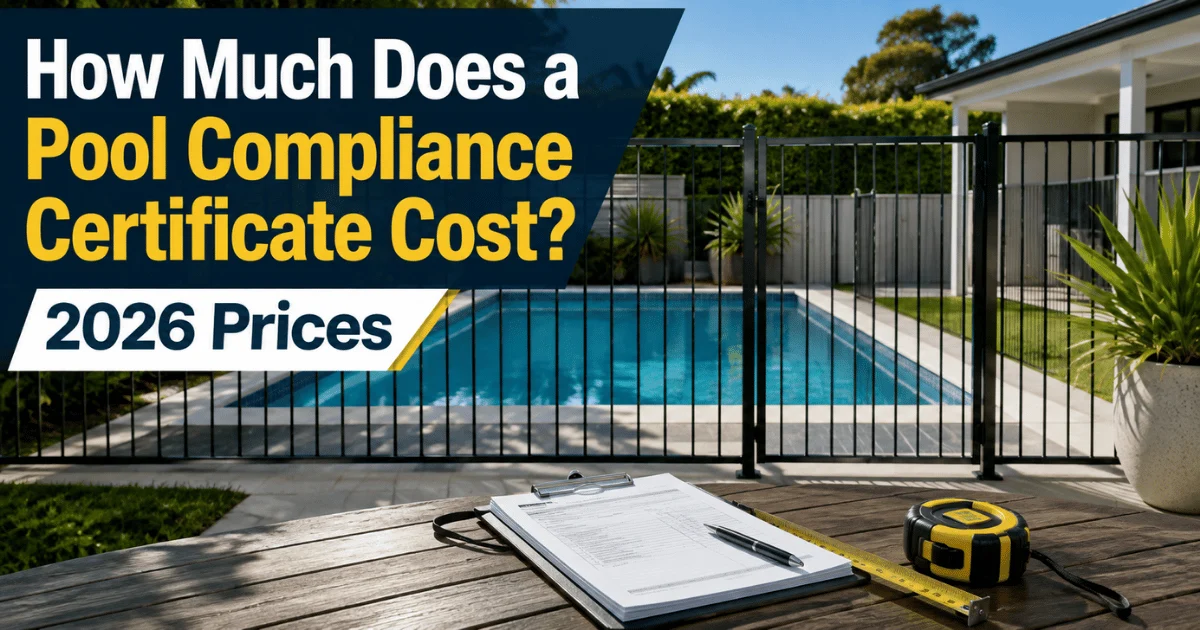
A pool compliance certificate costs up to $150 through a NSW council, because that fee is capped by law and includes the certificate itself. A private certifier in NSW typically charges between $280 and $350. In the ACT, where there is no legislated cap, published prices generally range from $295 to $395 depending on the inspector and the travel involved.
Registration is separate and free. Every pool holding 30cm or more of water must be registered on the NSW Swimming Pool Register, and you can do that yourself online at no cost. If you ask your council to register it for you, a fee of up to $10 may apply.
Most owners are surprised the certificate is not the expensive part. It rarely is. The cost that actually bites is the rectification work after a failed inspection, plus the reinspection fee to come back and check it.
At National Pool Safety, we carry out pool barrier and compliance inspections across Canberra, Queanbeyan, Googong, Jerrabomberra, Bungendore, Yass, Murrumbateman, Goulburn and the surrounding NSW region. The question we get before almost every booking is what the total will come to, and the honest answer depends less on our fee than on the state of the gate.
NSW Council Fees Are Capped by Law
Under clause 19 of the Swimming Pools Regulation 2018, there is a legal maximum a NSW council can charge for a swimming pool barrier inspection.
| Inspection | Maximum council fee |
| First inspection since you became the owner | $150 |
| Each subsequent inspection after that first one | $100 |
| First inspection since your Certificate of Compliance expired | $150 |
| Each subsequent inspection after that | $100 |
Three things follow from this
The fee includes the Certificate of Compliance. You are not charged separately for the document if the pool passes.
It is a cap, not a set price. Some councils charge less than the maximum, and some stop charging entirely after the second inspection. Several councils also apply pensioner discounts for holders of eligible concession cards. Check your own council’s fees and charges schedule rather than assuming $150.
The cap applies per inspection, not per job. If your pool fails twice, you pay the first inspection fee plus two reinspection fees. Councils are entitled to charge for each subsequent inspection until a certificate is issued, so a pool with real problems can quietly climb past private certifier pricing.
What a Private Certifier Charges in NSW
Private certifiers registered to issue swimming pool certificates set their own fees, with a flat rate of roughly $280 to $350 typical for a residential inspection in NSW.
That usually covers the site visit, the written report, the certificate and lodgement on the NSW Swimming Pool Register.
National Pool Safety inspections start from $295, with reports back within 24 hours. Our Certificate of Compliance service sets out what that includes.
The price difference against council is real, but so is the difference in what you get. Private certifiers generally book faster, attend at a time you choose, and issue the certificate within days rather than waiting on a council program schedule. Where you are working to a settlement date, that timing is usually worth more than the fee gap.
What It Costs in the ACT
The ACT has no legislated fee cap, so prices are set by the market. Published Canberra prices generally sit between $295 and $395 for a compliance certificate.
The ACT works differently from NSW. Certificates are issued by authorised persons appointed under the ACT scheme rather than through a council inspection program, and there is no clause 19 equivalent limiting what can be charged.
The upper end of the range usually reflects travel allowance for properties outside the city centre, larger or more complex barriers, or same-day certificate issue. Reinspection fees are quoted separately and vary widely.
What to ask for in an ACT quote
Because there is no cap, comparing quotes matters more in the ACT than it does in NSW. Ask specifically whether the quote includes:
- The written defect report
- The certificate itself
- Lodgement with Access Canberra
- Any reinspection, and at what price
- Travel, if you are outside Canberra
If your property is in Canberra rather than across the border, our ACT pool compliance guide explains the scheme, including the 1 May 2028 barrier compliance deadline.
Council or Private Certifier: Which Is Cheaper?
On the headline fee, council is cheaper in NSW. On the total cost of getting to a certificate, it is closer than it looks.
| NSW council | NSW private certifier | |
| First inspection | Up to $150, capped by law | Typically $280 to $350 |
| Reinspection | Up to $100 each, uncapped in number | Varies, some include one |
| Certificate included | Yes | Usually yes |
| Booking speed | Depends on council program | Usually within days |
| Choice of time | Limited | Usually flexible |
| Written defect report | Varies by council | Usually detailed |
The decision usually comes down to time pressure. If you have months before a sale and a pool you are confident about, council is the cheaper route. If you are inside a settlement window, or you suspect the barrier has issues and want a report you can hand to a tradesperson, a private certifier is generally better value even at a higher fee.
Note that the council route is only available in NSW. In the ACT there is no council inspection program for home pools, so an authorised person is the only option.
What the Quoted Price Does Not Include
Almost every complaint about pool inspection cost comes from something outside the quoted fee.
Rectification work. Gates and latches are the most common failure, and a gate service call is often in the $150 to $250 range. Anything structural, such as a new fence panel, a glazier, or removing a climbable object, is priced separately by the trade doing it.
Reinspection. In NSW, council can charge up to $100 for each subsequent inspection. Private certifiers vary. Some include one reinspection in the original fee, some charge a reduced rate, some charge full price. Ask before you book.
Travel. Properties well outside the main service area can attract a travel allowance. This shows up most on Goulburn, Cooma and rural Southern Tablelands jobs.
Multiple pools or spas. A property with both a pool and a separate spa is generally not one inspection.
Strata and multi-occupancy. Shared pools are assessed differently and priced accordingly.
The honest way to compare quotes is to ask what happens if the pool fails, not what it costs if it passes.
What It Costs to Skip the Certificate
Not getting the certificate is the most expensive option available, and the fines are the smallest part of it.
In NSW, an unregistered pool attracts a penalty notice of $220, with a maximum court-imposed penalty of $2,200. A pool not surrounded by a compliant barrier attracts a penalty notice of $550, with a maximum court-imposed penalty of $5,500. Registration is free, so the first of those is entirely avoidable.
The real cost is transactional. To sell a NSW property with a pool you need a certificate of registration plus a certificate of compliance, a relevant occupation certificate or a certificate of non-compliance. To lease, a certificate of non-compliance is not enough. A barrier defect found the week before exchange means a rectification, a reinspection and a delayed settlement, all under time pressure and at whatever price a tradesperson can attend at short notice.
Owners who book two months out pay the inspection fee and a tradesperson’s hourly rate. Owners who book two weeks out pay considerably more than that.
How to Keep the Total Cost Down
Register the pool yourself. It is free and takes about 10 minutes. Our guide on how to register a pool in NSW covers the form.
Self-assess before you book. The NSW Swimming Pool Register publishes checklists by pool type. Working through one takes half an hour and tells you what an inspector will find.
Fix the gate first. Self-closing and self-latching failures are the most common single reason pools fail, and they are usually the cheapest thing on a defect list.
Clear the non-climbable zone. Move the BBQ, the pot plants, the storage box and the deck chairs 900mm clear of the barrier. This costs nothing and removes a very common defect.
Check your doors and windows if the house forms part of the barrier. On older properties this is a frequent and avoidable failure. See our guide on whether a door can open onto a pool area.
Book early. Every cost in this article gets worse when it is urgent.
For a full breakdown of what an inspector checks, see our pool inspection services.
Frequently Asked Questions
Q1. How much does a pool compliance certificate cost in NSW?
Answer: A council inspection is capped by law at $150 for the first inspection and $100 for each reinspection, with the certificate included. Some councils charge less. Private certifiers typically charge $280 to $350 as a flat fee.
Q2. How much does a pool compliance certificate cost in the ACT?
Answer: There is no legislated cap in the ACT, so prices are set by the market. Published Canberra prices generally sit between $295 and $395, depending on the inspector, the barrier and travel distance.
Q3. Is it free to register a pool in NSW?
Answer: Yes. Online registration on the NSW Swimming Pool Register is free. If your council registers the pool for you, a fee of up to $10 may apply.
Q4. How much is a pool reinspection?
Answer: In NSW, a council can charge up to $100 for each inspection after the first. Private certifiers vary, so ask whether a reinspection is included before booking.
Q5. Is council or a private certifier cheaper?
Answer: Council is cheaper on the headline fee in NSW. A private certifier is often better value overall where you need speed, a specific appointment time, or a detailed defect report you can give to a tradesperson. In the ACT, council inspection is not an option for home pools.
Q6. What is the fine for not having a pool compliance certificate?
Answer: In NSW, an unregistered pool attracts a $220 penalty notice and a non-compliant barrier attracts a $550 penalty notice, with maximum court penalties of $2,200 and $5,500 respectively. The larger practical cost is usually a delayed property settlement.
Conclusion: The Fee Is Predictable, the Rest Is Not
The inspection fee is the one number in this whole process you can find out in advance. Everything else depends on what the inspector finds, and that is entirely within your control before anyone attends.
An owner who spends half an hour with the register’s checklist, tightens the gate, and moves the pot plants away from the fence usually pays one fee and gets one certificate. An owner who books blind, fails on three items and needs two return visits pays several times that, plus a tradesperson, plus the cost of whatever the delay does to their settlement.
National Pool Safety inspects your barrier against the standard that applies to your pool’s build date and issues your Certificate of Compliance through the NSW Swimming Pool Register once it passes. Where it does not, you get a written report listing exactly what needs rectifying, in plain language you can hand straight to a fencer or a gate technician, so the reinspection is not a second guess.
We work with homeowners, real estate agents, property managers, conveyancers and body corporate managers across the ACT and surrounding NSW, with inspections from $295 and reports back within 24 hours. If you are selling or leasing, book early. Every cost in this article is cheaper when it is not urgent.
Want a firm price for your property? Book your pool compliance inspection or call National Pool Safety on 02 6189 8455.
Fees stated are current at the date of last update. NSW council fees are capped by regulation but individual councils may charge less. ACT and private certifier prices are set by the provider. This is general information, not legal or financial advice.